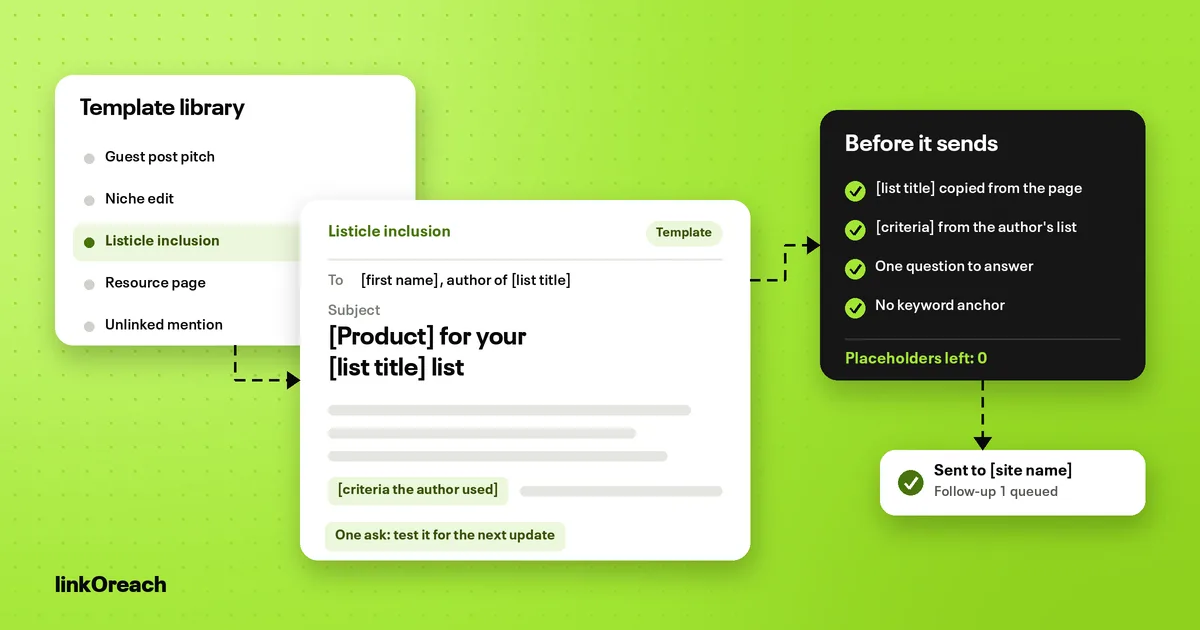
Follow Up Email Templates for Link Building: 11 to Copy
A follow up email template for link building outreach works when it adds one thing the first pitch did not have and makes the editor's yes easier than it was a few days ago. Send two follow-ups at most, in the same thread, three to four business days and then about a week after the pitch, and stop the moment anyone replies.
Most follow-up templates that rank for this search are written for job seekers and sales reps chasing a meeting. Link requests are different: the editor owes you nothing, you are asking them to change a page, and at outreach volumes one annoyed recipient can hurt your domain. Below are 11 follow-up templates written for that job, four for a pitch with no reply and seven for the situations a sequence never covers, from an out-of-office reply to a link that went live on the wrong URL.
How many follow-ups to send, and when
Two follow-ups, three messages in total, is the ceiling for link requests. In Hunter's State of Email Outreach 2026, built on 31 million cold emails sent in 2025, three-message sequences averaged a 6.8% reply rate against 3.3% for a single email, and sequences with three or more follow-ups had a lower average than three messages. The first message alone averaged 2.9% and still produced most replies.
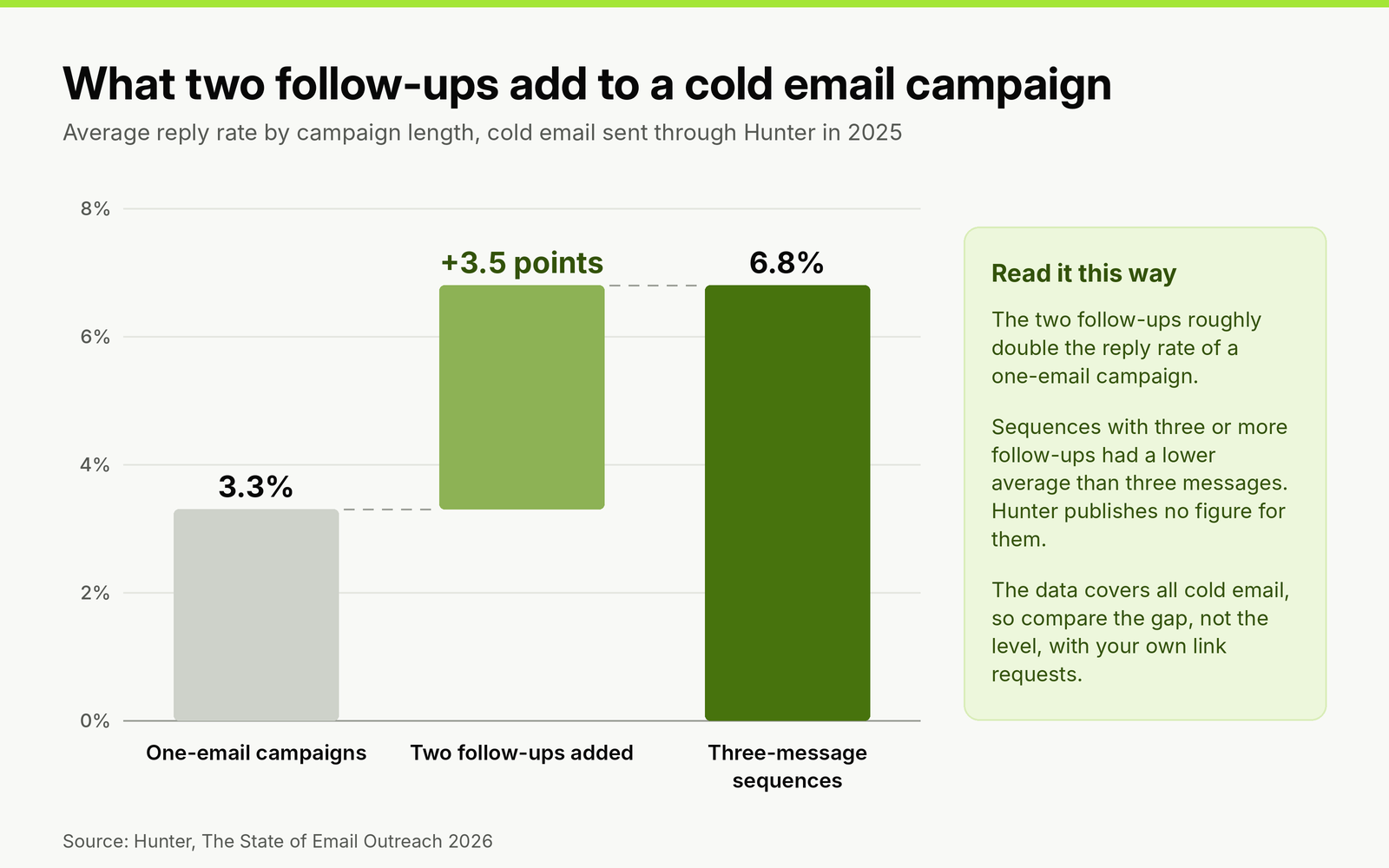
Two follow-ups roughly double the average reply rate of a one-email campaign. The data covers all cold email, not only link requests.
Not every dataset agrees on the ceiling, and the disagreement is useful. Instantly's 2026 cold email benchmark recommends four to seven touchpoints spaced three to four days apart, while also finding that 58% of all replies come from the first step. That advice fits a sales team sending thousands of emails to buyers who might need a product next quarter. It fits link building badly, for two reasons.
First, an editor who has ignored a specific request about their own page twice has usually made a decision. A fourth and fifth message rarely changes it. Second, the cost of a complaint is far higher at outreach volumes. Google's email sender guidelines ask every sender to keep the user-reported spam rate below 0.3% and recommend staying under 0.1%. If 100 of your messages reach Gmail inboxes in a day, one editor who presses "Report spam" puts that day at 1%. Every extra follow-up is another chance to earn that click from someone who already said no by staying silent. Our cold email deliverability guide for outreach senders covers the rest of that math.
The older data points the same way. Backlinko's study of 12 million outreach emails, published in 2019 with Pitchbox data, found that one additional follow-up raised replies by 65.8% and that three or more messages produced the best response rate. Neither study shows link requests gaining anything from a fourth message.
Here is the schedule the templates below assume:
| Message | When to send it | Thread | Stop if |
|---|---|---|---|
| Pitch | Day 0, a weekday morning in the editor's time zone | New | Any reply, bounce or out-of-office |
| Follow-up 1 | 3 to 4 business days after the pitch | Same | Any reply, bounce or out-of-office |
| Follow-up 2 (last note) | About a week after follow-up 1 | Same | Sequence ends here either way |
| Second contact at the same site | 30 days or more after follow-up 2, one email only | New | Never followed up |
| Draft submitted, no acknowledgement | 7 business days after you sent the draft | Same | Withdraw after one more check 14 days later |
| Agreed, not live yet | 14 days after the yes, or the day after the date they gave | Same | One check, then log it as lost |
What makes a follow-up worth answering
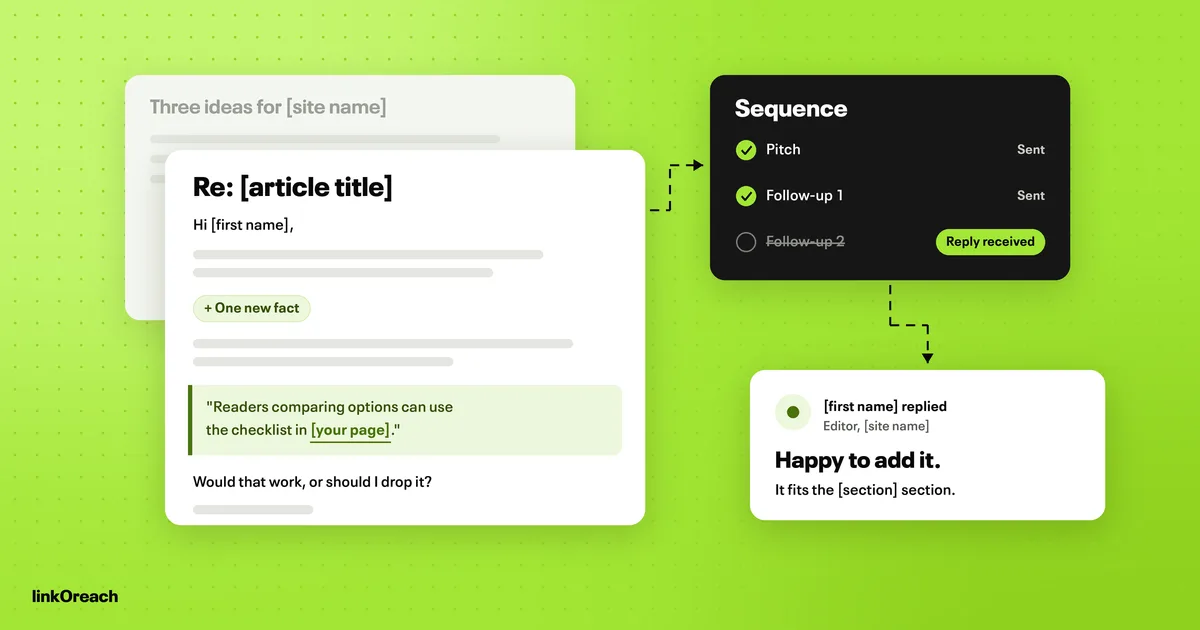
A follow-up that says "just bumping this" asks the editor to do the same work as the pitch, a second time, for no new reason. The ones that get answered do the opposite: they arrive under the original so the context is one scroll away, they bring a fact, figure or angle the first email left out, and they cut the editor's effort, ideally to the point where accepting means pasting one sentence. They are also shorter than the pitch, usually under 80 words, and end with a question that takes a line to answer.
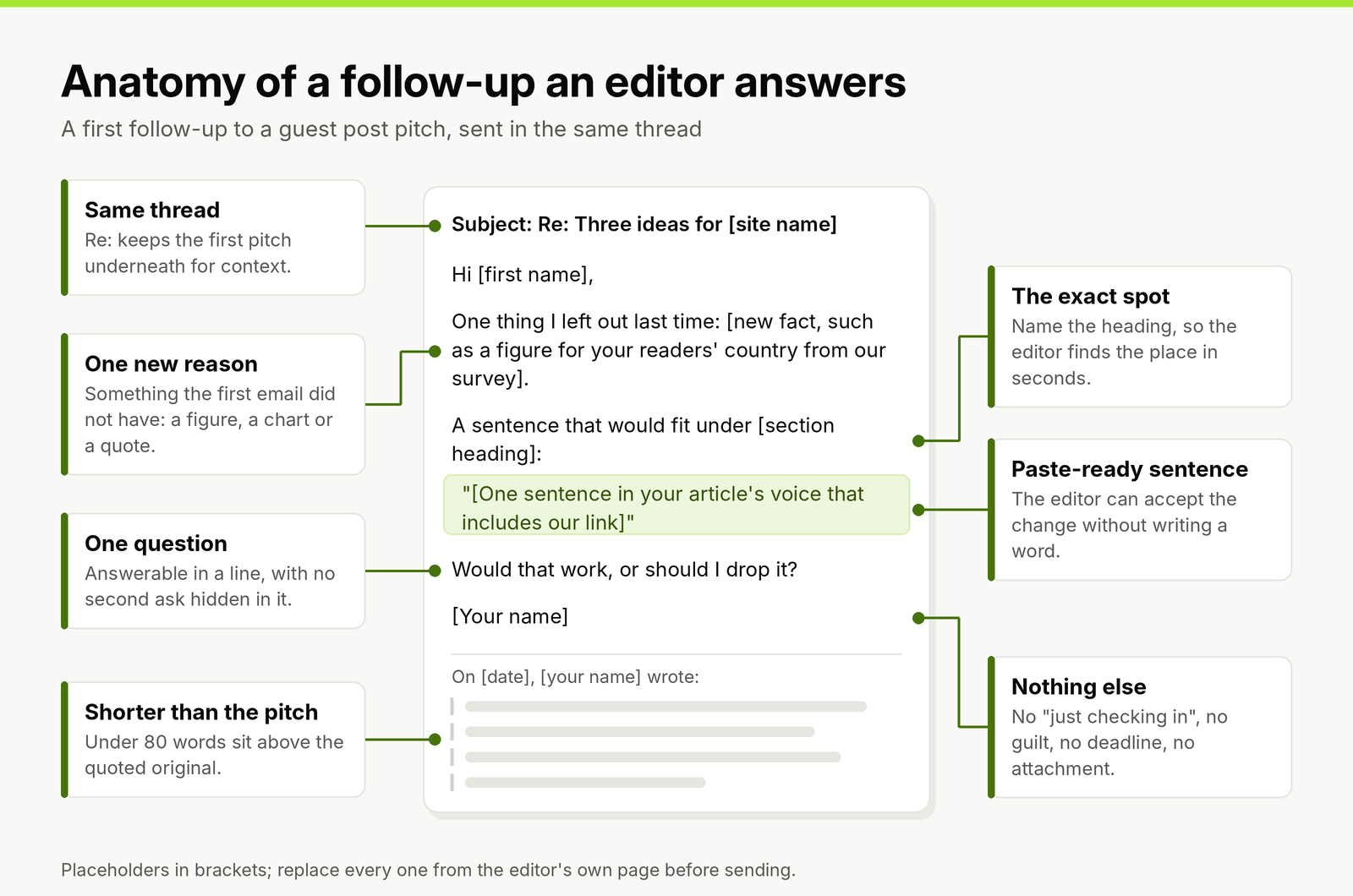
The parts of a first follow-up that do the work. Everything not marked here is a candidate for deletion.
Personalization matters as much in the follow-up as in the pitch. Emails with two custom fields in the body replied at 5.6% against 3.6% with none, and emails a person edited before sending beat fully automated ones, 5.2% against 4.4%. If a tool drafts your follow-ups, read every one before it sends. Our guide to automating outreach without losing the review step shows where that check fits.
Follow up email templates for a pitch with no reply
Replace every bracketed placeholder from the editor's own page before sending. Each template starts with its subject line; send everything below it as the email body. These pair with the first pitches in our cold email templates for first pitches and replies, so pick the follow-up that matches the campaign type you pitched.
1. Guest post: send a short outline
Use three to four business days after a guest post pitch that offered titles, when the editor has not answered.
Subject: Re: [original subject]
Hi [first name],
In case it helps you decide, here is an outline for "[title one]", the idea closest to your recent pieces on [topic]: (1) [opening section], (2) [section built on your data or process], (3) [practical section readers can apply].
It would cite [your source] and link once to [your page] where it supports a point. Happy to change the angle, or to drop it if you're not taking contributor posts right now.
[Your name]
An outline turns "would you like an article?" into "is this the article you want?", which is a much easier question. Pick the title you can write best, not the one with the most search volume.
2. Niche edit, resource page or broken link: point to the exact spot
Use as follow-up 1 for any pitch that asks the editor to change an existing page.
Subject: Re: [original subject]
Hi [first name],
To make this quick to check: the spot I meant is the [section heading] section of "[article title]", the paragraph that starts "[first five words of the paragraph]".
A sentence that would fit there: "[one sentence in your article's voice that includes the link]". Rewrite it or skip it as you like.
[Your name]
Editors ignore change requests mostly because finding the place and writing the sentence is work they did not plan for. Quoting the first words of the paragraph removes the search, and the paste-ready sentence removes the writing.
3. Listicle inclusion: answer the question the author will ask
Use as follow-up 1 after asking to be considered for a "best [category]" list.
Subject: Re: [original subject]
Hi [first name],
One detail I left out: [product]'s pricing is public at [pricing page URL], and the [plan name] plan is the one that matches how your list compares tools on [criterion the author scores].
If you test it, I can answer setup questions within a day, and the trial account comes with no conditions on what you write. Would a two-line summary of how it differs from [tool already on the list] help?
[Your name]
The author's first question is always "how does this compare with what I already listed?" Answer it before they ask, and keep the trial unconditional: Google's spam policies treat exchanging goods or services for links as link spam.
4. Last note: leave the resource, drop the ask
Use about a week after follow-up 1, as the final message of any sequence.
Subject: Re: [original subject]
Hi [first name],
I'll leave this here and won't write again about it. If [your page] is ever useful for "[article title]" or a future piece, it's at [URL], free to read, and we update it [how often you update it].
Thanks for your time.
[Your name]
A last note with no ask in it gets fewer replies than a "reply yes or no" close, but it gets almost no complaints, and it leaves a clean record if you pitch the same site with a different page next year. Use the one-word-answer close in our templates library when you need a decision; use this one when you would rather keep the relationship.
Which follow-up fits the situation
A sequence handles silence. Everything else, from an out-of-office reply to a yes that never turns into a live link, needs a person to read the reply and choose the next message. The flowchart below shows how the templates in this post map to each outcome.
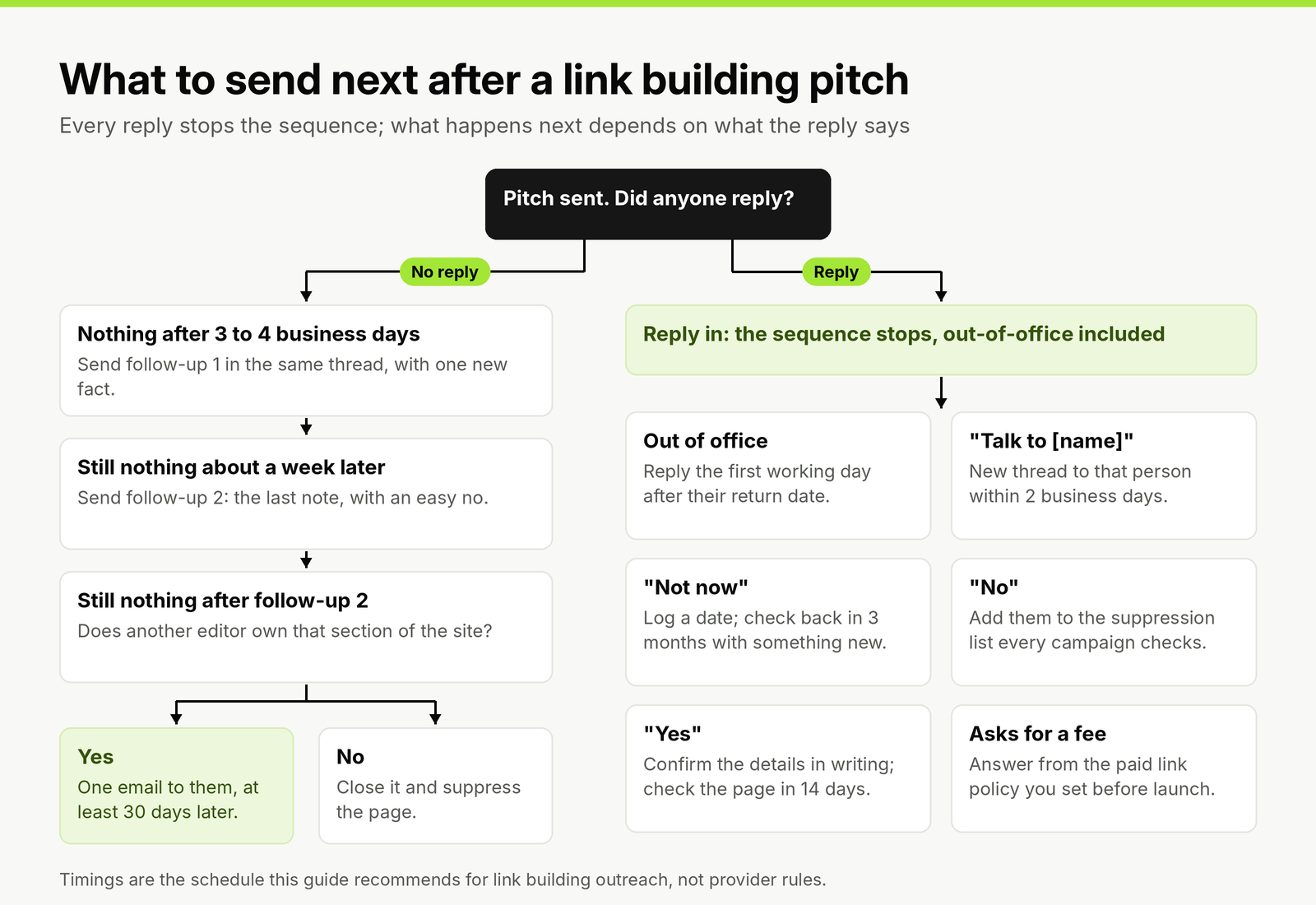
Any reply ends the automated sequence. From there, the reply type decides the next message and when it goes out.
Two outcomes are covered elsewhere: the check-back after a "not now" and the answer to an editor who quotes a fee both sit in the reply section of our templates library. The seven below are the ones most outreach teams improvise, and get wrong.
Follow-up templates for the situations sequences miss
5. After an out-of-office reply
Use on the first working day after the return date in the auto-reply, in the same thread. Pause the sequence the moment the auto-reply arrives.
Subject: Re: [original subject]
Hi [first name],
Welcome back. I wrote while you were away about [one-line summary of the ask] for "[article title]".
The short version: [one sentence on what your page adds that the article lacks].
Worth a look once you've caught up?
[Your name]
Never let an automated follow-up land while the editor is away. They return to a full inbox, and two unread messages from the same stranger read as pressure.
6. A second contact at the same site
Use once, 30 days or more after a sequence ended in silence, and only if the second person also edits the section you pitched. New thread, no follow-ups.
Subject: "[article title]" on [site name]
Hi [first name],
I'm [your name], [role] at [company]. I wrote to your colleague who covers [section] last month and didn't hear back, so I hope it's all right to ask you instead.
[One or two sentences: which page, what your page adds, and the single ask.]
If this belongs with someone else, a name is plenty, and if it's a no, no reply needed.
[Your name]
[Title, company, URL]
Saying plainly that you wrote to a colleague is what keeps this from feeling like going around someone. Contacting two people at once looks like spam; contacting a second person after a month, openly, looks like a professional checking they reached the right desk. Reaching more than one person at a site helps, with diminishing returns at five or more in the 2019 study, and in the 2025 data one or two contacts per company replied better than three or more. Stop at two.
7. After a referral to someone else
Use within two business days when the editor replies "talk to [name]". New thread to the person named.
Subject: [Referrer's first name] suggested I contact you about "[article title]"
Hi [first name],
[Referrer's first name] at [site name] mentioned you look after [content updates, or the section]. I'm [your name], [role] at [company].
[One or two sentences: the page, what your page adds, the single ask.]
Would it fit? If not, no reply needed.
[Your name]
Thank the referrer with a one-line reply in the original thread, and do not copy them on the new email unless they offered to introduce you. A referral is a warm lead; treat it as a new pitch, not as a follow-up to someone who was not part of the conversation.
8. After you submitted a guest post draft
Use seven business days after sending a draft that nobody has acknowledged, in the thread where you sent it.
Subject: Re: [draft title]
Hi [first name],
Checking that the draft of "[draft title]" reached you: I sent it on [date] as [a Google Doc with edit access, or the format they asked for].
If it needs changes to fit your guidelines, I'm glad to make them. If it's no longer a fit, just say so and I'll withdraw it.
[Your name]
Offering to withdraw sounds counterproductive, but it is what you need either way: a draft stuck in limbo cannot be pitched anywhere else. If a second check 14 days later gets no answer, withdraw it in writing and move on.
9. Agreed, but the link is not live yet
Use 14 days after an editor said yes, or the day after the publishing date they gave.
Subject: Re: [original subject]
Hi [first name],
Thanks again for agreeing to add [your page] to "[article title]". I haven't seen it on the page yet, so I'm checking that nothing is needed from my side.
The details we agreed: [placement] linking to [URL], with [brand name or URL] as the anchor.
If plans have changed, that's completely fine; a quick note lets me update my records.
[Your name]
Restating the agreed details saves the editor from scrolling back through the thread, and the line about plans changing makes a no as easy as a yes. Agencies tracking dozens of agreed links across clients usually need a proper record of each placement at this stage; BuildLinks is built for tracking orders, client reporting and invoicing once links are agreed.
10. The link is live but points to the wrong place
Use when the link resolves to a 404, a redirect or a different URL from the one agreed.
Subject: Small fix on "[article title]"
Hi [first name],
Thank you for adding the link to "[article title]". One small thing: it points to [wrong URL], which [returns a 404, or redirects to our home page]. The page we discussed is [correct URL].
Could you swap it the next time you update the article? Thanks for your help with this.
[Your name]
Ask only for the URL fix. If the editor added rel="nofollow" or rel="sponsored", leave it alone: that is their call, and for any placement involving payment Google's policies require one of those attributes. Asking to strip it turns a thank-you into a request to break the rules.
11. Thank you after the link goes live
Use within a day of seeing the link live and correct.
Subject: Re: [original subject]
Hi [first name],
I saw the link in "[article title]". Thank you.
When we refresh [your page] with [the next update, such as next year's figures], I'll send you a one-line note in case the article's numbers need the same update.
No reply needed.
[Your name]
This is the follow-up most link builders skip, and it is the cheapest one to send. It closes the thread politely and gives you a legitimate, useful reason to write again when your data changes, which is exactly the situation the niche edit template was made for.
What to cut from every follow-up
Most weak follow-ups fail on a handful of phrases. Swap them for something that gives the editor a reason to act.
| Line to cut | Why it fails | What to write instead |
|---|---|---|
| "Just checking in" or "bumping this to the top of your inbox" | Adds nothing and admits it | One new fact, figure or angle the pitch lacked |
| "As per my last email" | Reads as a complaint about their silence | A one-sentence summary of the ask |
| "I know you're busy, but..." | Guilt instead of a reason | A smaller ask: a paste-ready sentence instead of a review |
| "I'll assume you're interested unless I hear otherwise" | Pressure; invites a spam report | An explicit easy no |
| A deadline you invented | Editors can tell, and nothing happens when it passes | A real date only if one exists, such as a data release |
| A second ask (a share, a newsletter mention) | Doubles the decision for no gain | The original ask, made easier |
| An offer to pay, added in follow-up 2 | Turns an editorial request into a paid link | Decide your paid link policy before the campaign, not mid-sequence |
| Attachments or images | Filters treat them with suspicion; editors rarely open them | A link to the page or chart |
One more habit to drop: open tracking. Campaigns with it off replied at 7.4% against 4.4% with it on, and an "opened three times" signal tempts senders into follow-ups the editor did not ask for.
Running follow-ups at scale without annoying editors
Templates are the easy part. Most damage from follow-ups comes from how the sending tool behaves, so check these settings before any campaign starts:
- Stop on any reply, including auto-replies and bounces. A tool that only stops on "positive" replies will follow up after an out-of-office or a no.
- Count follow-ups in the daily volume. A mailbox starting 20 new prospects a day sends close to 60 emails a day once two follow-ups are running.
- One active contact per site at a time, so two people at the same publication never receive the same sequence in the same week.
- One suppression list across every campaign and client, checked before each follow-up, not only before the first pitch.
- Pause on bounces. If a campaign's bounce rate passes 2%, stop the follow-ups, clean the list and restart at half the volume.
If your current sender cannot do all five, our comparison of lemlist alternatives for link building teams covers which tools stop on every reply and what each costs, and the link building outreach guide from prospecting to placement shows where follow-ups sit in the full campaign.
Running follow-ups in linkOreach
We built linkOreach for link building outreach, and Linkzy is the AI agent inside it. Follow-ups fire on a cadence and the sequence stops the second someone replies, with built-in sending limits to protect your domain. You can save templates like the ones above and reuse them across campaigns, let Linkzy write a pitch for each site and run the follow-ups, or A/B test two pitches against each other; every email is editable before it goes out, and you send from your own Gmail, Outlook or SMTP mailbox. Replies land in a shared inbox, and each thread is tracked through to a live, indexed backlink. Our page on follow-up cadences, auto-stop on reply and the shared inbox covers the rest of the workflow.
We currently offer one plan at $49 a month, an introductory price, with 500 email credits, 5,000 searches and 100,000 Ahrefs credits, and a 7-day trial with no credit card; our plan and trial details list the top-ups.
Pick something else if your follow-ups chase sales meetings, demos, invoices or job applications. A sales engagement tool or a general cold email sender fits those jobs better and costs less for high volume.
Conclusion
Cap every link request at a pitch and two follow-ups: the first three to four business days later with one new fact or a paste-ready sentence, the last about a week after that with an easy way out. Keep both in the same thread, under 80 words, with one question, and stop on any reply, out-of-office included.
Then handle the situations no sequence can: reply after an editor's return date, approach a second editor only once and only after 30 days, check a draft after seven business days, chase an agreed link after 14, fix wrong URLs without touching link attributes, and thank every editor who links. Leave open tracking off and keep complaints rare, because at outreach volumes one spam report counts.
If you want follow-ups that stop on reply and threads tracked to a live link, start a free 7-day linkOreach trial and load these templates into your next campaign.
Frequently Asked Questions
How long should you wait before sending a follow-up email?
For a link building pitch, send the first follow-up 3 to 4 business days after the pitch and the second about a week after that. If you get an out-of-office reply, pause the sequence and follow up on the first working day after the return date it gives.
How many follow-up emails should I send for link building outreach?
Two, so three messages in total. In Hunter's data from 31 million cold emails sent in 2025, three-message sequences averaged a 6.8% reply rate against 3.3% for a single email, and sequences with three or more follow-ups did worse. At outreach volumes, every extra message also risks a spam report.
How do you write a polite follow-up email after no response?
Reply in the same thread, keep it under 80 words, add one thing the first email did not have (a new fact or a sentence the editor could paste in), ask one question and make it easy to say no. Leave out "just checking in", guilt lines and invented deadlines.
Should a follow-up email go in the same thread?
Yes, when you write to the same person: a "Re:" reply keeps your first email underneath, so the editor has the context without searching. Start a new thread only when you write to someone new, such as a second editor at the site or a person you were referred to.
Can I follow up with a different person at the same site?
Yes, once. Wait 30 days or more after your sequence ended, make sure the second person also edits the section you pitched, and say plainly that you wrote to their colleague first. Never email two people at the same site at the same time.
What should a follow-up do after an editor agrees but the link is not live?
Wait 14 days, or until the day after the date they gave, then reply in the same thread restating the agreed page, placement, URL and anchor, and say it is fine if plans have changed. Send one check, then record the link as lost if there is no answer.