Cold Email Templates for Link Building: 12 to Copy
A cold email template for link building works when it names one page, gives one reason that page is better with your link, and makes one ask. The twelve templates below are built that way: seven first pitches (guest post, niche edit, listicle, resource page, broken link, unlinked mention and reciprocal mention), two follow-ups, and the three replies most template lists leave out, for the moment an editor says yes, the moment an editor quotes a price, and the day you check back after a "later".
Every one of them is written for outreach to editors and site owners, not for booking sales meetings. Each comes with one line on when to use it, and the sections around them cover what to put in the placeholders, how long a pitch should run, when each message sends and how to test a template without fooling yourself.
Why sales cold email templates fail on link requests
Most pages that rank for "cold email template" are written by sales software companies, and their templates follow sales frameworks: AIDA, Problem-Agitate-Solve, Before-After-Bridge. Those frameworks open with the reader's pain and close with a meeting request. An editor has no pain you are solving. They have a page, a reader, and a reason to change the page or not.
Recipients notice the difference. In Hunter's State of Email Outreach 2026, built on 31 million emails sent in 2025 plus a survey of decision makers, 65% said cold emails fail because they feel too pushy or sales-focused, ahead of the 61% who blamed irrelevance. Average sequence reply rates were 3% for sales outreach and 13% for digital PR, the use case the report groups with link building. A link request that reads like a sales email gives up most of that difference.
The templates here use the structure from our seven-step link building outreach process instead: who you are and which page you mean, what your page adds, one ask, and an easy way to say no.
What the data says about writing the template
Five writing choices show a measurable gap in reply rates, and each one is built into the templates below. Two custom fields in the body lifted the reply rate from 3.6% to 5.6%. Subject lines built on the "Quick question" pattern did worse than the rest. Emails a person edited before sending beat fully automated ones. Reaching one or two people per company beat three or more, and three messages beat one by roughly double.
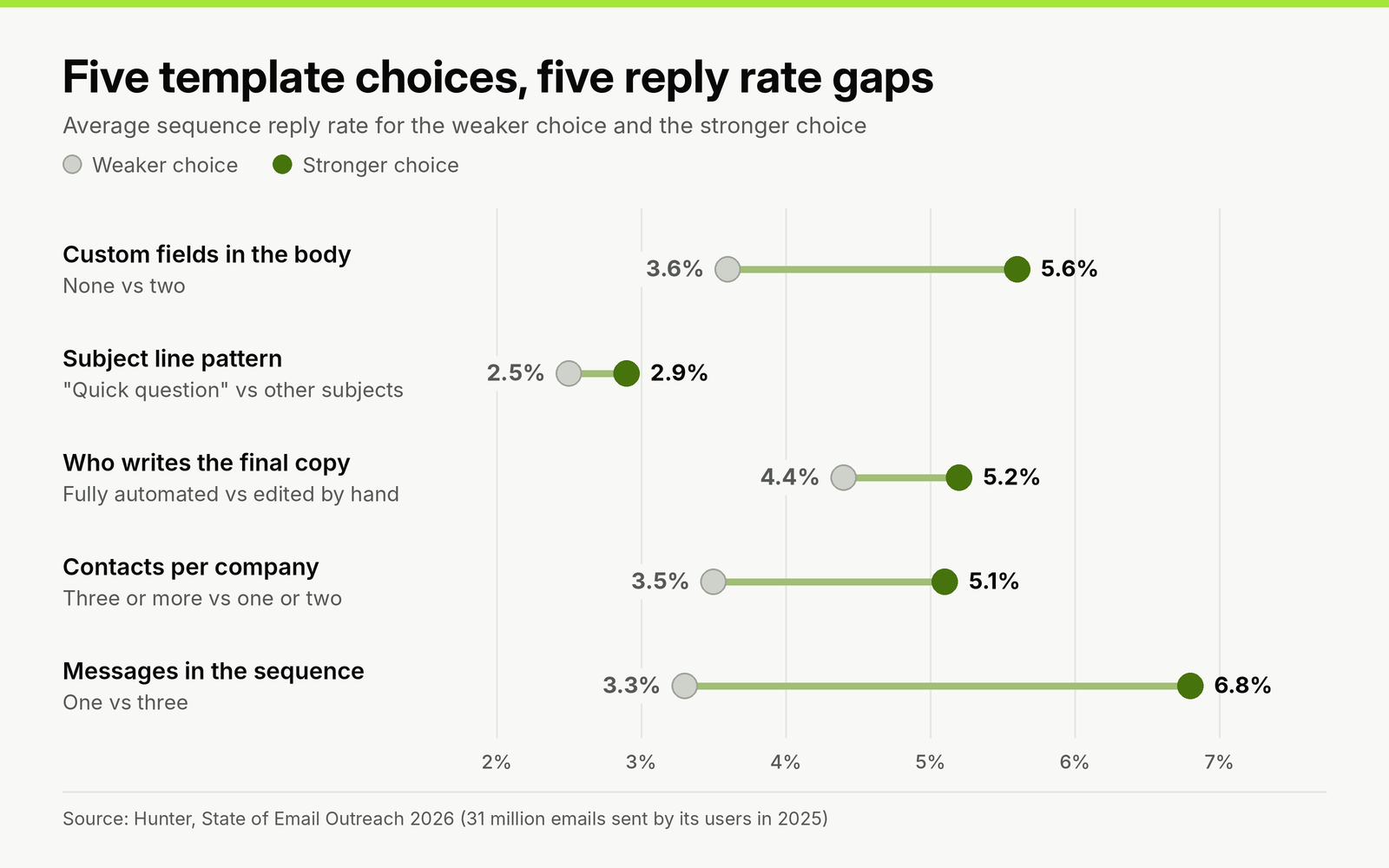
The gap between the weaker and the stronger choice for five decisions a template makes. Reply rates from Hunter's State of Email Outreach 2026, which covers all cold email, not only link requests.
Three more findings shape length and tone. Subject lines of 5 to 6 words had the best average reply rates, so the subjects below name the page or the offer rather than teasing it. Bodies of 61 to 80 words and of 181 to 200 words both did comparatively well, which suits link requests: a resource or mention pitch can stay near the short band, while a guest post pitch with three titles needs more room. And decision makers preferred open-ended asks such as "Open to learning more?" over a hard request, which is why every template ends with a question the editor can answer in one line.
One development is worth knowing about. Google began rolling out AI Inbox in Gmail to paid Google Workspace accounts in the US on October 12, 2026, with a wider rollout from October 26. It builds a view of suggested to-dos by pulling action items and due dates out of incoming mail. Google has not said how it treats cold email, so do not write for it; but a pitch with one clear ask is easier for a person, or a summary, to turn into a task than a pitch with three.
Which link requests get answered
Few large datasets break reply rates down by outreach topic. Backlinko's study of 12 million outreach emails, run with Pitchbox data and published in 2019, is one of them. Its topic figures sit far above the study's own 8.5% overall response rate, and the study does not explain how they were measured, so compare the topics with each other rather than with your own reply rate.
| Outreach topic in the study | Response rate | Closest template in this post |
|---|---|---|
| Guest post | 24.7% | Guest post pitch with three titles |
| Roundup | 23.8% | None directly; listicle inclusion is the nearest |
| Link building | 21.9% | Niche edit, broken link replacement, reciprocal mention |
| Sponsorship | 21.8% | None (paid placements; see the fee reply below) |
| Reviews | 21.6% | Listicle inclusion, when the author tests products |
| Infographic | 20.2% | None |
| Resources | 20.0% | Resource page addition |
| Mention | 15.64% | Unlinked brand mention |
Two readings hold up despite the age of the data. Guest post pitches, which offer the editor a finished article, had the highest rate in the set. And mention outreach had the lowest rate, which matches what most link builders see: an editor who already wrote about you has the least reason to reopen the page. The mention template below keeps that ask as small as possible for that reason.
Rules every template here follows
These are the same standards we would hold any outreach to, and they explain the choices in the copy.
- Say who is writing and why in the first line. Name, role, company and the exact page. An editor decides in the opening sentence whether the email is about their site or about yours.
- One ask per email. A link, a listing or an article. Never a link and a social share and a newsletter mention.
- No praise you cannot back up. "Loved your article" fits every site, so it tells the editor nothing. A specific reference to their page does that job.
- No invented details about their site. If a placeholder asks for a fact you cannot verify on their page, leave the prospect out of the campaign.
- An easy no. Every pitch tells the editor that no reply, or a one-word no, is a fine answer.
- Branded or URL anchors. Google's spam policies list optimized anchor text in guest posts and articles as link spam, so the templates never suggest a keyword anchor.
Cold email templates for first pitches
Replace every bracketed placeholder before sending. The subject line comes first in each template; send everything below it as the email body.
Guest post pitch with three titles
Use when the site publishes contributor articles and you can offer titles its archive does not cover yet.
Subject: Three article ideas for [site name]
Hi [first name],
I'm [your name], [role] at [company]. I've been reading the [category] section of [site name], most recently "[article title]".
Here are three titles your archive doesn't cover yet: (1) [title one], built on [your data or process]; (2) [title two]; (3) [title three]. Each would run about [word count] words, follow your contributor guidelines and include one link to [your page] where it supports a point.
Would any of these work for [site name]? If none fit, a one-word no is plenty and I won't follow up.
[Your name]
[Title, company, URL]
Three titles beat one because the editor can pick rather than judge. Make each title something you can write better than their usual contributors: built on your own data, a process you run, or an example only you have.
Niche edit: newer data for an existing article
Use when a ranking page quotes an old figure and you have published newer data on the same question.
Subject: Newer data for "[article title]"
Hi [first name],
I'm [your name] at [company]. Your article "[article title]" quotes [old figure] from [old source and year].
We published newer data on the same question in [month and year]: [one-sentence finding], based on [how you collected it, such as a survey of N people]. The page is here: [URL].
Would it be useful to cite it alongside, or in place of, the older figure? Either way, thanks for reading.
[Your name]
This is the niche edit request most editors are glad to receive, because it fixes their page. It only works if your data is newer and sourced; if all you have is a page that covers the same ground, use the resource template instead.
Listicle inclusion
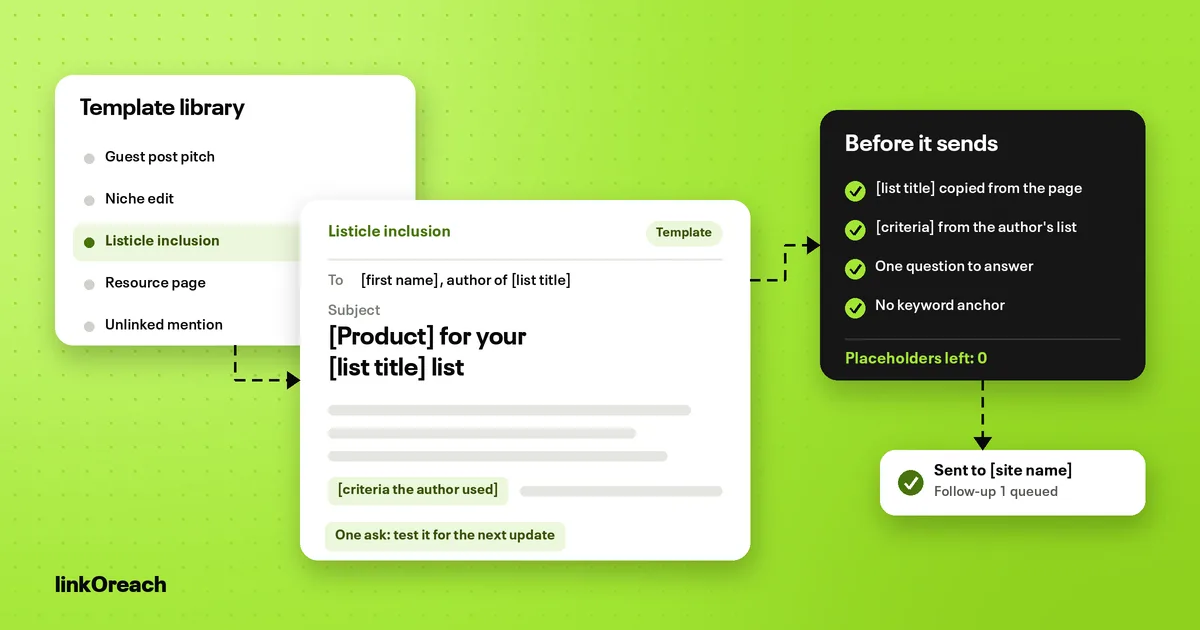
Use when a "best [category]" list compares products like yours and yours meets the criteria the author scores.
Subject: [Product] for your [list title] list
Hi [first name],
I'm [your name], [role] at [product]. Your list "[list title]" compares [category] tools on [criteria the author used].
[Product] fits that comparison: [one fact per criterion, such as price or a feature the list scores]. It differs from the tools already listed in [one honest difference, including who should not pick it].
Would you consider testing it for the next update? I can set up an account for [number] days, no card needed. If it's not a fit for the list, no reply needed.
[Your name]
[Title, company, URL]
Make the trial access unconditional. Sending someone a product in exchange for a write-up that includes a link counts as link spam, so the account is for testing, never a trade for the listing. If the author replies with a price for inclusion, use the fee reply further down.
Resource page addition
Use when a curated page of links on your topic is still maintained and your page meets the standard of what is already listed.
Subject: A resource for your [page title] page
Hi [first name],
I'm [your name] from [company]. Your [page title] page lists [number] resources on [topic], grouped by [how the page is organized].
Ours covers [specific thing missing from the list], which none of the listed resources do: [URL]. It is free to read, with no signup.
Would it fit under [section heading]? Thanks for keeping the page current.
[Your name]
Before you send, check that the page still gets edited: recent additions, links that still work, a visible update date. A resource page nobody maintains will not add your link, however good it is.
Broken link replacement
Use when a page links to a resource that now returns a 404 or redirects somewhere unrelated, and your page covers the same thing.
Subject: Broken link in "[article title]"
Hi [first name],
I'm [your name] at [company]. In "[article title]", the link to [old resource name] in the [section] section now [returns a 404, or redirects to an unrelated page].
If you want a replacement, our [page title] covers the same [topic] and was last updated in [month and year]: [URL].
Would it work as the new link there? If not, you may still want to remove the dead one.
[Your name]
Confirm the link is dead from two locations before you send, and name the exact section so the editor can find it in seconds. The last line is what makes this template useful even when the answer is no.
Unlinked brand mention
Use when a page names your brand, tool or data accurately but does not link to it.
Subject: Your mention of [brand] in "[article title]"
Hi [first name],
I'm [your name], [role] at [brand]. "[article title]" mentions [brand] in the section on [topic].
Readers who want to check [what the mention refers to] would land on the right page here: [exact URL].
Would you be open to linking the mention there? Thanks for including us either way.
[Your name]
Keep it this short. The editor already decided you were worth naming; the only question is whether the mention should point somewhere, and the link you offer should be the page the mention describes, not your home page or a product page that happens to convert.
Reciprocal mention (link exchange)
Use rarely, when two sites on the same topic each have a page that would help the other site's readers.
Subject: "[their page title]" and our [your page title]
Hi [first name],
I'm [your name] at [company]. Your page "[their page title]" and our [your page title] cover [shared topic] from different angles: yours [their angle], ours [your angle].
Our readers ask about [their angle] often, so I've added a link to your page in our [section] section: [URL of your page].
If our page would help your readers in [their section], would you consider linking to it? No obligation on your side; the link to your page stays either way.
[Your name]
This template links first and asks second, and it says plainly that your link stays whatever they decide. That keeps it a recommendation between two relevant pages rather than a trade. Excessive link exchanges and partner pages made only for cross-linking both count as link spam, so use this rarely, only between sites on the same topic, and never as a condition.
Follow-up templates
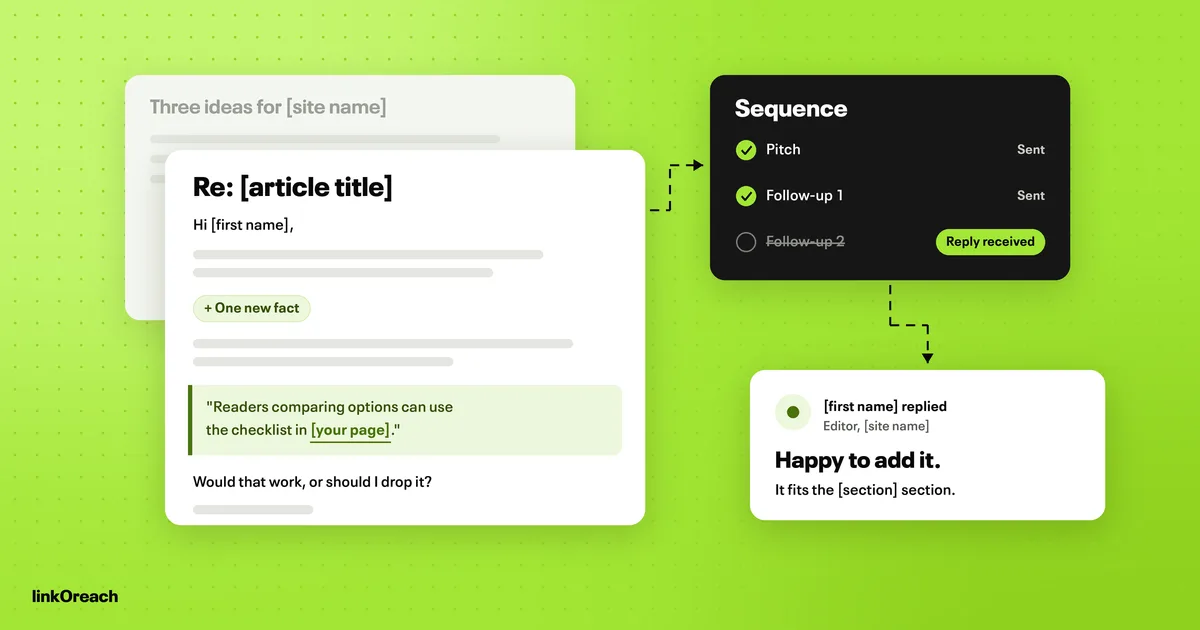
Two follow-ups is the ceiling. The first message produces most replies (2.9% on average), two follow-ups take a sequence to 6.8%, and sequences with three or more follow-ups had lower average reply rates. Send the first follow-up three to four business days after the pitch and the second about a week later, both in the same thread, and stop the sequence on any reply, out-of-office included.
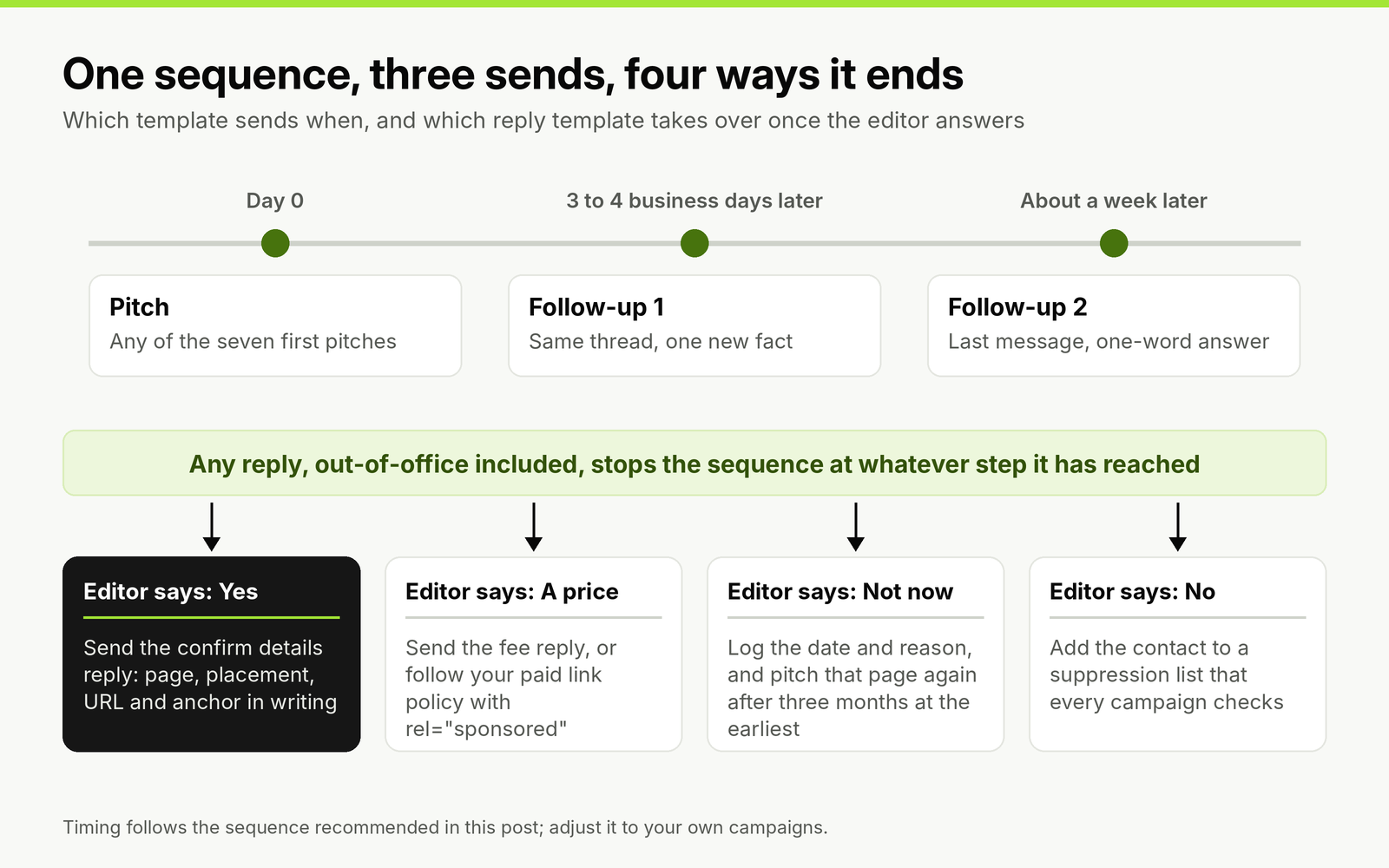
When each template in this post sends, and which reply template takes over once the editor answers.
Follow-up 1: add one new fact
Use three to four business days after any pitch above, in the same thread.
Subject: Re: [original subject]
Hi [first name],
One thing I left out last time: [new fact, such as a chart readers can embed, a figure for [their country] or a quote from [your expert]].
If it saves you time, here is a two-sentence version you could paste into the [section] section: "[two sentences that include your link]".
[Your name]
The paste-ready version is the new information here: it removes the editing work that stops many editors from saying yes. Write it in their article's voice and keep your link inside it.
Follow-up 2: make it a one-word answer
Use about a week after follow-up 1, as the last message in the sequence.
Subject: Re: [original subject]
Hi [first name],
Last note on this, and two options so you can answer in one word. Reply "later" and I'll check back in [month]. Reply "no" and I'll take you off this list for good.
Thanks for reading this far.
[Your name]
A one-word answer costs the editor nothing, so this message often gets a reply when the first two did not. Honor both answers: put "later" contacts on a dated reminder and "no" contacts on a suppression list every campaign checks. For the messages a sequence cannot send on its own, such as after an out-of-office reply, a referral or an agreed link that never went live, see our follow-up templates for situations sequences miss.
Reply templates for after the editor answers
The sequence ends with a reply, but the work does not. These three cover the replies that most often go wrong.
After a yes: confirm the details in writing
Use the same day an editor agrees, before anything is published.
Subject: Re: [original subject]
Hi [first name],
Thank you. So we're working from the same details:
Page: [their URL]
Placement: [section or sentence]
Link to: [your exact URL]
Anchor: [brand name or URL]
I'll check the page once it's live and let you know if anything looks off.
[Your name]
Confirming in writing prevents the two most common post-yes problems: the link going to the wrong URL, and a keyword anchor you never asked for. Once links like this are agreed for several clients, order tracking, client reporting and invoicing become their own stage, which BuildLinks is built for.
After a price: decline without closing the door
Use when an editor quotes a fee and your policy is not to pay for editorial links.
Subject: Re: [original subject]
Hi [first name],
Thanks for letting me know. We don't pay for editorial links, so I'll pass on a paid placement.
If [your resource] is ever useful for the piece on its own merits, the offer stands, and I'll be glad to send anything that makes it easier to check.
[Your name]
Decide your paid link policy before the campaign starts, not when the first price arrives. Google's policy treats buying links that pass ranking credit as link spam, and says paid links are acceptable only when they carry rel="sponsored" or rel="nofollow". If your policy allows sponsored placements, reply with your budget and state that the link will carry rel="sponsored"; no template, and no wording, makes a paid link that passes ranking credit risk free.
After a "later": check back with something new
Use on the date you logged when an editor replied "later" or "not now", and no sooner than three months after the first pitch.
Subject: Re: [original subject]
Hi [first name],
In [month] you asked me to check back about "[article title]", so this is that note.
Since then we've [one real change to your page, such as new figures for [year] or a template readers can copy]: [URL].
Is now a better time to take a look? If it's still a no, I'll close this out on my side.
[Your name]
Send it in the original thread so the editor sees their own "later" above it, and only when your page has changed since the first pitch. If nothing has, skip the check-back and move the contact to your list of sites to pitch with a different page.
How to fill the placeholders without faking it
A template is a structure; the placeholders are where the email is won or lost. Fill each one from the editor's own page, and if you cannot, drop the prospect.
| Placeholder | A fill that works | A fill that gives the template away |
|---|---|---|
| [article title] | The exact title, copied from the page | "Your recent post" or a paraphrase of the title |
| [section] | The heading where your link fits, word for word | "Somewhere in the article" |
| [missing element] | A specific gap: "no figures after 2023", "no template readers can copy" | "More depth" or "a fresh perspective" |
| [one honest difference] | "Cheaper than [tool] but without a free plan" | "The best option on the market" |
| [new fact] in follow-up 1 | A data point, chart or quote the first email did not have | "Just bumping this to the top of your inbox" |
| [first name] | The author or section editor of that page | The first name of whoever owns info@ |
AI can fill these quickly, and it is also where invented details creep in. Recipients notice: 69% of US decision makers surveyed said it bothers them if AI wrote the email. If a tool drafts the fills, a person reads every draft before it sends; our guide on keeping a person on every AI draft covers where that review step sits in an automated campaign.
Testing a template without fooling yourself
A/B testing two versions of a template sounds simple, but link building campaigns are small, and small samples lie. Suppose version A replies at 6% and version B at 10%. To tell those apart with the usual standard (95% confidence, 80% power), a two-proportion test needs roughly 720 prospects per version. A campaign of 21 to 50 prospects split in two produces one to three replies per side, which is noise.
Three ways to test anyway:
- Test across campaigns, not within one. Keep one variable fixed for a quarter (for example, the subject line format) and compare reply rates across every campaign that used it.
- Test big differences. Three titles against one title, or a paste-ready follow-up against a plain one, can show up in small samples. A changed adjective will not.
- Judge on replies and live links. Opens are unreliable, and campaigns with open tracking off replied at 7.4% against 4.4% with it on.
Templates also depend on the tool sending them stopping on every reply and limiting contacts per site. Our cold email senders and link building platforms compared on price shows which tools do both, and the blogger outreach trial checklist is a quick way to test that in a trial.
Using these templates in linkOreach
We built linkOreach for link building outreach, and Linkzy is the AI agent inside it. You can save templates like these and reuse them across campaigns, or let Linkzy write a pitch for each site from the page it is going to; either way, every email is editable before anything goes out. Follow-ups fire on a cadence and stop the moment someone replies, A/B testing runs two pitches against each other, and you send from your own Gmail, Outlook or SMTP mailbox. Our page on templates, follow-ups and A/B testing in linkOreach covers the rest of the workflow, from prospecting with Ahrefs data to tracking each thread through to a live backlink.
We currently offer one plan at $49 a month, an introductory price, with 500 email credits, 5,000 searches and 100,000 Ahrefs credits, and a 7-day trial with no credit card.
Pick something else if you need cold email templates for sales meetings, recruiting or job applications. The sales roundups that rank for this keyword serve those jobs better, and a general cold email sender will run them more cheaply.
Conclusion
Pick the template by campaign type, then make the placeholders do the work: the exact article title, the exact section, one specific thing your page adds, and an editor who can change that page. Keep subjects around 5 or 6 words, keep mention and resource pitches near 60 to 80 words, give guest post pitches three titles, and end every pitch with one question that takes a line to answer.
Send the pitch, a follow-up with one new fact three to four business days later, and a one-word-answer close about a week after that, then stop. Confirm every yes in writing, decide your paid link policy before the first price arrives, check back on a "later" only when your page has something new, and test templates across campaigns rather than inside a 40-prospect split.
If you want to run these templates with follow-ups that stop on reply, start a free 7-day linkOreach trial and load your first template into a campaign of 21 to 50 prospects.
Frequently Asked Questions
What is a good cold email template for link building?
One that names the exact page you want a link on, says in one or two sentences what your page adds to it, makes a single ask and gives the editor an easy way to say no. Pick the template by campaign type (guest post, niche edit, listicle, resource page, broken link or unlinked mention) and fill every placeholder from the editor's own page.
How long should a cold outreach email be?
In Hunter's 2026 data, bodies of 61 to 80 words and of 181 to 200 words both had comparatively high reply rates, and subject lines of 5 to 6 words did best. Short asks such as resource additions or unlinked mentions fit the shorter band; a guest post pitch with three titles needs more room.
How many follow-ups should a cold email sequence have?
Two. Three messages in total had a 6.8% average reply rate against 3.3% for a single email, and sequences with three or more follow-ups did worse. Send the first follow-up three to four business days after the pitch and the second about a week later, and make each one add something new.
Should I personalize cold email templates?
Yes, with facts from the recipient's page. Emails with two custom fields in the body had a 5.6% reply rate against 3.6% with none. Use the exact article title and section heading, and never invent praise or details about the site.
Can I use AI to write cold email templates?
AI can draft and fill templates, but have a person read every email before it sends. Emails edited by hand had a 5.2% reply rate against 4.4% for fully automated ones, and 69% of US decision makers said it bothers them if AI wrote the email.
What should I reply when an editor asks for payment for a link?
Decide your policy before the campaign starts. Google's spam policies treat buying links for ranking purposes as link spam and accept paid links only with rel="sponsored" or rel="nofollow". If you do not pay, decline politely and leave your resource on offer; if you do, state that the link will carry rel="sponsored".