Best Time to Send Cold Emails for Link Building Outreach
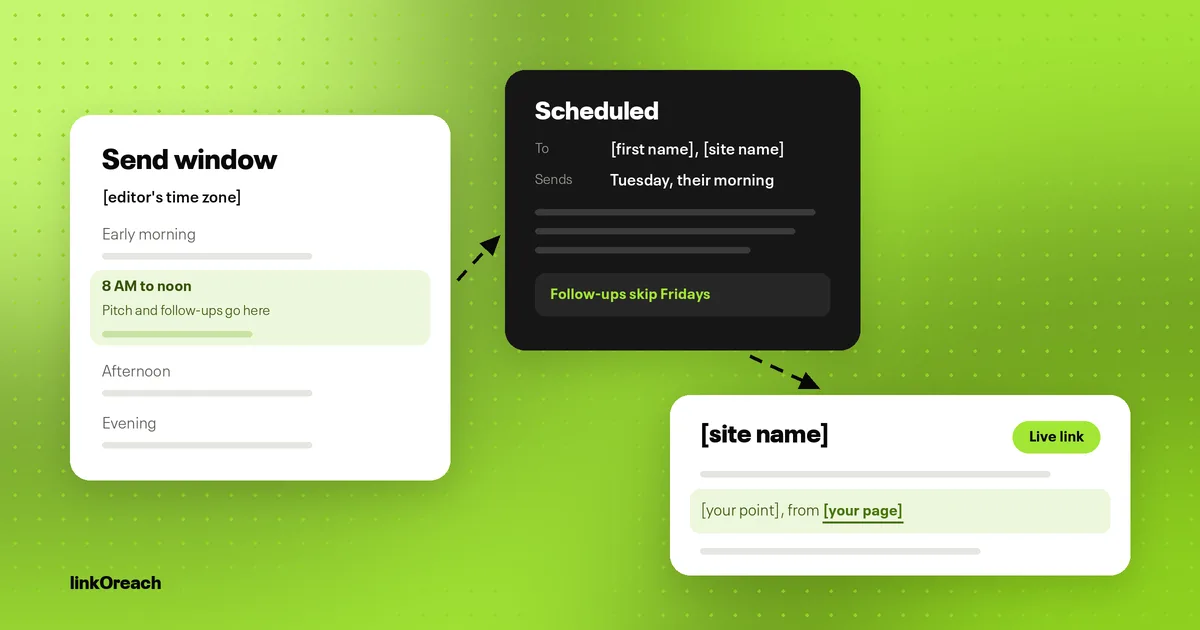
The best time to send cold emails for link building is Tuesday to Thursday between 8 AM and 11 AM in the editor's time zone, with Monday morning a close second. Timing moves replies far less than the list and the pitch do, so get the time zone right, keep sends inside that morning window and away from Fridays and holidays, and then put your effort back into the list and the pitch.
Most guides to the best time to send cold emails are written for sales teams booking demos, and much of the data behind them measures opens, which privacy features have made unreliable. This guide uses reply-based data, adds what we know about how editors and journalists read pitches, and covers the parts link builders get wrong most often: sending on their own clock instead of the recipient's, letting follow-ups drift onto Fridays and holiday weeks, and treating a single campaign as proof that one hour beats another. It sits inside every stage of a link building outreach campaign, between writing the pitch and following up.
What reply data says about the best day and time
The most useful recent dataset counts replies, not opens. Belkins analyzed 7.5 million B2B cold emails sent through its campaigns in 2025 and divided replies and booked meetings by every email sent. That denominator makes the rates look small, well under 1%, but the comparison between days and hours is what matters here.
| Send slot | Reply rate per email sent | Meeting rate per email sent |
|---|---|---|
| Monday | 0.45% | 0.2% |
| Tuesday | 0.45% | 0.2% |
| Wednesday | 0.48% | 0.1% |
| Thursday | 0.48% | 0.2% |
| Friday | 0.44% | 0.2% |
| Saturday | 0.35% | 0.2% |
| Early morning, 5 to 8 AM | 0.52% | 0.4% |
| Morning, 8 AM to noon | 0.54% | 0.4% |
| Afternoon, noon to 5 PM | 0.47% | 0.1% |
| Night and late evening | 0.40% | 0.1% |
Source: Belkins study of 7.5 million cold emails sent in 2025. Sunday showed 0.57% replies on very low volume, which the study treats as a niche tactic rather than a recommendation.
Two patterns stand out. Time of day matters more than day of week: morning sends got about 15% more replies than afternoon sends and four times the meeting rate. Day of week barely matters across Monday to Thursday, where the spread is 0.45% to 0.48%, about a 7% relative difference. Friday is slightly weaker, and Saturday is clearly weaker.
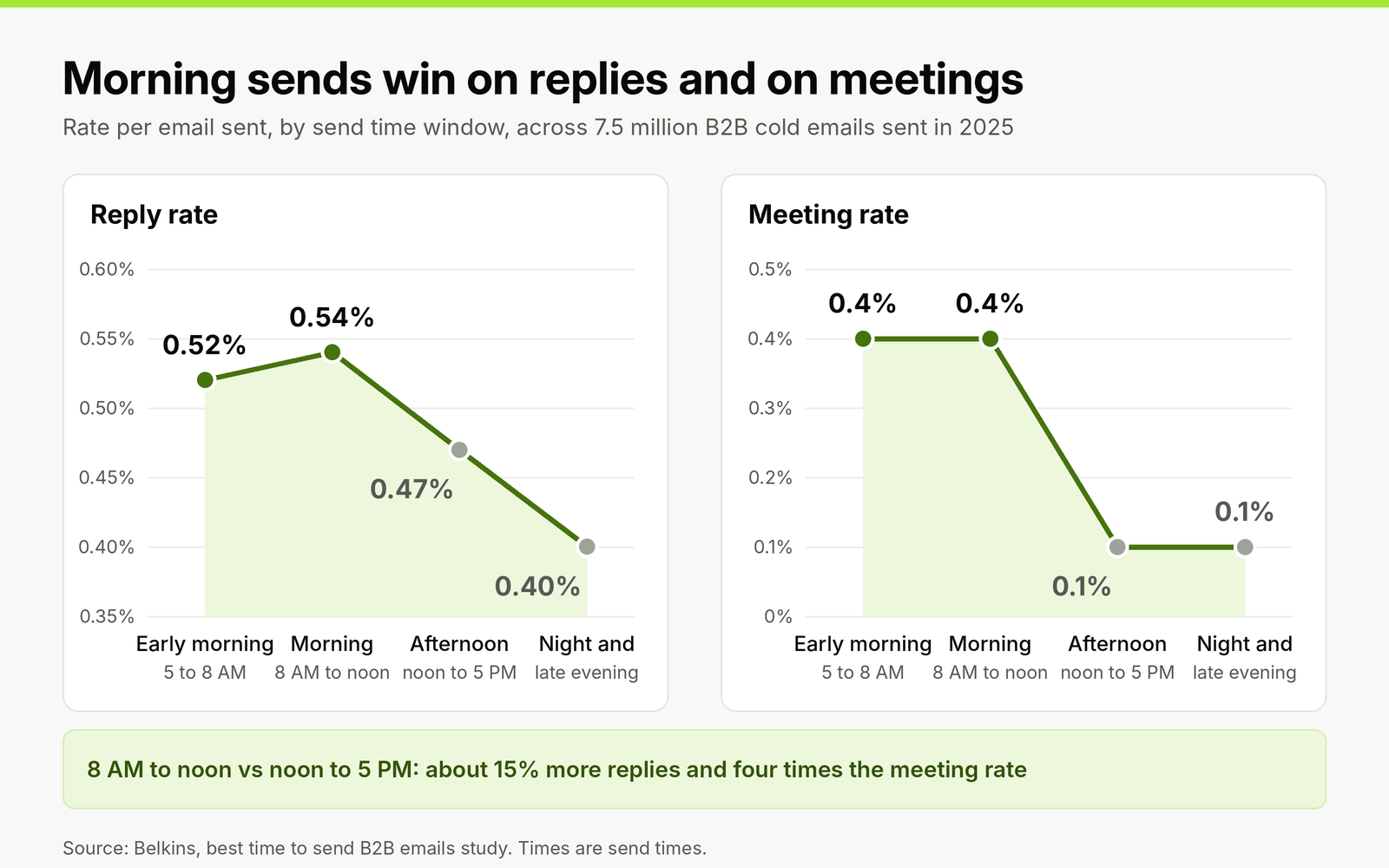
Replies fall gradually after noon; meetings fall off a cliff. Source: Belkins, best time to send B2B emails study.
Two caveats before you copy those windows into a scheduler. The study records the time an email was sent, not the time it arrived in the recipient's zone, so any campaign aimed at several time zones blurs the hours. And these are sales emails asking for meetings. For a link request, the meeting rate has no direct equivalent; the closer analogue is a reply that turns into a live link, which is why we weigh the morning advantage on replies more than the day-of-week spread.
Why open-rate timing studies mislead
Many of the send-time charts still in circulation were built from open timestamps: the hour a tracking pixel loaded. Apple's Mail Privacy Protection exists to stop senders from learning when and how many times a recipient opened their email, and it routes remote content through relays that hide the reader's IP address. An open logged at a given hour may be a relay loading the pixel, not an editor reading your pitch at that hour.
That has a practical consequence for link builders: judge send time on human replies and live links, never on opens. It is also one more reason to switch open tracking off for link requests, since the pixel adds nothing you can trust and is one more thing for a filter to flag.
Editors and journalists read pitches in the morning
Link requests go to a narrower audience than sales email: editors, writers, bloggers and site owners who decide alone whether to change a page. The closest survey of that audience comes from digital PR. In Muck Rack's State of Journalism 2026, 78% of journalists said they prefer pitches sent before noon, half said they do not care which day of the week they are pitched, and 18% named Monday as their preferred day. The same survey found 69% prefer pitches under 200 words and 62% prefer a one-to-one email.
That lines up with the reply data and adds one adjustment for link builders: Monday morning is a fine slot for editorial pitches, even though sales data puts it slightly behind midweek. An editor planning the week's updates on Monday is often the person most likely to say yes to a corrected figure or a missing example. For bloggers who run their site around a day job, the morning rule still holds in their time zone, but they may only get to email in the evening; that is a reason to give follow-ups more days, not to send at night. Our pitch templates written for bloggers are short enough to read on a phone before work.
Send in the editor's time zone, not yours
The timing mistake we see most in link building outreach is a time zone mistake. A New York agency that schedules a campaign for 9 AM Eastern reaches Los Angeles editors at 6 AM, London at 2 PM and Berlin at 3 PM, and an Australian site at 1 AM. The pitch is well timed for one city out of six.
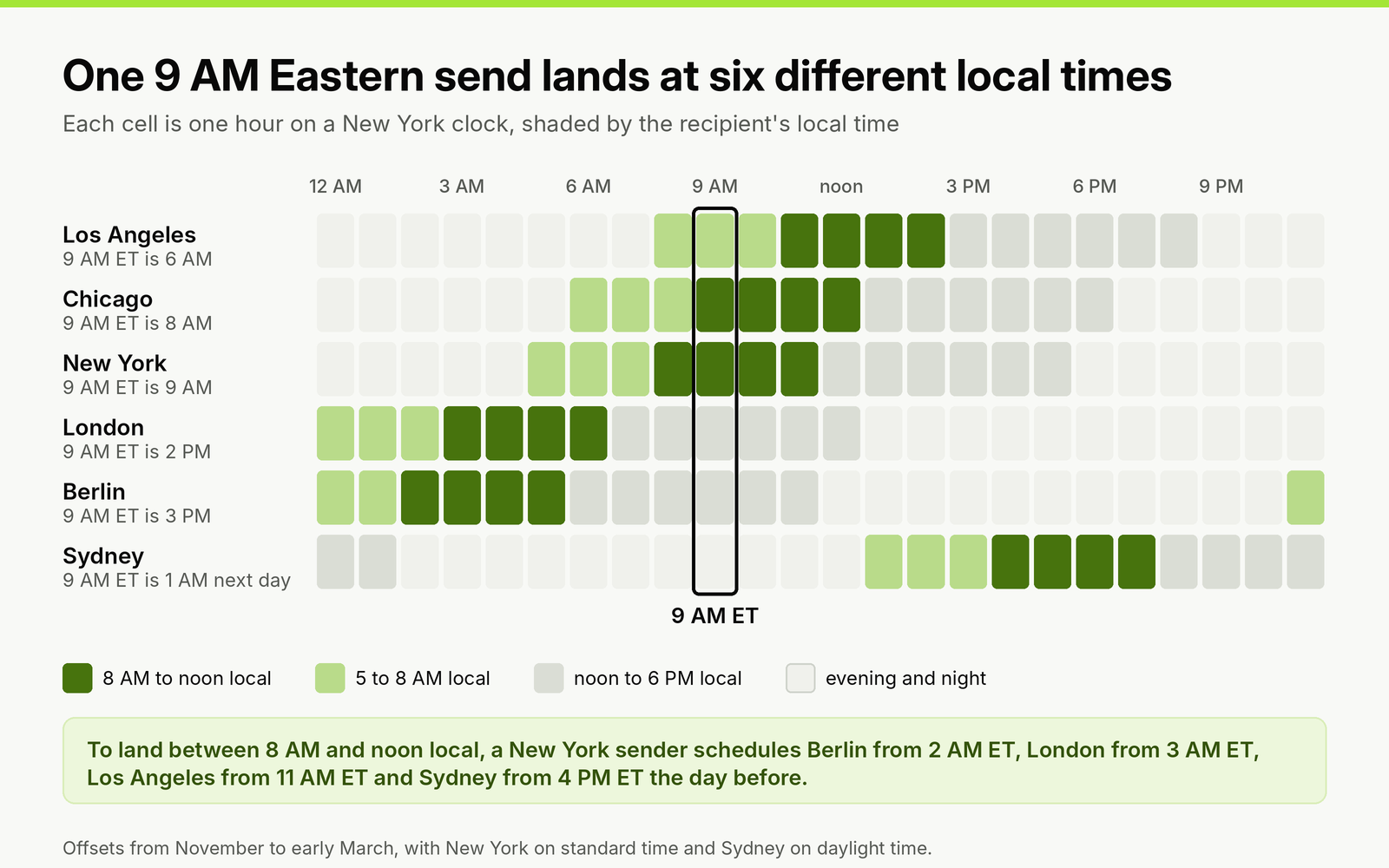
Each region's morning window sits at a different hour on the sender's clock. Offsets shown apply from November to early March.
For link building, the time zone that matters is the person who edits the page, and that is not always where the site's readers are. Work it out in this order:
- The author's own location. An author bio, a LinkedIn profile or a byline that says where the writer is based settles it.
- The site's contact or about page. A company address or a team page usually puts the editorial team in one city.
- The country-code domain. A .co.uk, .de or .com.au site is almost always edited in that country.
- The site's main traffic country. Ahrefs Site Explorer shows organic traffic by country; a site with most of its traffic in the US is usually edited in a US time zone.
You do not need precision to the hour. Group prospects into four or five regions (US East, US West, UK and Ireland, central Europe, Australia) and schedule each group for 8 AM to 11 AM local time. For the US, a send at 11 AM Eastern lands at 8 AM Pacific and covers both coasts inside the morning window, which makes it the safest single slot for a US-only list. Daylight saving time starts and ends on different dates in the US, Europe and Australia, so check your offsets every spring and fall.
Best day of the week for link building outreach
Send first emails Monday to Thursday and keep Friday for nothing that needs a decision. The reply data puts Wednesday and Thursday narrowly ahead and Friday narrowly behind; Instantly's 2026 cold email benchmark also finds Wednesday the peak day for replies and Friday the day with the most out-of-office auto-replies. A pitch that lands on Friday afternoon competes with the weekend and often sits under Monday's backlog.
Weekends are a poor default. Saturday was the weakest day in the reply data, and an editor who reads a link request on a Sunday usually cannot act on it until Monday anyway. The one exception we make is for solo bloggers who post on weekends, where a Sunday evening send can land at the top of Monday's inbox; test it on a small batch before making it a habit.
The day matters less than most guides imply. The same benchmark found 58% of replies came from the first email in a sequence and 42% from follow-ups, which means where each step lands in the week matters about as much as where the pitch lands.
Time the follow-ups, not only the pitch
A sequence is three send times, not one. If the pitch goes out on a Tuesday and your tool waits a fixed three and then seven calendar days, both follow-ups land on Fridays, and in late November the second one lands on the day after Thanksgiving. Count business days, keep every step in the recipient's morning, and skip holidays in the recipient's country.
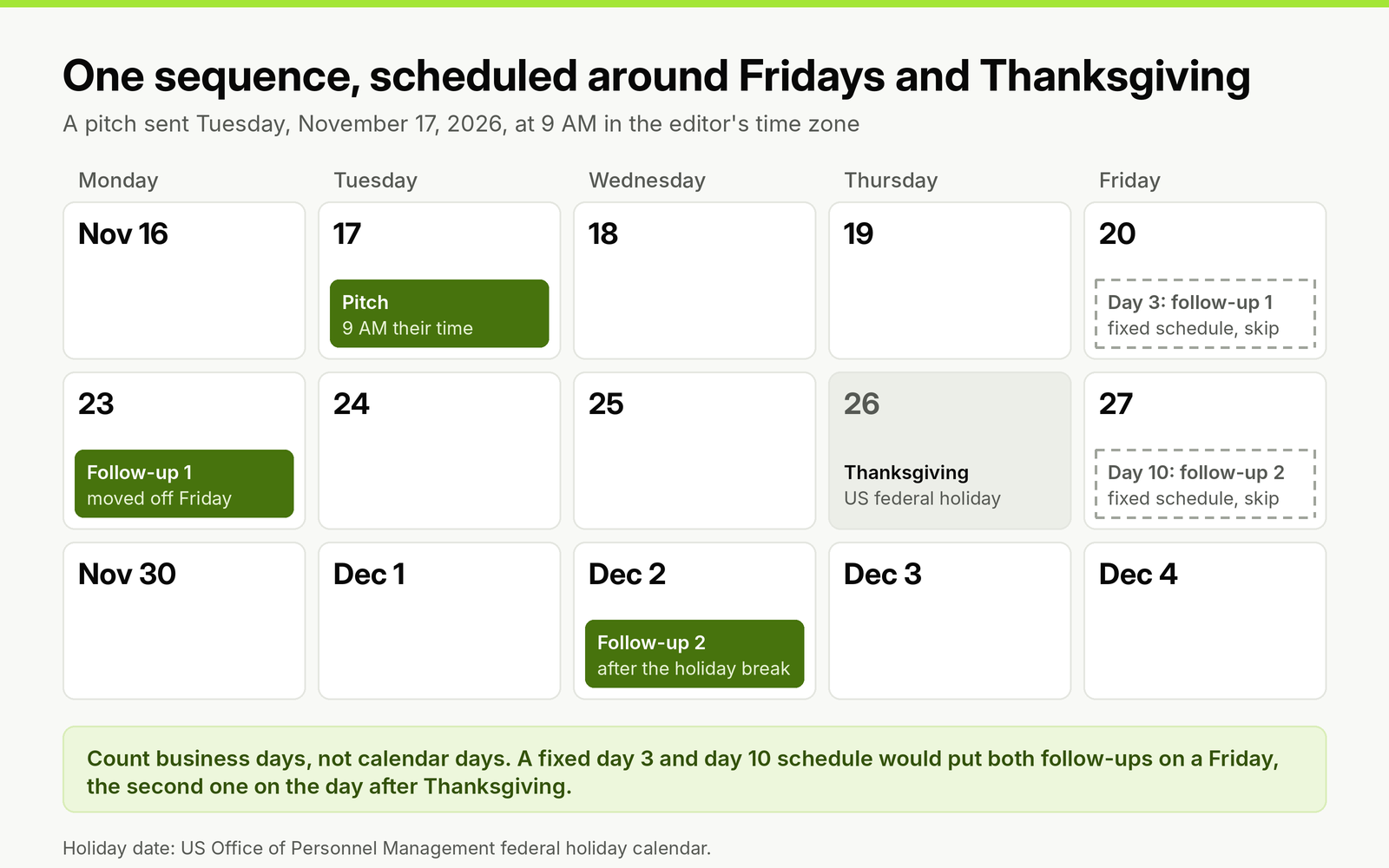
The same three emails, scheduled by business days. Both follow-ups move off a Friday, and the second waits until after the holiday break.
Two more rules keep follow-ups well timed. Pause a sequence when an out-of-office reply arrives and restart the next step after the return date the editor gave. And stop the whole sequence on any human reply, including a no, since a follow-up to someone who already answered is an easy way to earn a spam complaint. For the gaps themselves, we cover how many follow-ups to send and how far apart in a separate guide.
Seasons, holidays and quiet weeks
Season matters too. The same 2025 data found January to March the strongest period for replies, with the sharpest dips in summer and late fall. For link builders that suggests two things: launch new campaigns and test new segments early in the year, and plan for slower answers in August and from late November through the new year.
Holidays are the easiest win. In the US, Thanksgiving falls on Thursday, November 26, 2026, and Christmas Day on Friday, December 25, on the federal holiday calendar. We hold first emails to US sites from the Wednesday before Thanksgiving to the following Monday, and from about December 21 to January 4, and let follow-ups already in flight wait out the same weeks. Do the same for the recipient's own holidays: a UK site on a bank holiday Monday or a German site in the week after Christmas will not answer, and the email sinks under everything that arrives on the day they return.
Spread sends across the window, not all at 9:00
A morning window is a range, not a moment. If a mailbox sends 40 emails a day, scheduling all 40 for 9:00 AM produces a burst that looks nothing like a person writing email, and it puts every one of them in the same few minutes of the editor's inbox. Spread them: 40 sends across a three-hour window is one every four to five minutes. Set a window in your sending tool rather than a single time.
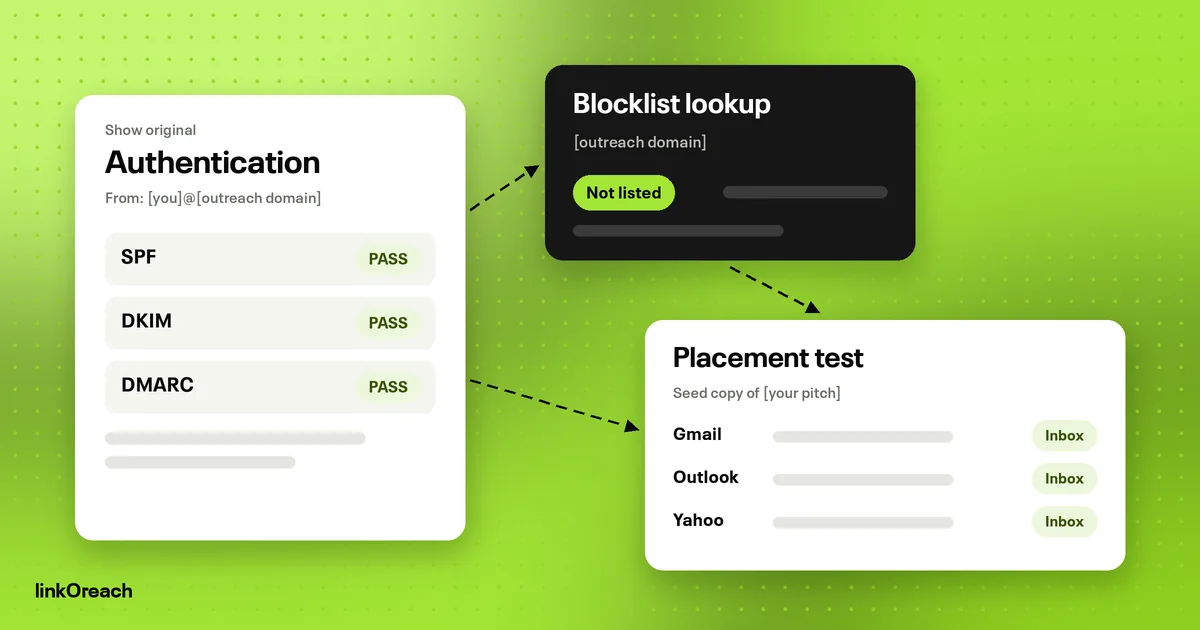
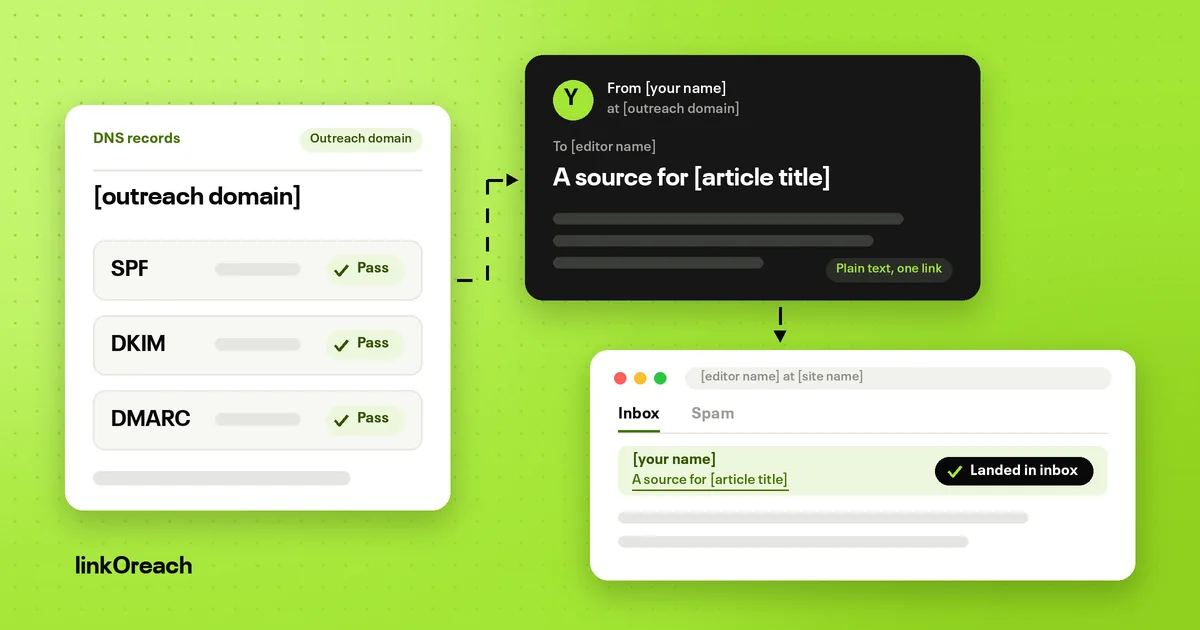
The daily cap matters more than the hour. Keep each mailbox at a steady 20 to 60 sends a day, follow-ups included, and size the campaign to fit, which is the capacity math we use when working back from a link goal to daily sends. A well-timed email from a domain with broken authentication still lands in spam, so fix SPF, DKIM and DMARC records and a slow mailbox ramp before you tune send times at all.
Should you test your own best send time?
Most link builders cannot, and it is worth knowing why before you spend a month on it. Send-time differences are small, and outreach campaigns are small, so the noise swamps the signal. Here is the math for a typical agency campaign.
- Goal: find out whether a 9 AM slot beats a 2 PM slot.
- Assumption: the morning slot replies at 13% and the afternoon at 10%, a larger gap than any of the studies above found.
- Sample needed: to detect a 3-point difference with the usual 95% confidence and 80% power, each slot needs about 1,770 prospects.
- Time to collect it: at 150 new prospects a month per client, the two slots together take close to two years of sending for one test.
- A realistic gap: if the true difference is 10% against 11.5%, the sample grows to about 6,700 prospects per slot.
So do not run send-time tests on one client's campaign. Use the defaults in this guide, and spend testing capacity on the variables that move replies by far more: which pages you pitch, who you contact and what you ask for. If you want a timing signal anyway, pool several campaigns over a quarter and compare replies by recipient region and weekday, alongside the habit of comparing replies by recipient mail provider, which catches placement problems that look like timing problems.
Send-time checklist for a new campaign
- Every prospect has a region or time zone, taken from the author, the site's address, its domain or its main traffic country.
- Each region sends between 8 AM and 11 AM local time, Monday to Thursday.
- Sends are spread across the window, and each mailbox stays at 20 to 60 emails a day, follow-ups included.
- Follow-up gaps are counted in business days and skip Fridays and the recipient's public holidays.
- Sequences pause on out-of-office replies and stop on any human reply.
- Open tracking is off, and the campaign is judged on replies and live links.
Scheduling outreach in linkOreach
We built linkOreach for link building outreach, and Linkzy is the AI agent inside it. Once you brief Linkzy, it builds the prospect list from Ahrefs data with DR and traffic on every row, finds the right contact at each site, checks each address for deliverability, and writes a pitch for each site. Follow-ups run on a cadence and stop the moment someone replies, inside built-in sending limits, and you send from your own Gmail, Outlook or SMTP mailbox. Our follow-ups on a cadence that stop on reply, inside daily sending limits sit next to a shared inbox and per-campaign reports of replies and live links. Every step can also be run by hand. We currently offer one plan at $49 a month, an introductory price, with a 7-day trial and no credit card.
Pick a different tool if your outreach is high-volume sales prospecting across many regions, where a sales sequencer built around per-lead send windows and long multichannel cadences fits the job better. linkOreach is built for pitches that end in a link.
Conclusion
Send link building pitches Monday to Thursday between 8 AM and 11 AM in the editor's time zone, worked out from the author, the site's address, its domain or its main traffic country. Morning sends got about 15% more replies than afternoon sends, while weekdays differed by a few percent, so the time zone matters more than the day. Spread sends across the window and keep each mailbox at 20 to 60 a day.
Count follow-up gaps in business days, skip Fridays and the recipient's holidays, and pause on out-of-office replies. Judge timing on replies and live links, not opens, and do not test send times on a single campaign: a meaningful test needs well over 1,000 prospects per slot.
If you want per-site pitches and follow-ups that stop on reply, sent from your own mailbox, start a free 7-day linkOreach trial and schedule your next campaign for the editor's morning.
Frequently Asked Questions
What is the best time to send cold emails?
Between 8 AM and 11 AM in the recipient's time zone, Monday to Thursday. In 7.5 million cold emails sent in 2025, sends between 8 AM and noon got the highest reply rate (0.54% per email sent) against 0.47% for the afternoon, and four times the afternoon meeting rate. For link building, use the time zone of the person who edits the page.
What is the best day to send cold emails?
Tuesday to Thursday, with Monday close behind. Wednesday and Thursday had the highest reply rates in 2025 data (0.48% per email sent) against 0.45% for Monday and Tuesday and 0.44% for Friday. For editorial pitches, Monday morning works well too: in a 2026 survey, half of journalists did not mind which day they were pitched.
Should you send cold emails on weekends?
Not as a default. Saturday had the lowest reply rate of any day in 2025 data, and an editor who reads a link request on Sunday usually cannot act on it until Monday. Sunday showed a high rate only on very low volume. Test a small Sunday evening batch only for solo bloggers who post on weekends.
What time zone should I use for cold emails?
The recipient's. For link building, that is the time zone of the person who edits the page: check the author's bio, the site's contact page, its country-code domain and its main traffic country. Group prospects into a few regions and schedule each for 8 AM to 11 AM local time. For a US-only list, 11 AM Eastern reaches both coasts in the morning.
When should I send follow-up emails?
In the same morning window as the pitch, with gaps counted in business days. A fixed three and seven calendar day schedule after a Tuesday pitch puts both follow-ups on Fridays. Move them off Fridays, skip the recipient's public holidays, pause on out-of-office replies and stop the sequence on any human reply.
What is the best time to pitch journalists for links?
Before noon in their time zone. In Muck Rack's State of Journalism 2026, 78% of journalists said they prefer pitches sent before noon, and 69% prefer pitches under 200 words. Half said they do not care about the day of the week, and 18% named Monday as their preferred day.