Cold Email Follow Up for Link Building: How Many, How Often
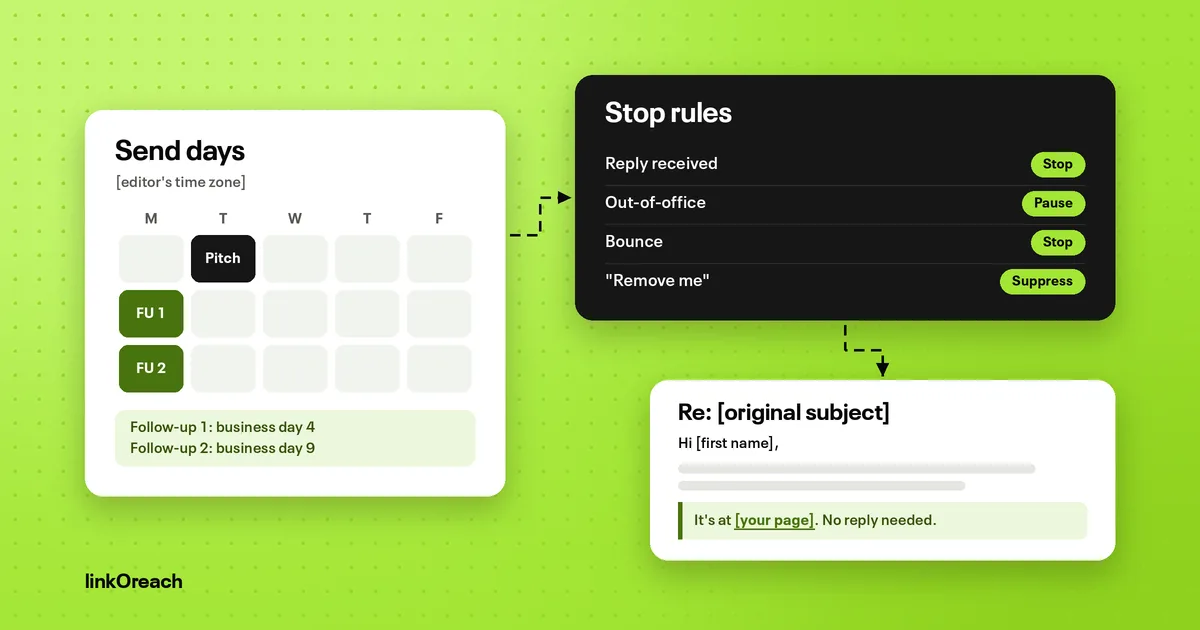
For a cold email follow up on a link request, send two follow-ups at most: the first three to four business days after the pitch, the second about a week after that, both in the same thread, and stop the moment anyone replies, auto-replies included. That is shorter than most cold email advice, and the difference is deliberate.
Most guides on following up a cold email are written for sales teams booking meetings, where a buyer who ignores four emails may still need the product next quarter. An editor who has ignored a request to change their own page twice has usually decided. This guide covers how many follow-ups to send, how far apart, what each one should add, the volume and complaint math behind those numbers, and when to stop. For the wording itself, copy from the follow-up email templates for link requests.
How many follow-ups to send after a cold email
Every large dataset agrees that one follow-up beats none. They disagree about where to stop, and the disagreement comes almost entirely from who is sending and what they are asking for.
| Source | Data behind it | What it found about follow-ups |
|---|---|---|
| Hunter, State of Email Outreach 2026 | 31 million emails sent by Hunter users in 2025 | Three-message sequences averaged a 6.8% reply rate against 3.3% for a single email; sequences with three or more follow-ups averaged lower than three messages |
| Instantly, Cold Email Benchmark Report 2026 | Workspaces on Instantly, January to December 2025 | 58% of replies came from the first email; recommends 4 to 7 touchpoints spaced 3 to 4 days apart |
| Belkins, sales follow-up statistics | 7.5 million emails from Belkins' managed sales outreach in 2025 | Steps 2 to 6 produced 58.6% of replies and step 1 produced 41.4%; step 3 alone drove 35.6% of email-sourced meetings |
| Woodpecker, follow-up statistics | Campaigns sent by Woodpecker users | Campaigns with at least one follow-up averaged 13% replies against 9% without; recommends two to three follow-ups |
| Backlinko email outreach study with Pitchbox (2019) | 12 million outreach emails sent through Pitchbox | One follow-up lifted replies by 65.8%; three or more messages produced the best response rate |
Read the rows by who is sending. The two datasets that favor long sequences measure mostly sales outreach, where a sixth email can reach a buyer whose budget opened last week. The sequences in the third row run to six steps for clients booking meetings, so the later steps have more room to produce replies. The two datasets closest to link building, in the first and last rows, both peak at three messages.
Link requests also get answered faster. In the same Hunter report, senders doing digital PR and link building averaged a 13% response rate against 3% for sales outreach. When the ask is specific and the recipient can judge it in a minute, most of the answers you are going to get arrive by the second follow-up.
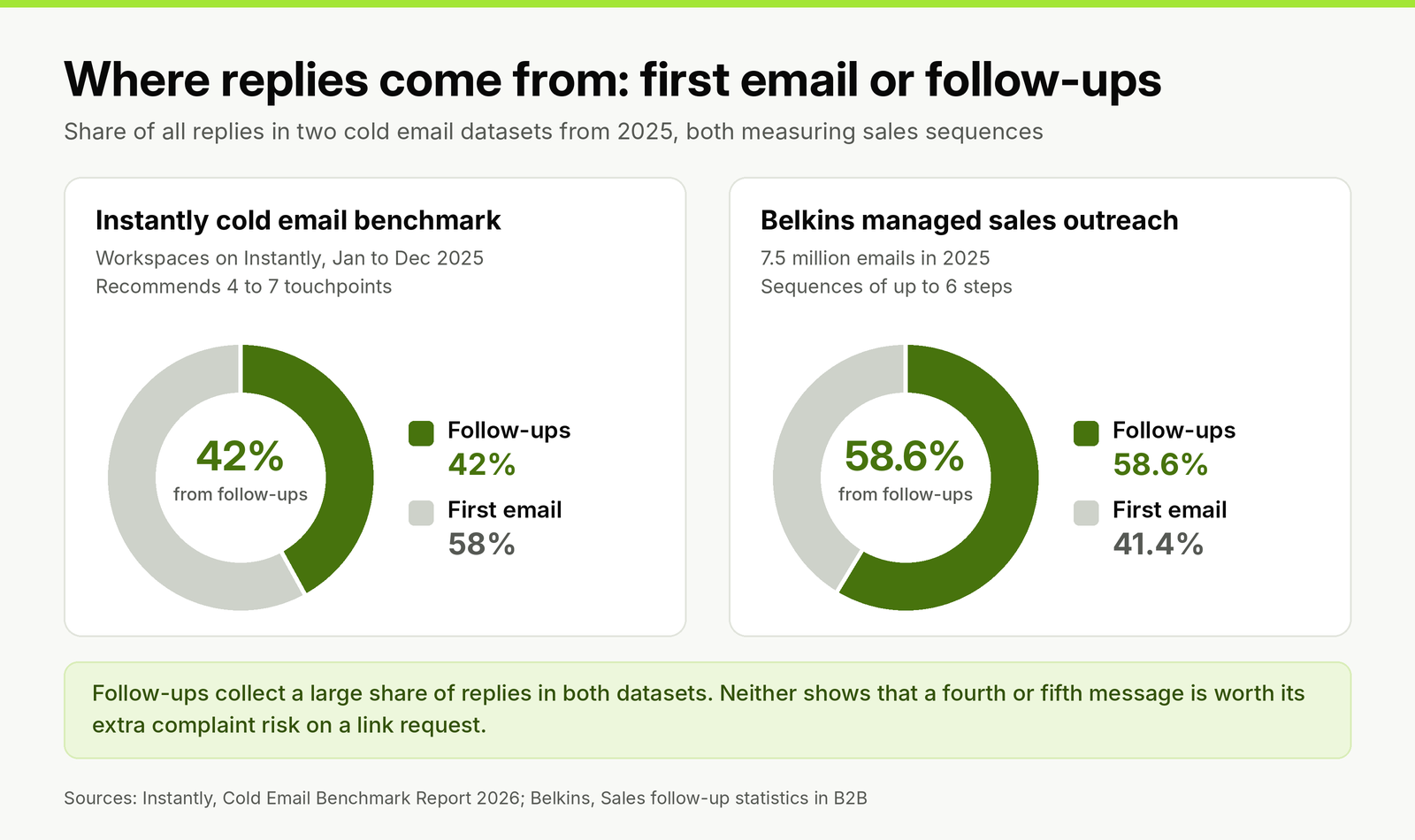
Both datasets measure sales sequences, and they disagree on how much the first email carries. Neither shows what a fourth or fifth message costs in complaints.
Our rule for link requests: a pitch and two follow-ups
Three messages per person is the ceiling we use, for three reasons.
First, each follow-up needs something new, and a link request has only two new things to offer after the pitch: an easier version of the ask (the exact paragraph, a sentence the editor could paste in, an outline) and a clean exit. A third follow-up has nothing left to say, so it becomes "just checking in", which gives the editor no reason to answer and one more chance to press Report spam.
Second, the editor's silence is information. A sales buyer may not have read your email; an editor who received a specific request about a specific page, twice, usually has.
Third, the complaint math covered below punishes long sequences far more at outreach volumes than in a sales team's inbox.
That does not mean a site is closed after three emails. A second editor at the same site can get one email 30 days or more after the sequence ends, and the same editor can hear from you again with a different page after three months. Both are new conversations, not a fourth follow-up.
How long to wait before following up on a cold email
Send the first follow-up three to four business days after the pitch. Sooner reads as pressure to an editor who clears outreach once or twice a week. Later than a week, and the pitch has slid below enough new mail that the follow-up has to carry the whole request on its own. The largest sales benchmark in the table uses the same three to four day spacing.
Send the second follow-up about a week after the first, which puts it nine to ten business days after the pitch. The longer gap matters: the last note is a goodbye, and a goodbye that arrives three days after a reminder looks like part of a drip.
Three details decide whether that schedule works in practice:
- Count business days in the editor's time zone, not calendar days in yours. A follow-up set to "3 days" after a Thursday pitch lands on Sunday and sits under Monday's mail.
- Skip the editor's public holidays. A US editor's Thanksgiving week or a UK editor's bank holiday Monday is a bad day for a reminder.
- Treat Friday pitches with care. Instantly found Friday brings the highest volume of auto-replies, so a pitch sent late in the week often comes back with an out-of-office. Pause the sequence and resume on the first working day after the return date.
The day of the week matters less than the gap. Send day had no measurable effect on replies in the 31 million emails from 2025, and in the 2019 study weekday sends earned 23.3% more responses than weekend sends. Send on weekdays, in the editor's morning, and spend your testing time on the message rather than on Tuesday against Thursday. For time zones, holiday weeks and the morning window itself, see send times for link building pitches, by hour and weekday.
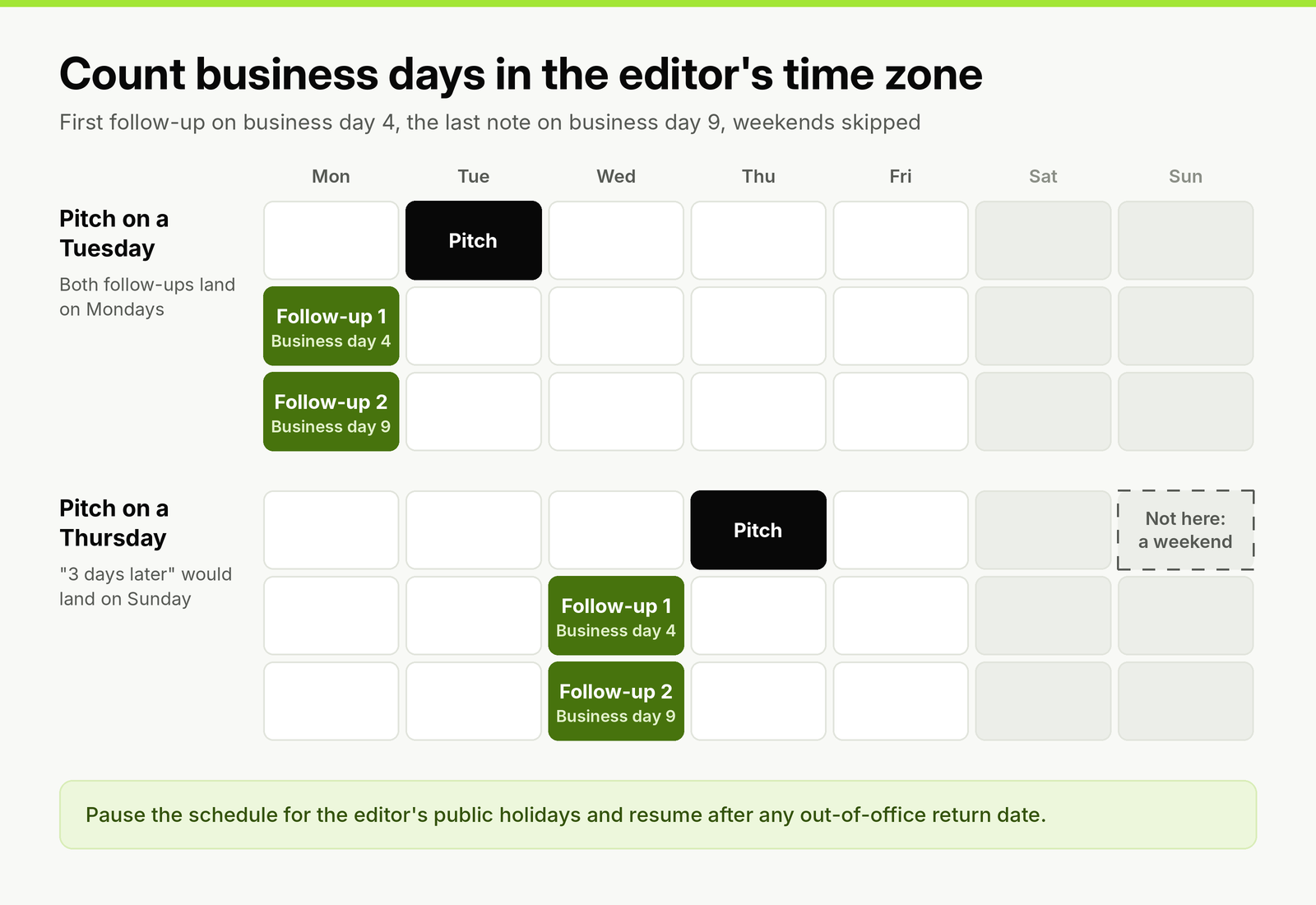
The same schedule, counted in business days, never lands a follow-up on a weekend.
What each follow-up should add
The first follow-up makes yes easier. It arrives in the same thread, under the pitch, and is shorter than the pitch, usually under 80 words. It brings one thing the first email left out: the first words of the paragraph you mean, a sentence the editor could paste in, a three-point outline for a guest post, or the dead link you spotted on their list. Write it the way a person replies, not as a formal reminder; Instantly measured roughly a 30% lift for second steps written to read like a reply.
The second follow-up closes the loop. It either leaves the resource with no ask ("if it's useful for a future update, it's here") or asks for a one-word answer. The first gets fewer replies and almost no complaints; the second gets a decision. Pick based on whether you would pitch this site again.
Here is a worked example for one niche edit prospect, an article that cites a 2022 figure your page has since updated. The pitch named the article and offered the newer figure. The first follow-up removes the editor's work:
Subject: Re: Newer figure for "[article title]"
Hi [first name],
To save you looking for it: the figure is in the paragraph that starts "[first five words of the paragraph]", under [section heading].
A sentence that would fit there: "[Updated figure], from [your page title] at [URL]." Edit it or skip it as you like.
[Your name]
And the last note, about a week later:
Subject: Re: Newer figure for "[article title]"
Hi [first name],
I won't write again about this. If you refresh "[article title]", the updated figure and its method are at [URL], free to cite with or without a link.
Thanks for reading.
[Your name]
What to leave out of both: "just checking in", a second ask such as a social share, an offer to pay added halfway through the sequence, attachments, and any deadline you invented. Each follow-up should also match the pitch it answers, so start from the cold email pitch templates, one first email for each campaign type.
What follow-up 1 adds, by campaign type
| Campaign type | What follow-up 1 adds | Follow-up 2 |
|---|---|---|
| Guest post | A three-point outline for the title closest to their recent posts | Withdraw the offer politely and say you would pitch again if contributor slots open |
| Niche edit | The first words of the paragraph and a paste-ready sentence with the link | Leave the URL for their next update, no ask |
| Listicle inclusion | Your public pricing page and one line on how you differ from a tool already on the list | Offer a trial with no conditions on what they write, then stop |
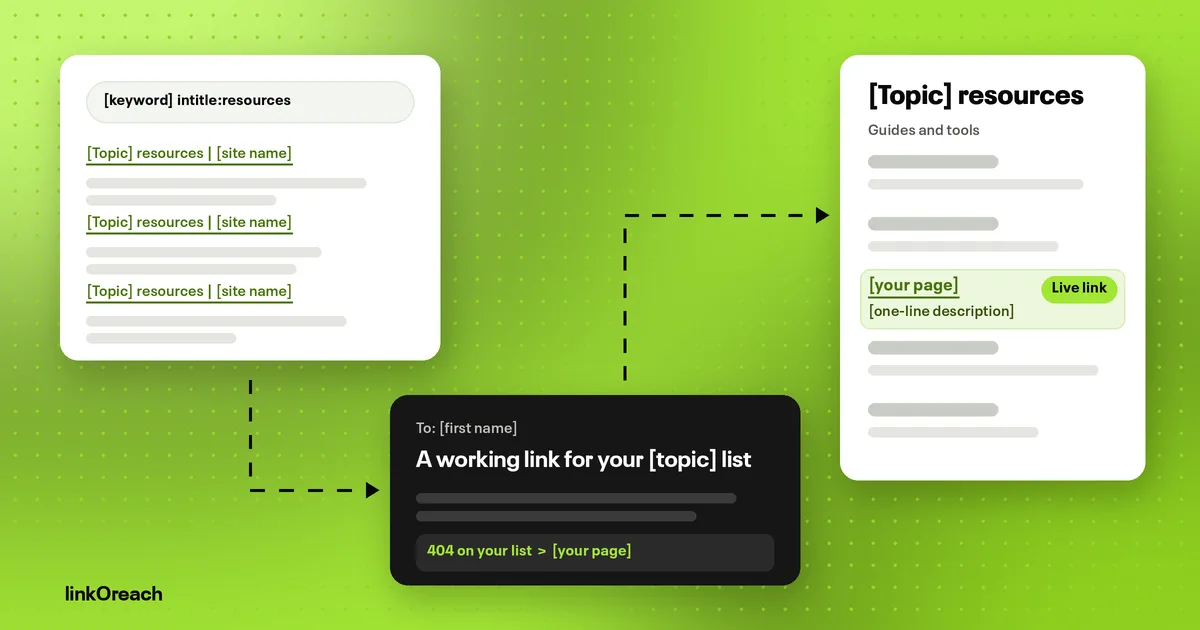
| Resource page | The dead link on their list, if there is one, and a one-line description written in their format | Leave the description for their next review of the page |
| Unlinked brand mention | The exact sentence that mentions you and the page it should point to | Usually not needed: they chose to mention you, so one reminder is enough |
Resource pages reward the dead-link follow-up more than any other campaign type, because the curator gets a fix for their page, not just a request. Finding those links before you write is the core of resource page link building.
The volume and complaint math behind two follow-ups
Follow-ups multiply sending volume, and in a running campaign they make up most of each day's sends. A mailbox that starts 20 new prospects a day sends close to 60 emails a day once both follow-ups are running, a little less as replies stop sequences. Set your daily cap on total sends, not on new pitches.
The bigger cost is complaints. Google's email sender guidelines require every sender to keep the spam rate reported in Postmaster Tools below 0.3% and recommend staying below 0.1%. At 300 messages a day to Gmail addresses, a single "Report spam" click puts that day at 0.33%. Every follow-up you add goes to people who have already ignored you, the readers least interested in your request.
Run the numbers on one campaign. If 100 prospects never reply, a pitch and two follow-ups sends them 300 emails. A seven-touch sales cadence sends them 700, so the extra four steps add 400 emails, every one of them to an editor who has stayed silent through three. The replies those steps might add are small next to the complaint exposure they create. The rest of that setup, from authentication to ramp-up, is part of cold email deliverability for outreach domains. To see whether complaints are already hurting a domain, the free tools that show a domain's spam rate and blocklist status cover most of the checks.
Settings that change follow-up results
Sequence length is only one of the settings that moves reply rates, and open tracking moved them almost as much. In the same 31 million emails, campaigns with open tracking turned off replied at 7.4% against 4.4% with it on. Two personalized fields in the body lifted replies from 3.6% to 5.6%, and emails a person edited before sending beat fully automated ones, 5.2% against 4.4%.
Open tracking does particular harm in a follow-up sequence: an "opened three times" signal tempts senders to follow up harder with someone who has already read the email and decided. Turn it off and judge campaigns on replies and live links.
The contacts-per-site question has a split answer. The 2019 outreach data found that messages sent to more than one contact at a site got a 93% higher response rate, with diminishing returns at five or more. The 2025 data found that contacting one or two people per company replied at 5.1% against 3.5% for three or more. Both point to the same practice for link requests: one person at a time, a second only after the first sequence has ended, and never more than two.
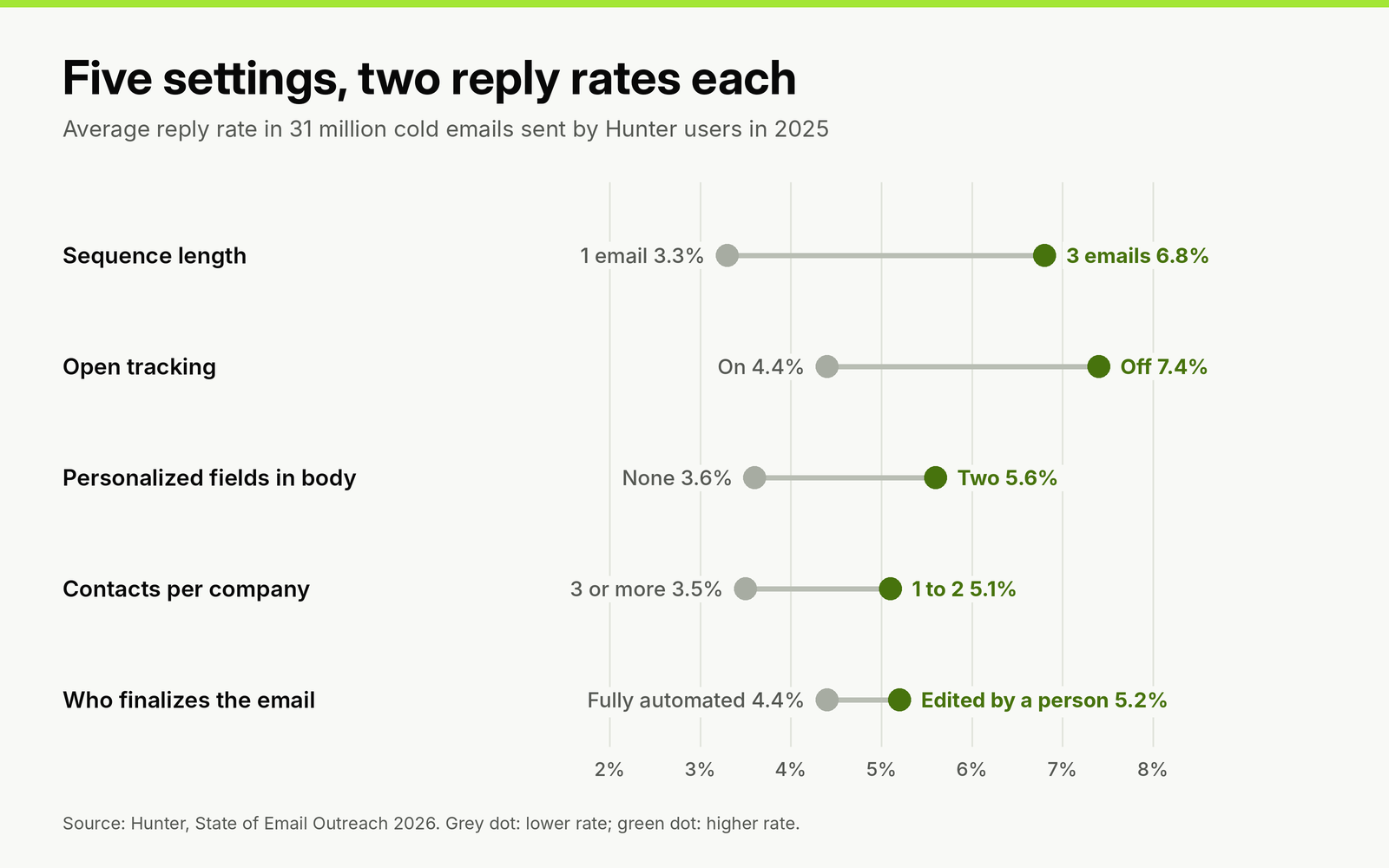
Turning off open tracking moved average replies about as much as adding two follow-ups did.
When to stop following up
Any response from a person ends the automated sequence, whatever it says. Each type of response then needs its own next step:
- Yes, or a question: stop the sequence and answer by hand within a working day.
- No, or "not now": stop, log the reason and suppress the contact for that page. A "not now" with a date earns one check-back on that date.
- Out-of-office: pause, then follow up once on the first working day after the return date.
- A referral to a colleague: stop and start a new thread to the person named, mentioning who sent you.
- Bounce: stop, verify the address and find another contact before trying again.
- "Remove me" or any unsubscribe request: suppress the address across every campaign and client, not only the current one.
- The link appears before anyone replies: stop the sequence and send a thank-you instead of the next follow-up.
A tool that stops only on positive replies, or keeps sending after an auto-reply, breaks most of these rules on its own. Check that behavior before a campaign starts, along with where follow-ups fit in a link building outreach campaign.
Running follow-ups in linkOreach
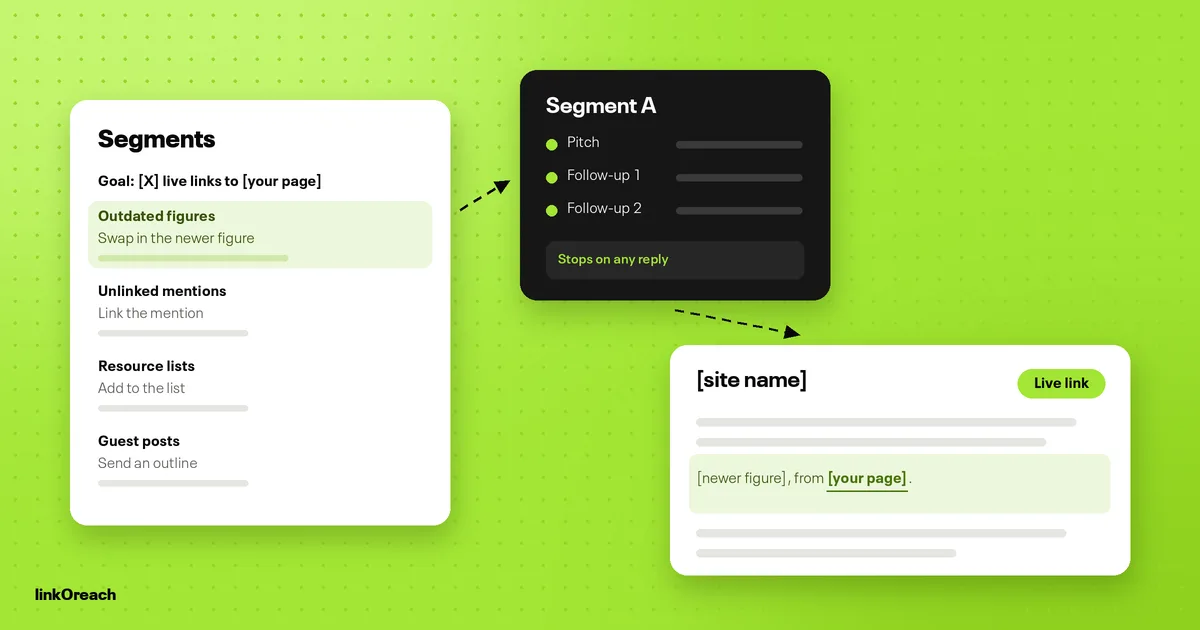
We built linkOreach for link building outreach, and Linkzy is the AI agent inside it. Linkzy writes a pitch for each site, sends the follow-ups on a cadence and stops the sequence the second someone replies, with built-in sending limits to protect your domain. Every email is editable before it goes out, you can A/B test two pitches and reuse saved templates, and you send from your own Gmail, Outlook or SMTP mailbox. Replies land in a shared inbox, and each thread is tracked through to a live, indexed backlink. The linkOreach feature set covers the rest of the workflow.
We currently offer one plan at $49 a month, an introductory price, with 500 email credits, 5,000 searches and 100,000 Ahrefs credits, and a 7-day trial with no credit card.
Pick a different tool if your follow-ups chase sales meetings, demos or candidates. Those jobs suit longer cadences and a sales engagement platform built around them.
Conclusion
Cap every link request at a pitch and two follow-ups. Send the first three to four business days later, in the editor's time zone, with one thing that makes yes easier; send the last about a week after that as a clean exit. Keep both in the same thread, under 80 words, and stop on any response, auto-replies included.
Then manage the settings that matter almost as much as sequence length: open tracking off, a person reading every draft, one contact per site at a time, and a daily cap on total sends. Keep complaints under Google's 0.1% target, and treat a second editor or a new page months later as a new conversation, not a fourth follow-up.
If you want follow-ups that stop on reply and threads tracked to a live link, start a free 7-day linkOreach trial and set up your next sequence with two follow-ups.
Frequently Asked Questions
How long should you wait to follow up on a cold email?
For a link request, send the first follow-up three to four business days after the pitch and the second about a week after the first. Count business days in the recipient's time zone, skip their public holidays, and if an out-of-office arrives, pause and follow up on the first working day after the return date.
How many times should you follow up on a cold email?
Twice for link building outreach, so three messages in total. Sales benchmarks often recommend four to seven touches, but the outreach datasets closest to link requests peak at three messages, and every extra email to someone who has stayed silent adds spam complaint risk.
How do you politely follow up on a cold email?
Reply in the same thread so the original sits underneath, keep it shorter than the first email (under 80 words), add one thing the first email lacked, ask one question and make a no easy. Leave out guilt lines, invented deadlines and "just checking in".
Should you follow up if they opened your email but did not reply?
Follow the same schedule whether or not the email shows as opened. In Hunter's 2025 data, campaigns with open tracking turned off averaged a 7.4% reply rate against 4.4% with it on, so turn tracking off and judge campaigns on replies and live links instead.
When should you stop following up on a cold email?
Stop after the second follow-up, or earlier on any response from a person, a bounce, an unsubscribe request or the link going live. Pause, rather than stop, on an out-of-office reply. A different editor at the same site can get one new email 30 days or more after the sequence ends.