Outreach Marketing for Link Builders: Types, Process, Benchmarks
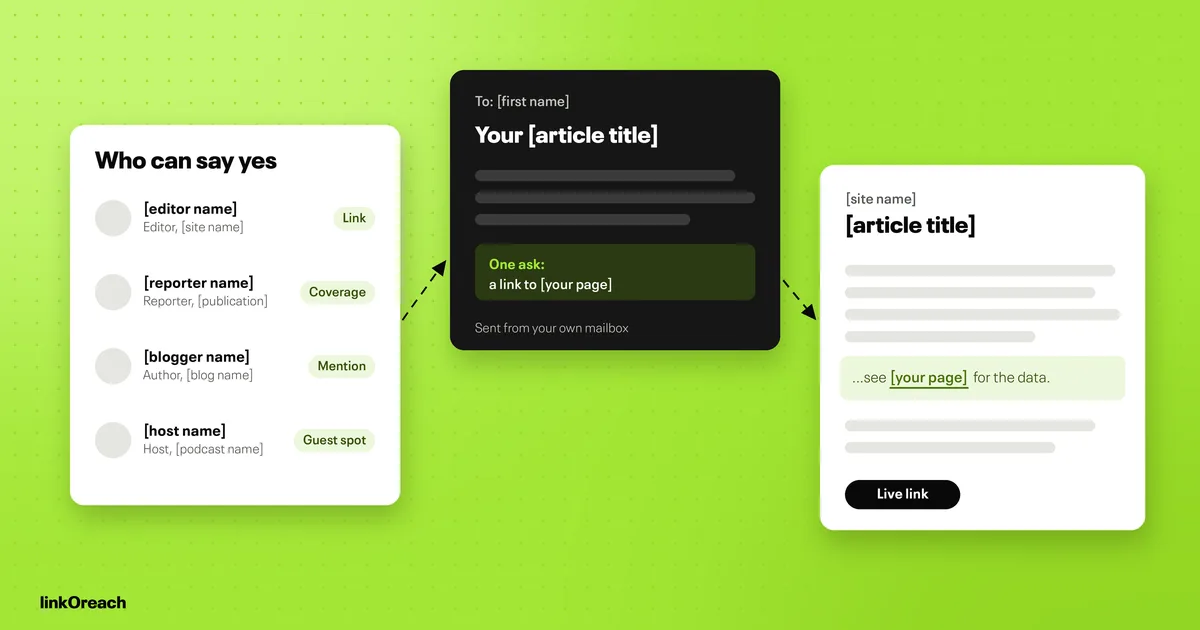
Outreach marketing is contacting specific people who already have an audience (editors, journalists, bloggers, podcast hosts, partner companies) one at a time, and asking each of them for one concrete thing: a link, a mention, a quote, a guest spot or a collaboration. It works when the ask is narrow and useful to the person receiving it, which is why link building outreach drew a 13% average reply rate in 2025 while sales cold email drew 3%, across the 31 million emails in Hunter's State of Email Outreach 2026.
Most guides to outreach marketing are written for small businesses looking for customers, and they blur outreach into social posting, ads and handwritten notes. This one is for SEO teams, agencies and freelance link builders who run outreach as a channel. It covers the types of outreach worth running, how to build a campaign that editors answer, the benchmarks to plan with, a worked example for sizing a month of work, two pitches to copy and the rules that apply to every email you send.
What outreach marketing is, and what it is not
Outreach marketing borrows someone else's audience. You find a person whose readers, listeners or customers overlap with yours, and you give them a reason to point that audience at you. The return is a backlink, a citation in an article, a product included in a roundup, an interview slot or a co-marketing deal.
Three things separate it from the channels it gets confused with:
- It is not inbound. Inbound waits for people to find you. Outreach picks the person first and writes to them about their own page, show or newsletter.
- It is not sales prospecting. A sales email asks the recipient to buy. An outreach email asks a gatekeeper to do something for their audience, and the offer has to make their work better, not just yours.
- It is not paid media. If money changes hands for the placement, it becomes sponsorship, and different rules apply (see the rules section below).
"Marketing outreach" and "outreach marketing" describe the same thing; people search both. In practice, for an SEO team, outreach marketing and link building outreach overlap almost completely, because most of the measurable value ends up as links and citations. That core campaign type has its own link building outreach process, from prospect list to live link.
Why link building outreach gets answered more than sales email
The gap between use cases is large, and it follows from how specific the ask is.
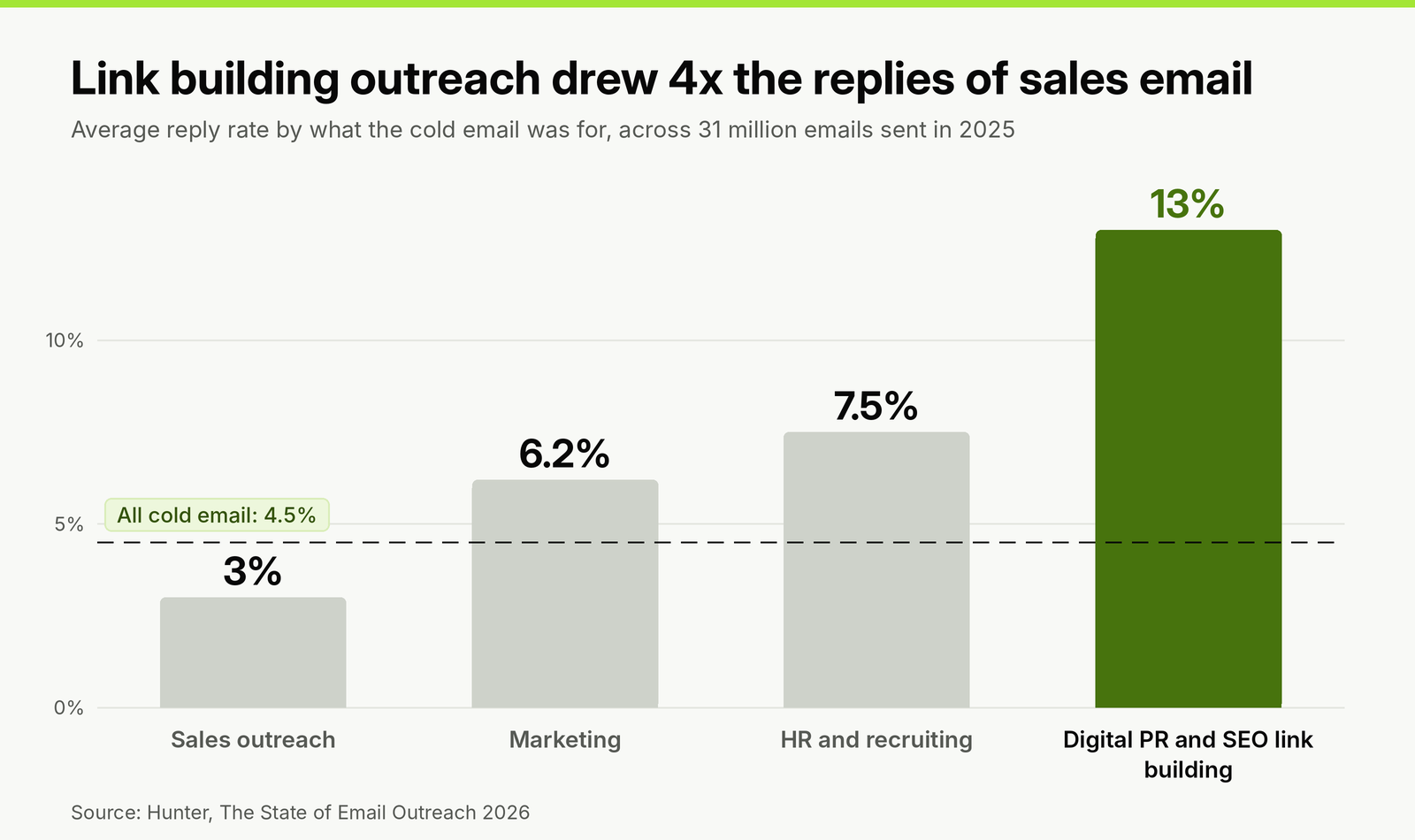
Reply rates by what the email was for. Link building and digital PR outreach averaged nearly three times the 4.5% figure for all cold email.
A sales email asks a stranger to change what they buy. A good link request asks an editor to improve a page they already own, about a topic they already chose, with a resource they can check in a minute. The recipient sees a clear benefit and a small, reversible action. That is the whole craft of outreach marketing: shrink the ask until saying yes costs the recipient less than ignoring you.
The reverse also holds. Sales-style habits drag outreach replies down to sales-style numbers: generic openers, a pitch about your product rather than their page, 500-person sequences with one template. Sequences of 21 to 50 recipients replied at 6.2% against 2.4% for sequences of 500 or more. Smaller, tighter lists win.
Types of outreach marketing worth running
Six types cover almost every outreach campaign an SEO or content team runs. They differ in who you contact, what you ask for and which rules apply.
| Type | Who you contact | The ask | What makes it work | Rules to know |
|---|---|---|---|---|
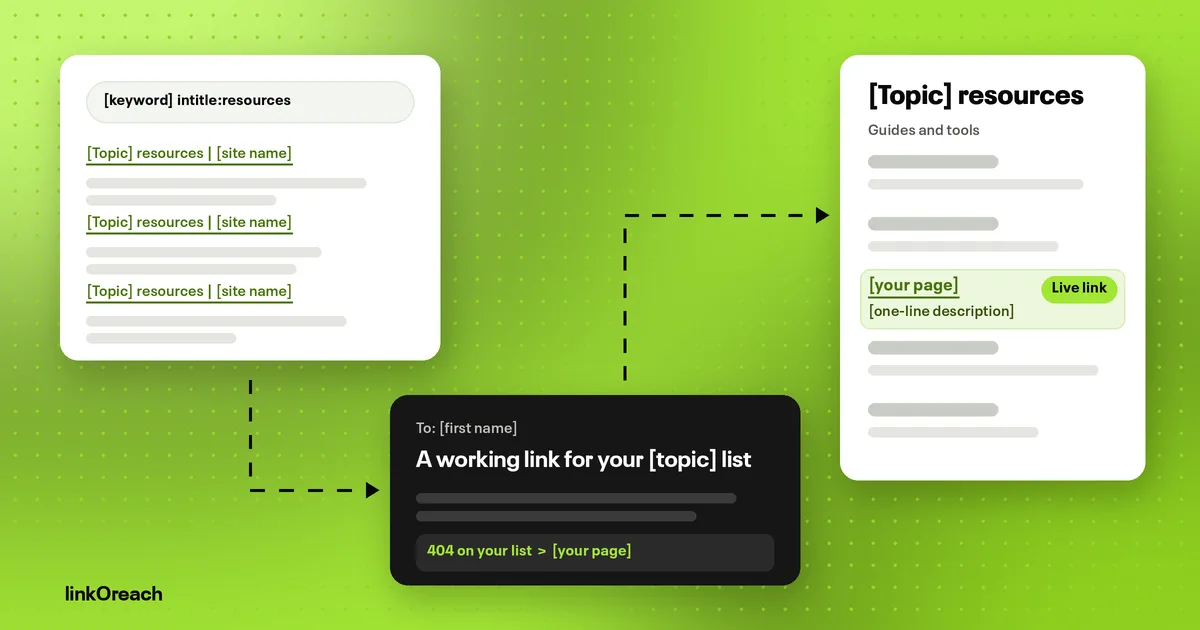
| Link building (SEO) outreach: niche edits, resource pages, broken links, unlinked mentions | The author or editor of one specific page | Add or fix one link on an existing page | A resource that improves that exact page, and a sentence they can paste | Google's link spam policy if anything is exchanged |
| Guest posting | Editor of a blog or publication section | Publish an article you write | Titles that fit gaps in their archive, written to their guidelines | Link spam policy on keyword-rich anchors |
| Digital PR | Journalists and reporters on a beat | Cover your data, study or expert | Original data or access the reporter cannot get elsewhere | CAN-SPAM for commercial email |
| Blogger and listicle outreach | Authors of reviews and "best [category]" lists | Consider your product for inclusion | Public pricing, a trial with no conditions, a clear point of difference | Link spam policy; FTC disclosure if you give anything of value |
| Influencer and creator outreach | Creators with an engaged audience | Feature, review or mention your product | Fit with their audience, and a brief that leaves them creative control | FTC disclosure rules for endorsements |
| Partnership and podcast outreach | Companies with an overlapping audience, show hosts | Co-marketing, a webinar, a guest spot | A specific idea that benefits both audiences | CAN-SPAM; disclosure if the deal is paid |
Most teams should run one or two of these well rather than all six at once. Link building outreach and digital PR share the most infrastructure (lists, mailboxes, templates, tracking), so they pair naturally. Influencer outreach usually lives on social platforms and needs a separate workflow.
Digital PR: what journalists say about pitches
Journalists depend on outreach and are tired of most of it. Cision's 2026 State of the Media survey of 1,899 journalists found that two thirds rely on PR content for story ideas, while nearly three quarters say fewer than a quarter of the pitches they receive are relevant.
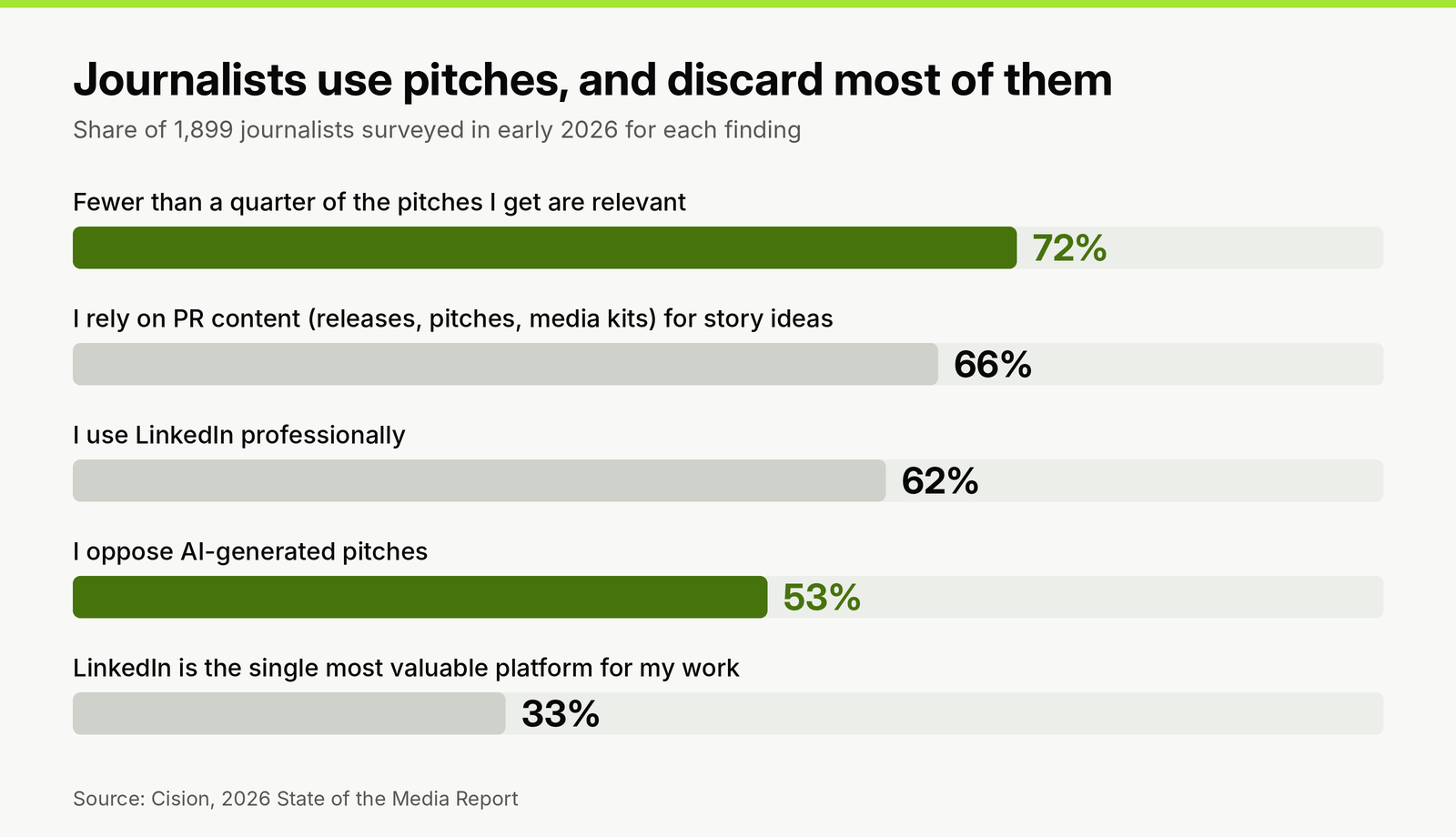
The opening for digital PR is real, and so is the noise. Relevance is the filter most pitches fail.
Two findings shape how to pitch. First, 53% oppose AI-generated pitches, so a model can draft, but a person who knows the reporter's beat has to rewrite and approve every email. Second, LinkedIn matters: 62% use it professionally and a third call it the most valuable platform for their work. Following a reporter there and reading what they share is the fastest way to find the angle they are working on.
How to build an outreach marketing campaign
Every type above runs on the same six steps. The order matters more than the tools.
1. Pick one goal and one asset
Decide what the campaign should produce (links to a pillar page, coverage of a study, inclusion in "best [category]" lists) and which single asset earns it. An asset is the thing the recipient gets: a dataset, a calculator, a guide that beats what they currently cite, an expert they can quote. A campaign with no asset is a request for a favor, and favors get ignored.
2. Define who can say yes
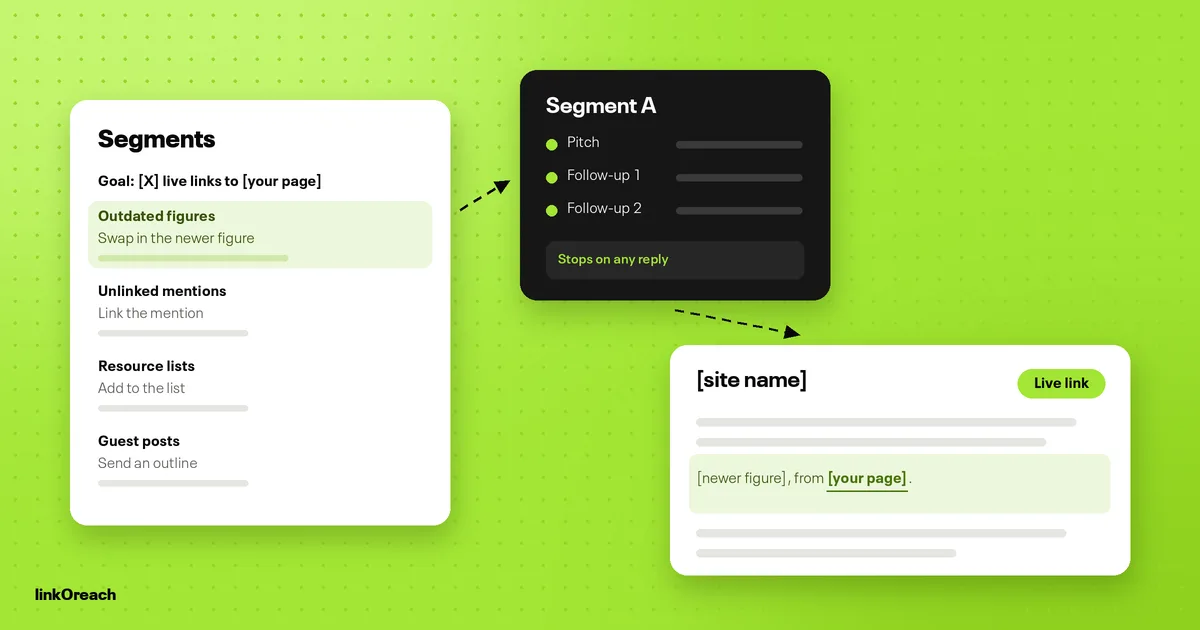
Write down the role, not just the site type: "the author of a guide that cites outdated data on [topic]" or "the reporter who covered [topic] in the last 90 days". Set qualification thresholds before you build the list, such as a minimum organic traffic figure, a Domain Rating range, a topic match on the specific page and a post published in the last six months. Sites that fail stay off the list, however tempting their metrics.
3. Build and verify the list
Find the named person for each site and verify every address before it enters a sequence. Contact one or two people per organization at most: sequences that reached one or two people at a company replied at 5.1% against 3.5% for three or more. Split the list into segments of no more than 50 that share an angle, so each segment gets an opener written for it.
4. Write a pitch about their page, not your product
Lead with the recipient's own work, state the one ask, explain in a sentence why it improves their page or story, and give them an easy way to say no. Keep it short: bodies of 61 to 80 words were among the best performers for replies. Personalization pays: emails with two custom attributes in the body replied at 5.6% against 3.6% with none. The pitch templates for guest posts, niche edits and unlinked mentions follow this structure.
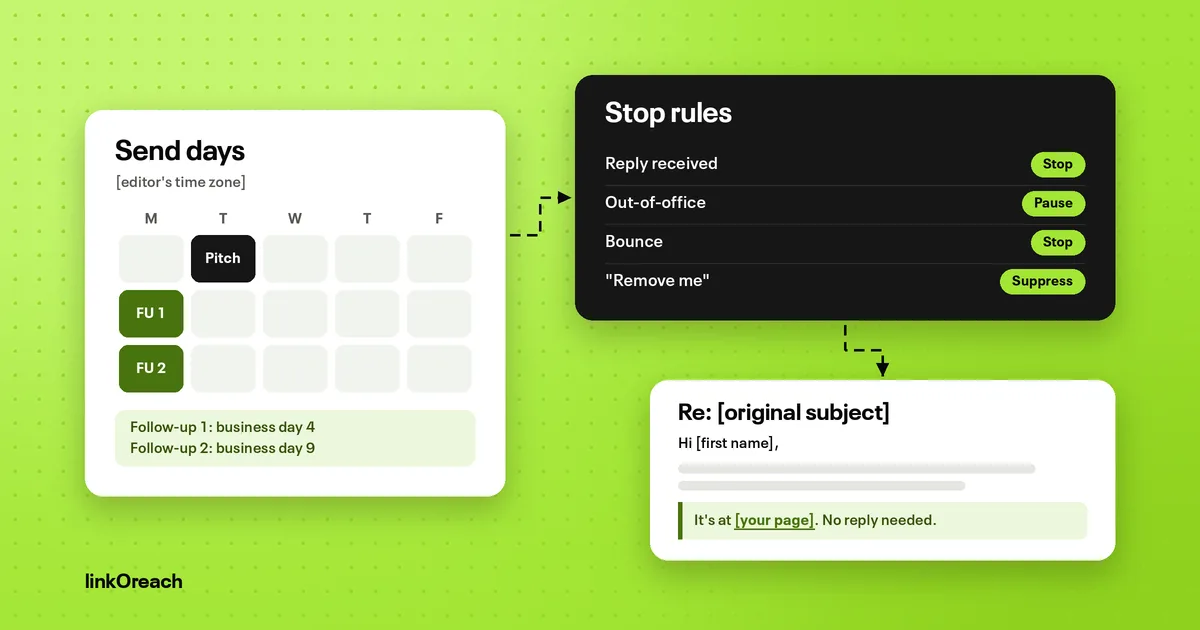
5. Follow up twice, then stop
Two follow-ups, three messages in total, is the ceiling. One-email campaigns averaged 3.3% replies and three-message sequences 6.8%, while longer sequences did worse. Each follow-up should add something new, and the sequence must stop on any reply, out-of-office included. Separate follow-up templates for each stage of a sequence cover what to send and when.
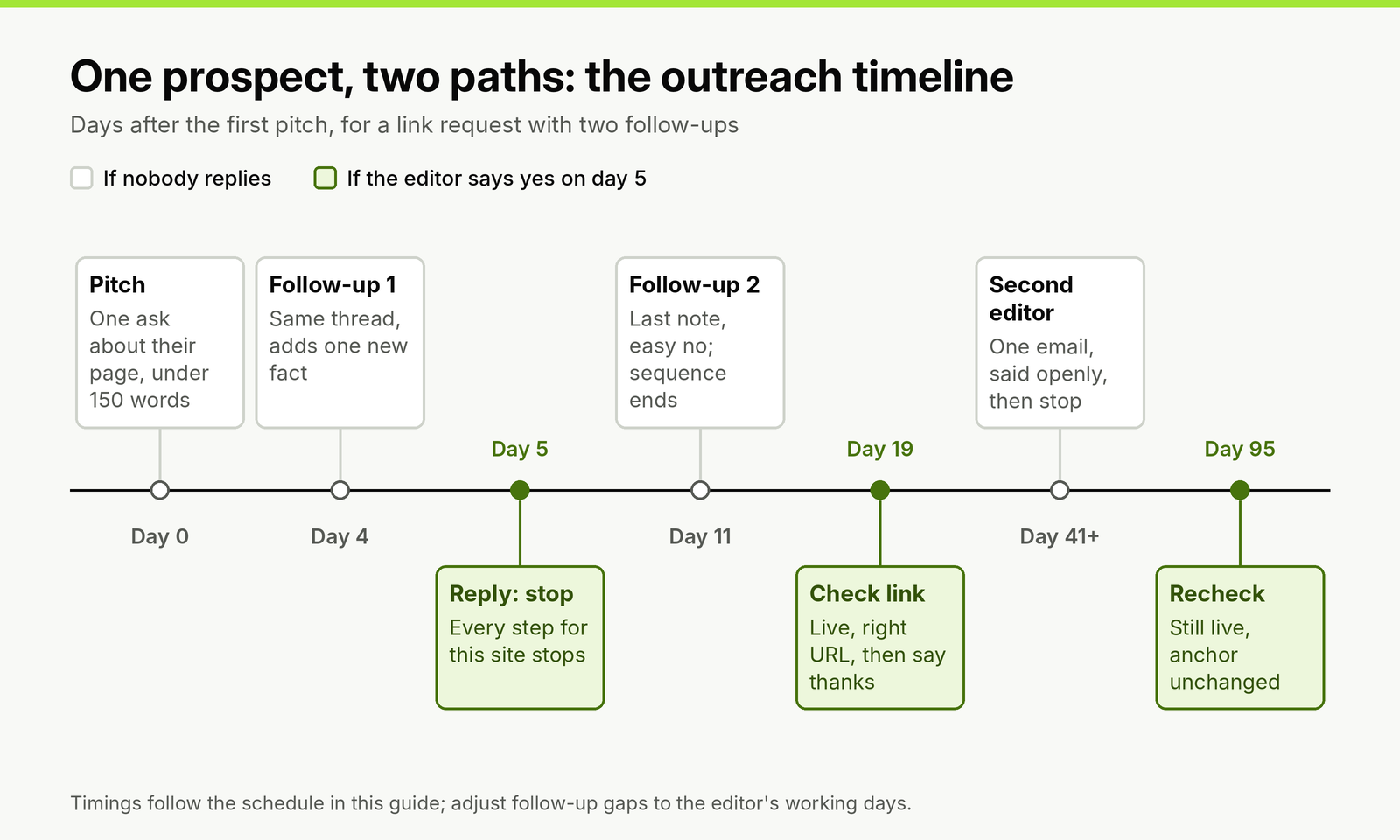
What happens to one prospect over three months, depending on whether the editor answers. A yes ends the sequence and starts the placement checks.
6. Confirm the placement and record it
A reply is not a result. Check that the link is live 14 days after a yes, on the agreed URL and anchor, and recheck it about three months later; pages get edited, and links can disappear with them. Once you manage agreed links across several clients, order tracking, client reporting and invoicing become a job of their own, which BuildLinks is built for.
Outreach marketing benchmarks to plan with
Use these figures to set expectations and to find what is dragging a campaign down. All come from the same 2025 dataset of cold email, so they describe outreach as a whole, not link requests alone.
| Factor | Weaker setup | Stronger setup | What to do |
|---|---|---|---|
| Sequence length | One email: 3.3% | Three emails: 6.8% | Pitch plus two follow-ups, no more |
| Personalization in the body | None: 3.6% | Two custom attributes: 5.6% | Reference the page and one specific detail |
| Open tracking | On: 4.4% | Off: 7.4% | Turn it off; judge campaigns on replies |
| Recipients per sequence | 500 or more: 2.4% | 21 to 50: 6.2% | Segment lists by angle, 50 at most |
| Contacts per company | Three or more: 3.5% | One or two: 5.1% | Pick the person who edits the page |
| Sending domain | Free mailbox: 2.5% | Custom domain: 5.2% | Send from a separate outreach domain you own |
| Daily volume per mailbox | All senders: 4.5% average | 20 to 49 a day: 5.7% | Add mailboxes rather than push one harder |
The average bounce rate in that data was 3.6%, which is too high for a young outreach domain; aim to stay under 2% by verifying every address. Older studies point the same direction on follow-ups: Backlinko's 2019 analysis of 12 million outreach emails found that only 8.5% received a reply, and that a follow-up lifted replies by 65.8%. All of these rates assume the pitch reaches the inbox, which comes down to the domain, DNS records and ramp-up schedule behind keeping outreach email out of spam.
Worked example: sizing a month of outreach for one client
A freelance link builder wants to run link building outreach for one SaaS client, contacting 300 qualified sites a month with a pitch and two follow-ups.
- Emails: 300 prospects times three messages is up to 900 emails, if nobody replies early. Across 22 sending days that is about 41 emails a day.
- Mailboxes: at 20 to 49 sends per mailbox per day, one mailbox can carry it, and two give room for a slow week or a bounce problem. Both sit on a separate outreach domain, never the client's main one.
- Segments: 300 prospects become six segments of 50, each with its own angle (resource pages, outdated statistics, unlinked mentions, and so on).
- Replies to expect: at the 13% average for link building outreach, about 39 replies a month. Some will be no, some will ask for a fee, and some will say yes.
- Links: the share of replies that become live links depends on your asset and your policy on paid requests. Run two campaigns, measure your own reply-to-link rate, and only then promise the client a number.
The arithmetic matters for two reasons. It tells you the workload before you take on the client, and it shows how little room a small domain has for mistakes: at 41 emails a day, a handful of spam reports or a bad list can damage the domain long before the campaign proves anything.
Two outreach pitches to copy
Replace every bracketed placeholder with details from the recipient's own page or coverage. Each starts with its subject line, and there are more subject lines for each type of link request if neither fits.
Data asset pitch to an editor or journalist
Use when you have original data that updates or adds to something the recipient has already published.
Subject: New [topic] figures for "[article title]"
Hi [first name],
I'm [your name], [role] at [company]. Your piece "[article title]" uses [figure or source they cite] for [claim].
We just published [asset name], built from [how you collected the data, in one line]. The headline finding is [one specific finding], which updates the figure in your [section] section.
If it helps, here is the page: [URL]. Happy to send the underlying data or answer method questions. If it's not a fit, no reply needed.
[Your name]
[Title, company, URL]
Partnership or podcast guest pitch
Use when the recipient runs a show, newsletter or webinar series whose audience overlaps with yours.
Subject: Episode idea for [show name]: [topic]
Hi [first name],
I listened to your episode with [guest] on [topic], especially the part about [specific point].
I run [what you do] at [company], and we [one fact that gives you something new to say]. An episode on [specific angle] could give your listeners [practical takeaway], with examples they can use the same week.
If that fits your plans, I can send three talking points. If not, thanks for reading.
[Your name]
[Title, company, URL]
Both follow the same rules: say who you are and why you are writing, make one ask, invent nothing about the recipient's work, and leave an easy no.
Rules that apply to every outreach email
Outreach marketing is regulated at two levels: the email itself and what you exchange for coverage.
- CAN-SPAM covers commercial outreach, B2B included. The CAN-SPAM rules make no exception for business-to-business email. Headers must be accurate, subject lines must not mislead, commercial messages need a valid postal address and a clear way to opt out, and opt-outs must be honored within 10 business days. Penalties reach $53,088 for each violating email.
- Paid or exchanged links fall under Google's link spam policy. Google's spam policies list buying or selling links for ranking purposes, excessive link exchanges, and links with optimized anchor text in guest posts as link spam. Paid placements are acceptable only with rel="sponsored" or rel="nofollow" on the link. None of this is risk free: decide your policy on paid requests before a campaign starts, not when an editor quotes a fee.
- Endorsements need disclosure. Under the FTC's endorsement rules for influencers, creators must disclose any financial, employment, personal or family relationship with a brand, including free or discounted products, and put the disclosure with the endorsement itself. If you send a creator or reviewer a free account, expect and welcome that disclosure.
Google's September 2026 spam update finished rolling out on October 8, after about two weeks. Google did not describe it as a link spam update, but it is a reminder that the policy is enforced in waves, and a link earned by a relevant pitch is the kind that survives them.
Measuring outreach marketing
Opens are not a useful outreach metric: tracking them lowers replies and privacy features make the numbers unreliable. Track these per campaign instead:
- Reply rate, against the 13% link building average, with positive replies counted separately.
- Placement rate: live links or coverage divided by prospects contacted. This is the number to forecast with.
- Time to live: days from first pitch to a verified live link.
- Bounce rate, under 2%, and spam complaints, which should be close to zero.
- Cost per placement: tools, data and hours divided by live links.
- Link survival: the share of placements still live, with the agreed URL and anchor, after three months.
Tools for running outreach marketing
The tool should match the type of outreach. Sales sequencers handle volume well but usually show nothing about Domain Rating, page relevance or whether a link went live. Outreach CRMs and link building platforms add prospect data and link tracking, at a higher price per seat. Influencer outreach usually needs a creator platform instead. The monthly cost of each outreach tool at 500 prospects depends on which of these types you pick.
Teams without the hours to run outreach in-house can outsource it instead. SaaS companies that would rather hand link building to a specialist agency can look at Digital Gratified, which runs SaaS SEO and link building as a service.
Running outreach marketing in linkOreach
We built linkOreach for link building outreach, and Linkzy is the AI agent inside it. Give Linkzy a brief and it builds the prospect list from Ahrefs data using your keywords, DR range, traffic floor and location, goes for the SEO lead first, then content marketing, then the CMO, checks each address before anything sends, writes a pitch for each site that you can edit first, runs follow-ups on a cadence and stops the sequence when someone replies. Replies land in a shared inbox, and each thread is tracked through to a live, indexed backlink. Campaign types cover guest posts, niche edits, listicles, blogger outreach, link exchange and unlinked brand mentions, and you can run every step manually instead. A/B testing, client reports and backlink gap analysis come with it too, and you send from your own Gmail, Outlook or SMTP mailbox.
We currently offer one plan at $49 a month, an introductory price, with 500 email credits that include finding and verification, 5,000 searches and 100,000 Ahrefs credits, and a 7-day trial with no credit card; the plan and credit top-ups are listed on our pricing page.
Pick something else if your outreach is mainly influencer campaigns on Instagram or TikTok, or sales prospecting to book meetings. A creator platform or a sales engagement tool fits those jobs better.
Conclusion
Treat outreach marketing as a channel with numbers, not a favor you ask at random. Choose one goal and one asset, define the person who can say yes, and qualify every site before it enters a list. Keep segments to 50 or fewer, contact one or two people per organization, and send a pitch about their page plus two follow-ups that stop on any reply.
Plan against a 13% reply rate for link building outreach, keep bounces under 2%, leave open tracking off, and measure placements and link survival rather than opens. Follow CAN-SPAM on every commercial email, mark paid links as sponsored, and expect creators to disclose anything you give them.
If you want prospecting, pitches, follow-ups and live link tracking in one place, start a free 7-day linkOreach trial and launch your first campaign this week.
Frequently Asked Questions
What is outreach marketing?
Outreach marketing is contacting specific people who already have an audience, such as editors, journalists, bloggers, podcast hosts and partner companies, one at a time, and asking each for one concrete thing: a link, a mention, a quote, a guest spot or a collaboration. Unlike inbound marketing, you choose the person first and write to them about their own work.
What are examples of outreach marketing?
Common examples are asking an editor to add a link to an existing article, pitching a guest post, sending original data to journalists for coverage, asking a reviewer to include your product in a "best [category]" list, briefing creators on a product, and pitching a podcast guest spot or a co-marketing webinar.
What is a good reply rate for outreach marketing?
Across 31 million cold emails sent in 2025, digital PR and SEO link building outreach averaged a 13% reply rate, against 4.5% for all cold email and 3% for sales outreach. Small segments of 21 to 50 recipients, two follow-ups and open tracking switched off all pushed reply rates up in the same data.
Is outreach marketing the same as cold email?
Cold email is one channel for it, and the main one for link building and digital PR. The difference is the ask: sales cold email asks the recipient to buy, while outreach marketing asks someone with an audience to cover, link to or feature something that helps that audience.
Does CAN-SPAM apply to outreach emails?
It applies to commercial email, and the FTC says the law makes no exception for business-to-business messages. Use accurate headers and subject lines, include a valid postal address and a clear way to opt out, and honor opt-outs within 10 business days. Penalties reach $53,088 for each violating email.
How do you measure outreach marketing?
Track reply rate, placement rate (live links or coverage divided by prospects contacted), days from first pitch to a live link, bounce rate under 2%, cost per placement and the share of links still live after three months. Leave open rates out: tracking them lowers replies.