Email Outreach Strategy for Link Building: A 6-Part Plan
An email outreach strategy for link building is a written plan with six decisions in it: how many live links you need, which pages you will pitch, who you contact at each site, what you ask each group for, how much you send from each mailbox, and which numbers you review every week. Get those right and the templates almost write themselves; skip them and no subject line will rescue a campaign sent to the wrong list.
Most guides to email outreach strategy are written for sales teams booking meetings, and their advice (long cadences, big lists, multichannel touches) works against link builders. An editor deciding whether to change their own page behaves differently from a buyer evaluating software. This guide works through each decision for link requests specifically, with the capacity math to size a campaign, a segment plan you can copy, the sending settings that moved reply rates in 2025 data, and a weekly review routine. Each campaign then runs on the full link building outreach process, step by step.
What an email outreach strategy covers
Tactics are the pieces you can copy: a template, a subject line, a follow-up interval. Strategy is the set of choices that decides which tactics fit. Two agencies can use the same pitch template and get very different results because one sent it to 50 editors whose articles cite an outdated figure and the other sent it to 450 sites that rank for a keyword.
For link building, the strategy has to answer six questions before anything is sent:
- Goal: how many live links, to which pages, by when.
- Segments: which groups of prospect pages you will pitch, and why each group has a reason to link.
- Contacts: who at each site can say yes, and how many people per site you will email.
- Asks: one specific request per segment, tied to the campaign type.
- Capacity: sequence length, list size per sequence, daily sends per mailbox and the domain you send from.
- Review: the numbers you check weekly and the rule for stopping or changing a segment.
The rest of this guide takes them in that order. If you are still deciding where link building sits among your other outreach channels, start with how link building fits into outreach marketing as a whole, then come back here to plan the email side.
Set the goal in live links, then work backward
A goal of "send more outreach" cannot be planned against. A goal of "10 live links a month to the pricing comparison page and two guides" can, because you can work back from it to the number of prospects, emails and mailboxes it takes.
You need three rates, ideally from your own past campaigns: the share of prospects who reply, the share of replies that are positive (a yes or a conditional yes), and the share of positive replies that turn into a live link. Multiply them and you get live links per prospect. Divide your goal by that and you get the prospects you need.
If you have no history, plan below the published averages rather than at them. In Hunter's State of Email Outreach 2026, built on 31 million emails sent by its users in 2025, digital PR and SEO link building sequences averaged a 13% response rate, against 3% for sales outreach. That 13% is an average across every kind of link campaign, good and bad, so treat it as a ceiling for a first plan.
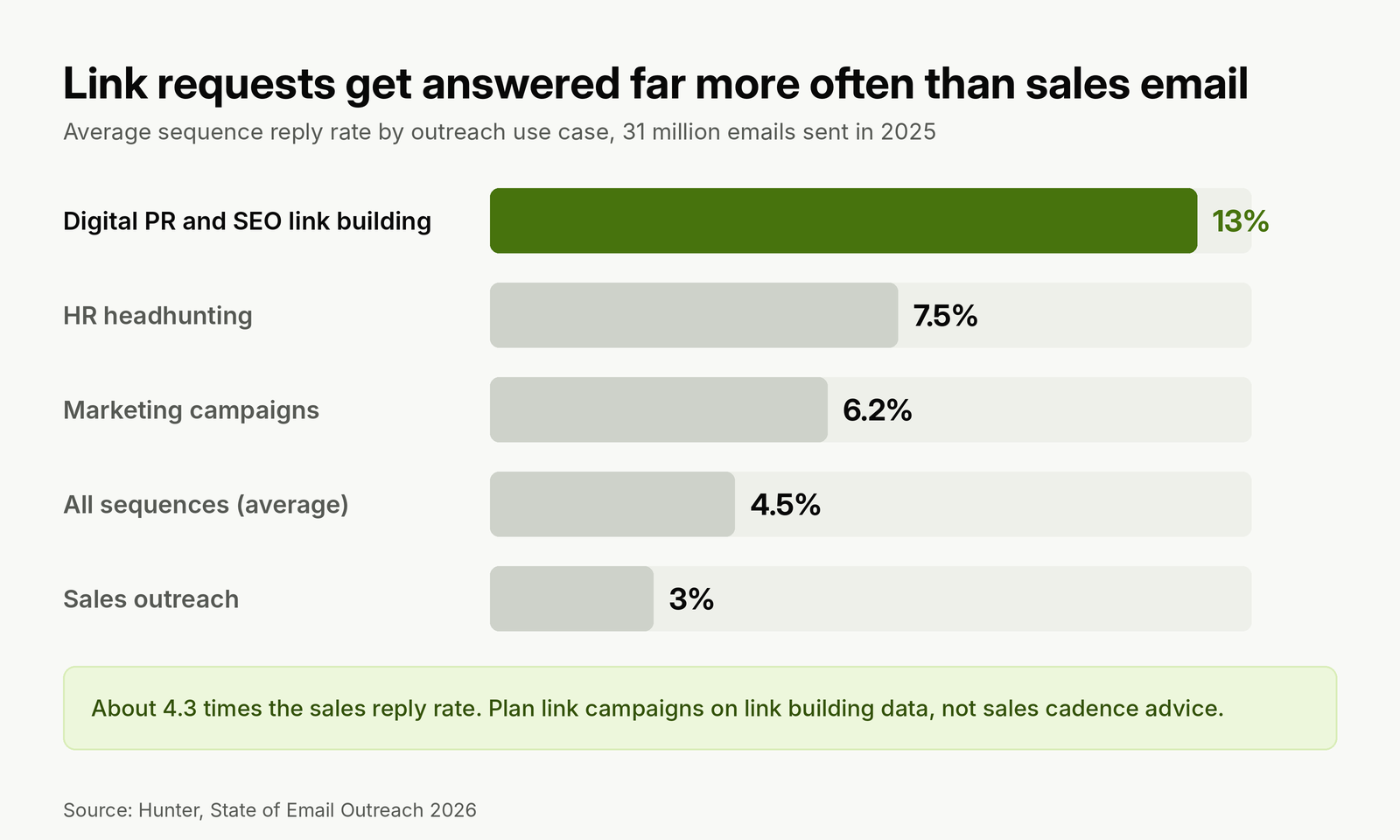
Link requests answer at roughly four times the rate of sales sequences, which is why sales cadence advice overshoots for link builders. Source: Hunter, State of Email Outreach 2026.
Worked example: 10 live links a month
Here is the math for one client, using planning assumptions you should replace with your own numbers as soon as you have them.
- Reply rate: plan at 10%, below the 13% average.
- Positive share of replies: assume 40%. The rest are declines, referrals and "not now".
- Positive replies that go live: assume 60%, since some editors agree and never publish, and some ask for changes you will not make.
- Live links per prospect: 10% x 40% x 60% = 2.4%.
- Prospects needed: 10 links / 2.4% = about 420 new prospects a month.
- Daily new prospects: 420 over 20 business days = 21 a day.
- Daily sends at full run: with a pitch and two follow-ups, up to about 63 emails a day once all three steps are running, slightly fewer as replies stop sequences.
Two things fall out of the math. First, the prospect list is the constraint, not the copy: 420 qualified pages a month for one client is real research work, and it is the number to agree with a client before promising a link count. Second, a single mailbox can carry it. Accounts sending 20 to 49 emails a day averaged 5.7% replies against a 4.5% overall average, reply rates held at 50 to 99 a day, and open rates were highest below 100 a day per account. At 63 sends a day you are inside that range; at three clients you need three domains, which you want anyway so a complaint on one client's campaign stays on that client's domain.
Segment prospects before you write anything
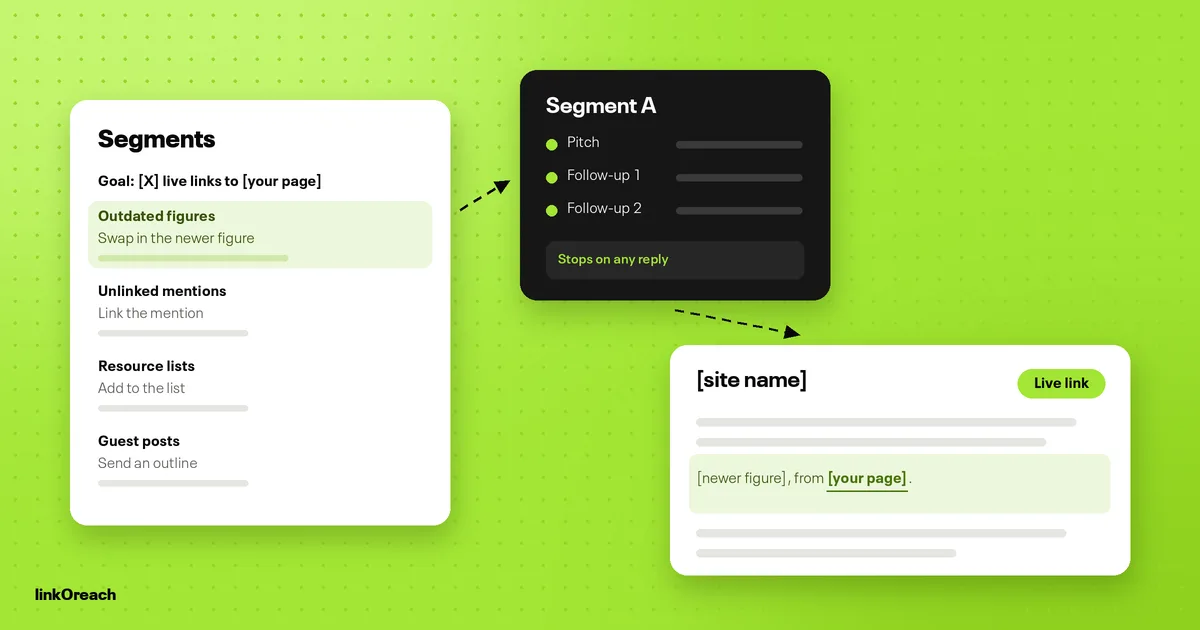
A segment is a group of prospect pages that share one reason to link to you. The reason decides the campaign type, the ask and what the first email must prove. Building segments first is what lets you write one strong pitch per group instead of one weak pitch for everyone.
| Segment | How you find it | The ask | The first email must include |
|---|---|---|---|
| Articles citing an outdated figure you have updated | Search for the old figure in quotes; check pages linking to the old source | Niche edit: swap or add the newer figure with a link | The exact sentence, the old figure and the new one |
| Unlinked mentions of your brand or data | Brand alerts; search your brand name minus your own domain | Turn the mention into a link | The sentence that mentions you and the page it should point to |
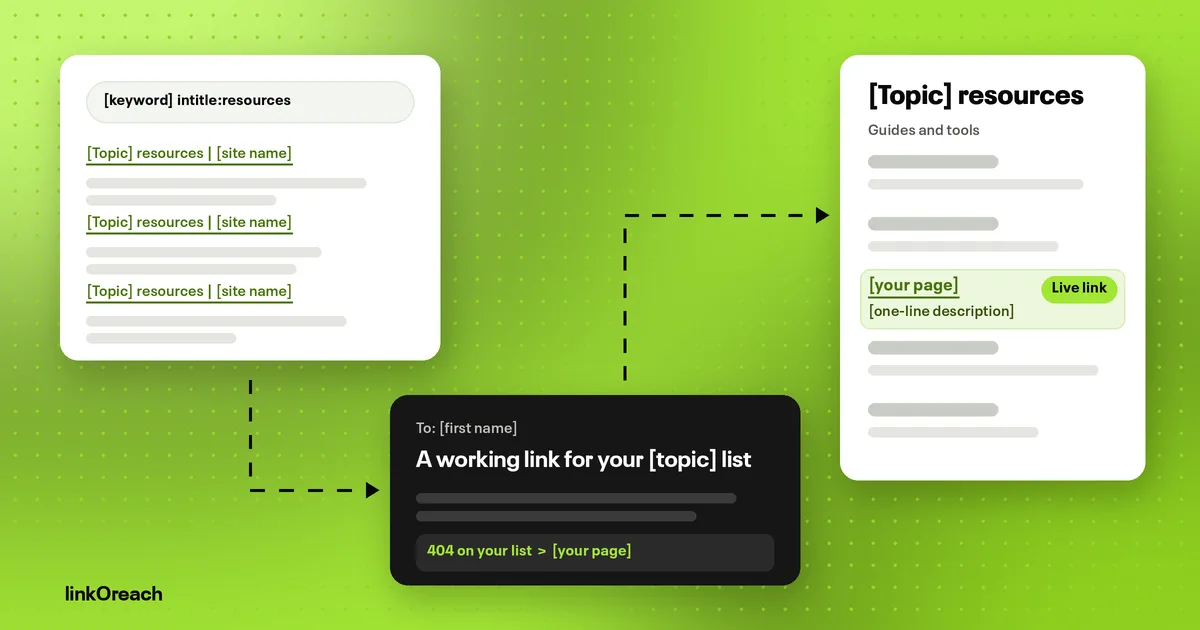
| Resource and link lists in your topic | Searches such as "[topic] resources" or "useful [topic] links" | Add your page to the list | A one-line description in their format; a dead link on the list if you found one |
| "Best [category]" listicles | Search "best [category]" and "[competitor] alternatives" | Inclusion in the list | Public pricing and one line on how you differ from a tool already listed |
| Blogs that accept contributors on your topic | Pages with "write for us" or bylines from outside writers | Guest post with a contextual link | Two or three titles matched to their recent posts |
| Sites linking to two or more competitors but not you | A backlink gap report on up to five competitors | Depends on the linking page; assign it to one of the segments above | Whatever that page's segment requires |
Keep each segment small enough that one pitch fits every page in it. If you find yourself writing "or" in the ask, split the segment. The last row is a source of prospects, not a segment of its own: a competitor's backlink can be a listicle, a resource page or a guest post, and each needs its own pitch.
Segments also tell you where to spend personalization time. Some asks are high value and cost the editor almost nothing; others need a draft, an outline or a pricing conversation. The matrix below is how we decide which segments get a hand-written first line for every prospect and which get a template with one custom detail.
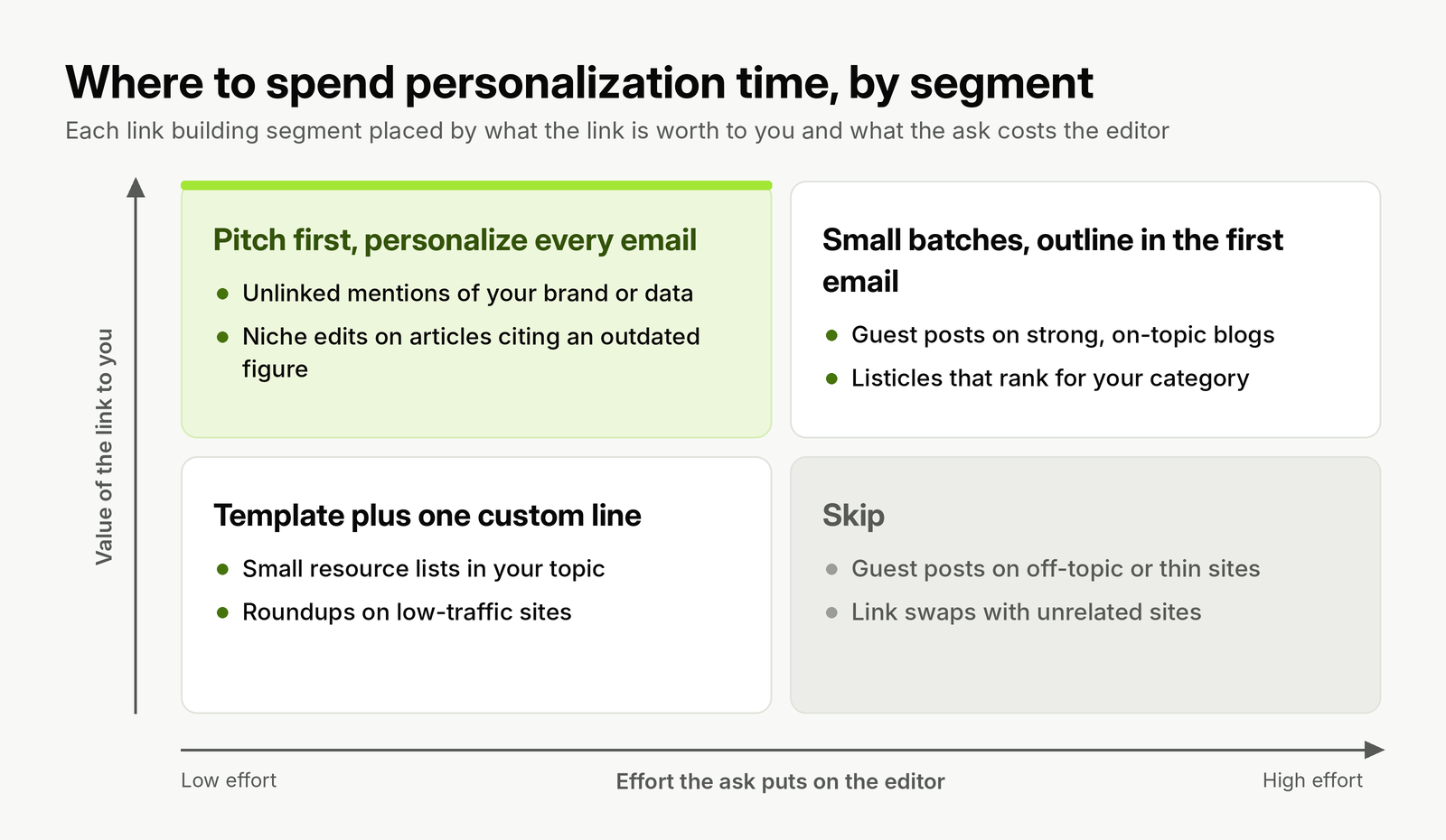
Start each month in the top left quadrant: the links are worth most and the editor has the least work to do. Skip the bottom right entirely.
Choose who to contact at each site
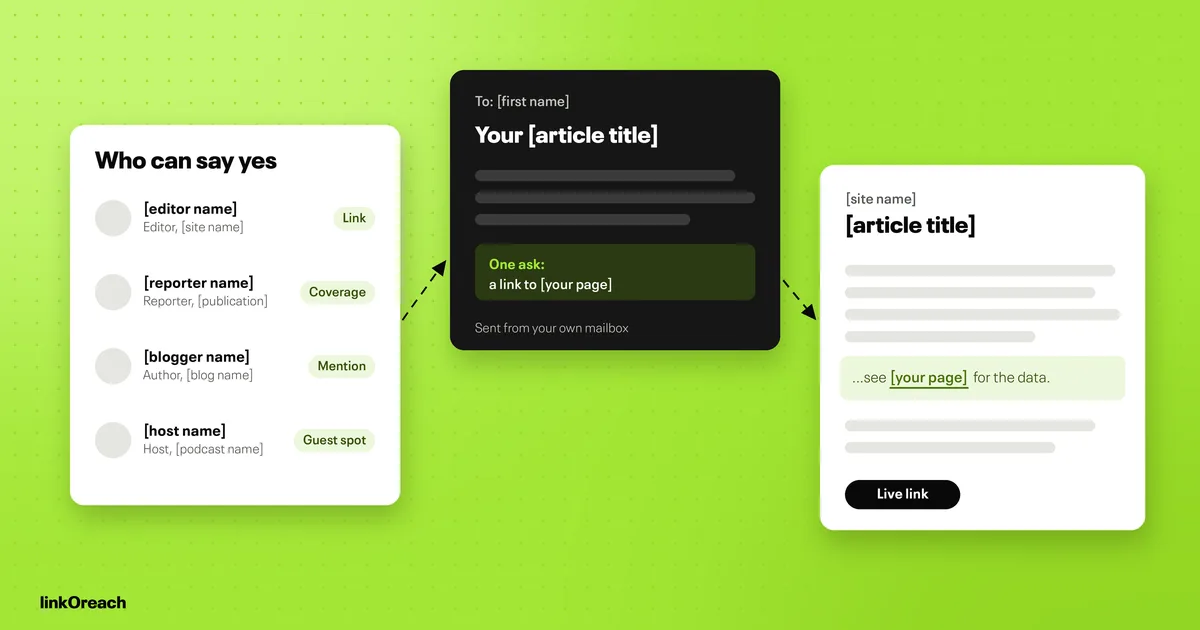
The right contact is the person who can edit the page: the named author for a recent article, the site's editor or content lead for an older one, and the owner for a small site with no team. A generic info@ address reaches someone who usually cannot say yes and forwards nothing.
How many people per site is where older and newer data disagree. Backlinko's study of 12 million outreach emails, published in 2019, found messages sent to several contacts at a site got a 93% higher response rate, with diminishing returns at five or more. The 2025 data points the other way: sequences that contacted one or two people per company averaged 5.1% replies against 3.5% for three or more.
For link requests, the practical answer is one person at a time and never more than two. Email the best contact first. If the full sequence ends without a reply, a second contact at the same site can get one new email 30 days or more later. Emailing three people at a small blog the same morning reads as pressure, and when two of them compare notes, the request dies.
Write one ask per segment
Each segment gets one request that the editor can judge in under a minute. A pitch that offers a guest post, a link swap and a social share in one email gives the editor three decisions and an easy reason to make none. Pick the campaign type the segment table assigns, write the ask as one sentence, and build the email around it.
Here is the first email for the outdated-figure segment, the one we start most months with:
Subject: Newer figure for "[article title]"
Hi [first name],
I'm [your name], and I run research at [your company]. Your article "[article title]" cites [old figure] from [old source and year] in the section on [section heading].
We published updated numbers on [date]: [new figure], from [sample and method in one line]. The full method is at [URL].
Would you be open to swapping in the newer figure? A sentence that would fit: "[new figure], according to [your page title]." Change it however suits the article.
[Your name]
[Title, company, URL]
It says who is writing and why, names the exact place on their page, gives the editor a sentence to paste, and makes one ask. Every other segment follows the same pattern with its own proof point, and the subject lines matched to each segment's ask give you starting points for the line above it.
Personalization pays when it is evidence that you read the page. Emails with two personalized fields in the body averaged 5.6% replies against 3.6% with none, and emails a person edited before sending beat fully automated ones, 5.2% against 4.4%. A first name and a site name are fields; the sentence you want changed is evidence.
Set sequence length and sending capacity
Capacity decisions are made once per campaign and decide whether the rest of the strategy reaches an inbox. The 2025 figures below come from the same report, so they share one dataset and one method.
| Decision | Setting we plan with | Reply rate at that setting | Reply rate at the alternative |
|---|---|---|---|
| Recipients per sequence | 21 to 50 | 6.2% | 2.4% at 500 or more |
| Emails per account per day | 20 to 49 | 5.7% | 4.5% average across all volumes |
| Sending domain | Custom business domain | 5.2% | 2.5% from a free email address |
| Messages per person | Three (pitch plus two follow-ups) | 6.8% | 3.3% for a single email |
| Open tracking | Off | 7.4% | 4.4% with tracking on |
| Contacts per company | One to two | 5.1% | 3.5% at three or more |
None of these rows proves cause on its own. Small sequences are usually better targeted, and senders who turn tracking off may be more careful in other ways too. Taken together, though, they describe one approach: small, well-defined segments sent from a real domain at a modest daily pace, three messages at most. That is the opposite of the 500-recipient, seven-touch campaign many sales guides recommend.
The recipients-per-sequence row is where segmentation shows up in the numbers. The average sequence held 449 recipients. Splitting the same prospects into segment-sized sequences gives each one a pitch written for its pages.
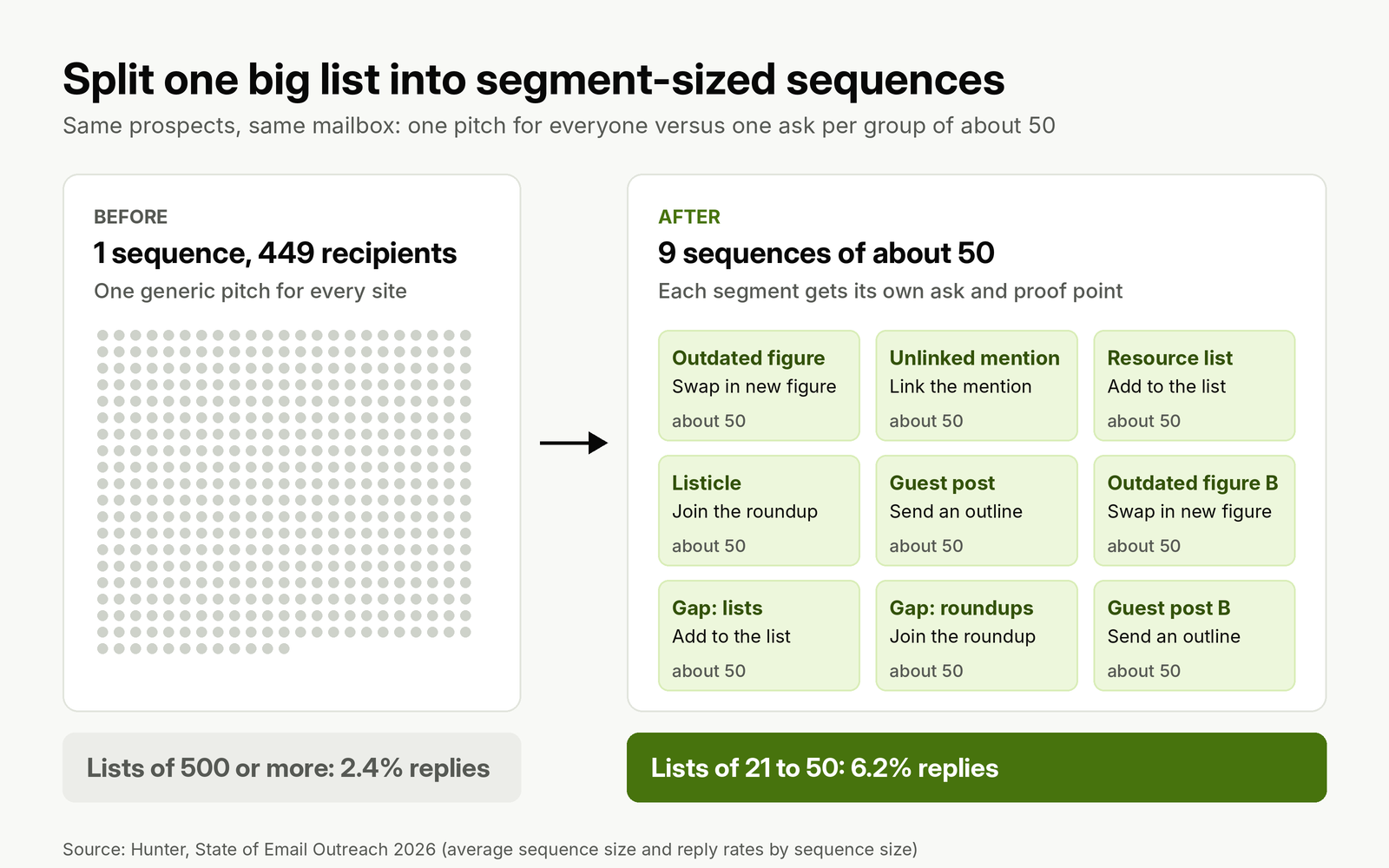
Same prospects, same mailbox. The split costs an afternoon of sorting and gives every sequence an ask that fits. Source for list sizes and reply rates: Hunter, State of Email Outreach 2026.
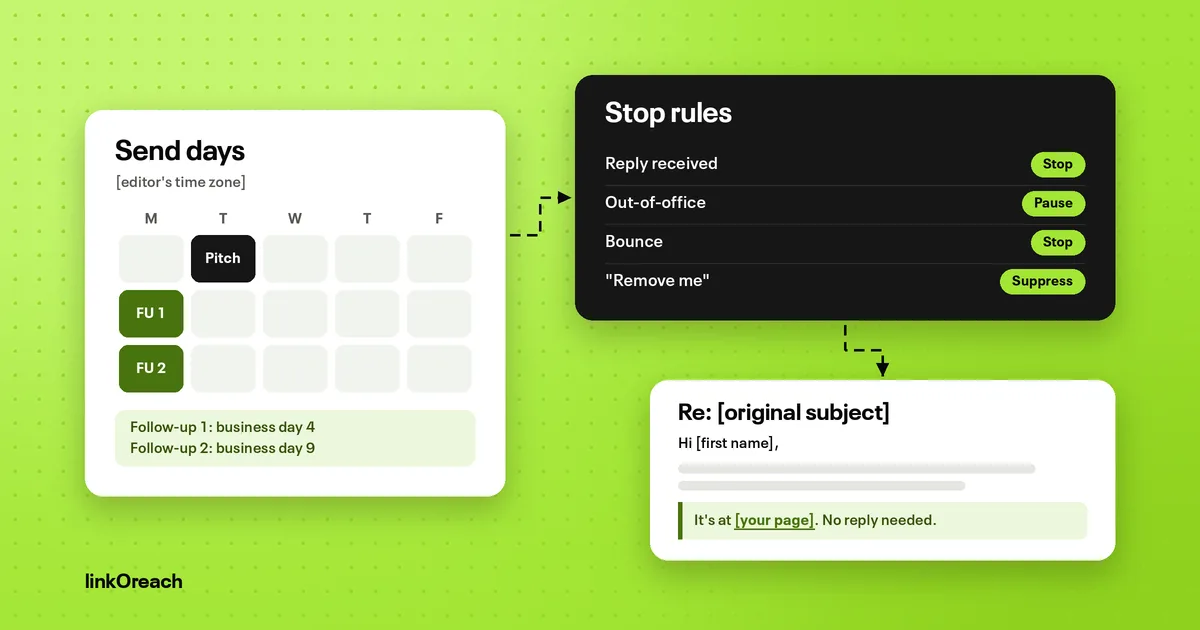
Two more capacity rules protect the domain. Set your daily cap on total sends, follow-ups included, not on new pitches. And keep complaints far below the line: Google's email sender guidelines require every sender to keep the spam rate in Postmaster Tools below 0.3% and recommend staying under 0.1%. At 60 sends a day, one complaint is 1.7% of that day's mail, far above either line. Space the follow-ups themselves by the rules for when to send each follow-up and when to stop.
Measure and review every week
Review by segment, not by campaign total. A campaign averaging 8% replies can hide one segment at 15% and another at 2%, and the fix for each is different. Track these per segment every week:
- Reply rate from people, excluding auto-replies.
- Positive reply rate: yes or conditional yes, as a share of prospects contacted.
- Live links and the days from first email to link.
- Bounce rate. The 2025 average across all sequences was 3.6%; anything above that points to an unverified list or old contacts.
- Unsubscribe and complaint signals. Any "remove me" goes on a suppression list across every client.
- Cost per live link: hours of research and writing plus tool cost, divided by links that went live.
Give a segment one full sequence of about 50 prospects before judging it. If it lands no positive replies, change one thing (the ask, the proof point or the contact role) and run another 50. Two dry rounds in a row means the segment has no reason to link, so drop it and move the effort to the segment that is working. Change one variable at a time, or you will not know which change worked.
When replies fall across every segment at once, the cause is usually deliverability, not strategy. Run the free checks for spam rate, blocklists and authentication before rewriting any pitch.
Keep the strategy inside Google's link policies
An outreach plan is also a risk plan. Google's spam policies list excessive link exchanges ("link to me and I'll link to you"), exchanging money, goods or services for links, and links with optimized anchor text in guest posts as link spam. Paid placements are acceptable only when the link carries rel="sponsored" or rel="nofollow".
In practice, that shapes three parts of the strategy. Keep link exchange segments small and limited to pages where the link helps the reader, never as a standing swap arrangement. Do not ask guest post hosts for exact-match anchors; let the editor choose the wording. And if a segment turns into paid placements, budget for them as sponsored links, not as editorial ones.
Running an outreach strategy in linkOreach
We built linkOreach for link building outreach, and Linkzy is the AI agent inside it. You brief Linkzy on your product once, set keywords, a DR range, a traffic floor and a location, and it builds the prospect list from Ahrefs data. At each site it goes for the SEO lead first, then content marketing, then the CMO, and checks each address for deliverability before anything goes out. Linkzy writes a pitch for each site, runs follow-ups on a cadence that stops the moment someone replies, and keeps daily volume under built-in sending limits. You send from your own Gmail, Outlook or SMTP mailbox, can A/B test two pitches, and can pull prospects from a backlink gap analysis of up to five competitors. Our campaign setup, contact selection and per-campaign reports cover each decision in this guide, and every step can also be run by hand.
We currently offer one plan at $49 a month, an introductory price, with 500 email credits, 5,000 searches and 100,000 Ahrefs credits, and a 7-day trial with no credit card; extra credits are on our current plan and credit top-ups page.
Pick a different tool if your outreach books sales meetings or runs across LinkedIn and phone as well as email. A sales engagement platform built for long multichannel cadences suits that job better.
Conclusion
Write the strategy before the first email. Set a goal in live links, work back to prospects with your own reply, positive and live rates (planning below the 13% link building average if you have no history), and agree that prospect number before promising a link count. Split prospects into segments of about 50 that share one reason to link, start with unlinked mentions and outdated figures, and give each segment one ask.
Send three messages at most, from a custom domain, at 20 to 60 sends a day per mailbox, with open tracking off and one contact per site at a time. Review by segment weekly, change one variable per round, and keep complaints under 0.1%.
If you want prospecting, verification, pitches and stop-on-reply follow-ups in one place, start a free 7-day linkOreach trial and run your first segment from your own mailbox.
Frequently Asked Questions
What is an email outreach strategy?
A written plan for a campaign before any email goes out. For link building it covers six decisions: the goal in live links, the segments of prospect pages you will pitch, who you contact at each site, one ask per segment, sending capacity (sequence length, list size and daily sends per mailbox), and the numbers you review each week.
What is a good reply rate for link building outreach?
In Hunter's data on 31 million emails sent in 2025, digital PR and SEO link building sequences averaged a 13% response rate, against 3% for sales outreach and 4.5% across all sequences. Treat 13% as a ceiling for a first plan and replace it with your own campaign history as soon as you have it.
How many prospects do I need for 10 links a month?
Multiply your reply rate, the share of replies that are positive and the share of positive replies that go live, then divide 10 by the result. At a 10% reply rate, 40% positive and 60% going live, each prospect yields 2.4% of a link, so you need about 420 new prospects a month.
How many outreach emails should I send per day?
Keep each mailbox at about 20 to 60 emails a day, follow-ups included. In 2025 data, accounts sending 20 to 49 a day averaged 5.7% replies against a 4.5% overall average, reply rates held at 50 to 99, and open rates were highest below 100 a day per account.
Should I email more than one person at the same site?
One at a time, and never more than two. Recent data shows sequences contacting one or two people per company replied at 5.1% against 3.5% for three or more. Email the best contact first, and contact a second person only after the first sequence ends, 30 days or more later.