Blogger Outreach Email Templates: 10 Pitches to Copy
A blogger outreach email template that works does four things in under 150 words: it names one post on the blogger's site, says who you are, makes one small ask, and gives the blogger something their readers will use. Below are 10 blogger outreach email templates for link building, each with a subject line and a note on when to send it, plus the rules that change the email when a free product or a fee is involved.
Bloggers are a different audience from editors at large publications. Most run the site themselves, write most of it, and get pitched by brands every week, often by people who want free work or a link for nothing. That changes what the first email has to prove. The templates here are written for a full link building outreach campaign, from prospect list to live link, and assume you have already found bloggers who write about your topic.
What a blogger outreach email has to get right
A blogger reads your email as the owner of the site. They decide alone, they know every post on it, and they can tell within two lines whether you have read any of them. Five rules hold across every template below:
- Name one post. The title of a specific post, and one detail from it that shows you read it. "I love your blog" is not personalization; "your post on [topic] stops at [point]" is.
- Say who you are in one line. Your name, your role and the site you work for. Bloggers check, and an email with no clear sender reads as a link seller.
- Make one ask. A guest post, an addition to one post, or a review. Never a guest post, a link swap and a social share in the same message.
- Leave the link to them. In the first email, describe the content and let the blogger decide on links. Asking for a specific anchor up front is the fastest way to a "how much are you paying?" reply.
- Keep it short enough to answer on a phone. The first emails below run 70 to 110 words before the signature, and the follow-ups under 50.
The last rule has some data behind it. In Hunter's State of Email Outreach 2026, built on 31 million emails sent by its users in 2025, emails of 61 to 80 words got comparatively high reply rates, and so did emails of 181 to 200 words. Length matters less than whether every sentence is about the reader. For a blogger pitch, that usually lands near the shorter band: one line on their post, one on you, two or three on the idea, one ask.
Reply rates for link requests, and what moves them
Link building outreach gets answered more often than most cold email, which is why blogger templates should be calmer and shorter than sales templates. The same report breaks reply rates down by use case:
| Outreach use case | Average reply rate, 2025 | What it means for a blogger pitch |
|---|---|---|
| Digital PR and SEO link building | 13% | Bloggers answer link requests far more often than buyers answer sales emails; no need for pressure |
| HR headhunting | 7.5% | Personal, one-to-one asks still beat broadcast mail |
| Marketing campaigns | 6.2% | Generic "collaboration" emails sit closer to this line |
| All sequences | 4.5% | The baseline: 45 replies for every 1,000 recipients |
| Sales outreach | 3% | A pitch that reads like a sales email gets sales email results |
That 13% is an average across good and bad link campaigns. Your own numbers depend far more on how the email is written and sent. Four settings moved reply rates the most in the same dataset, and each one is built into the templates below: two personalized details instead of none, a person editing the final copy, a pitch plus two follow-ups instead of a single email, and open tracking switched off.
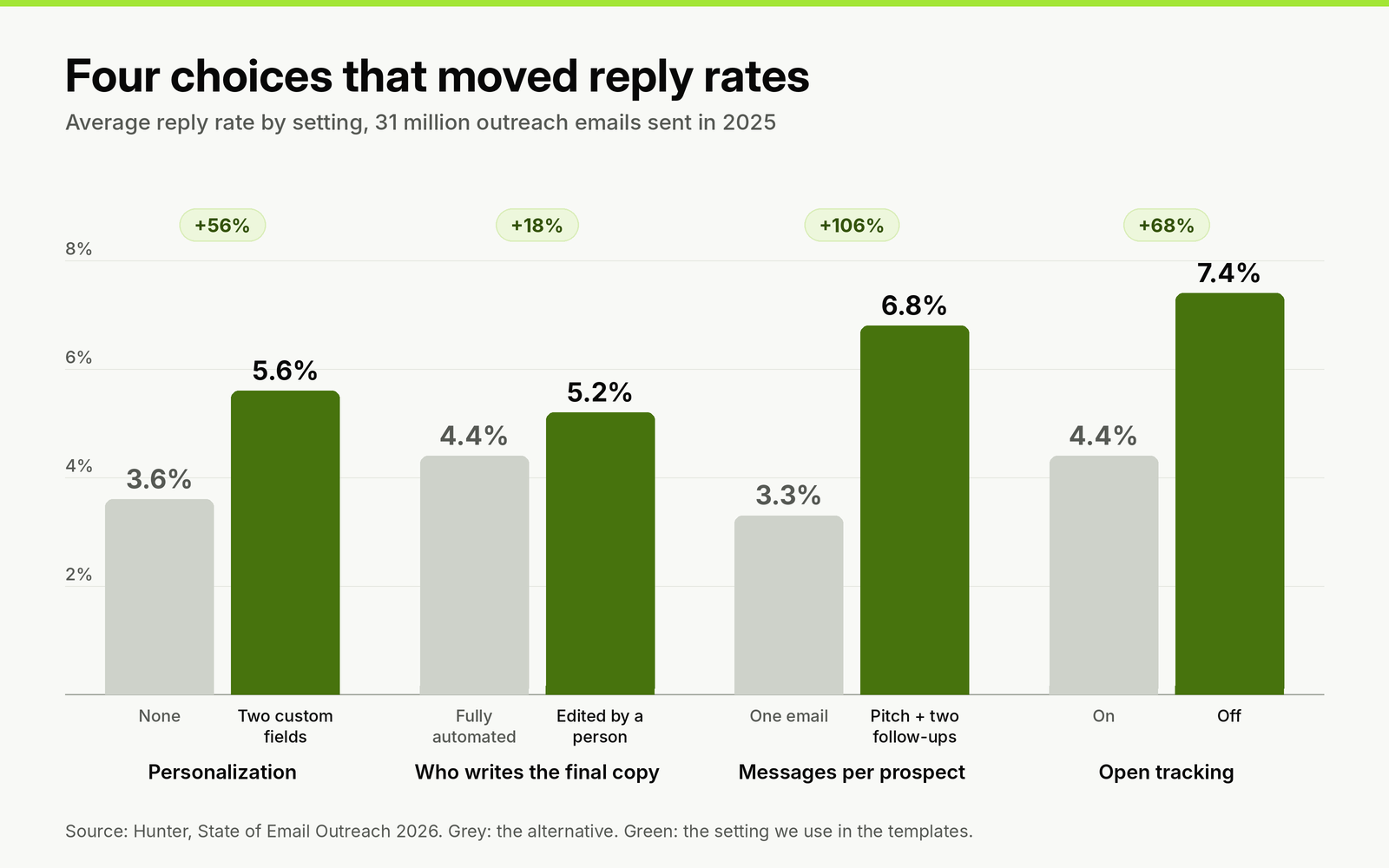
Follow-ups made the biggest difference: three messages more than doubled replies against one. Source: Hunter, State of Email Outreach 2026.
None of these rows proves cause on its own; careful senders tend to make several good choices at once. Taken together they describe the approach these templates use: a short email a person has checked, about one post, sent from a real domain without tracking pixels, followed up twice.
10 blogger outreach email templates for link building
Replace every bracketed placeholder with something specific to the blogger before you send. A template with an unfilled or vague placeholder ("I loved your recent post") is worse than no template. Each one below starts with when to use it.
1. Guest post pitch to a blogger
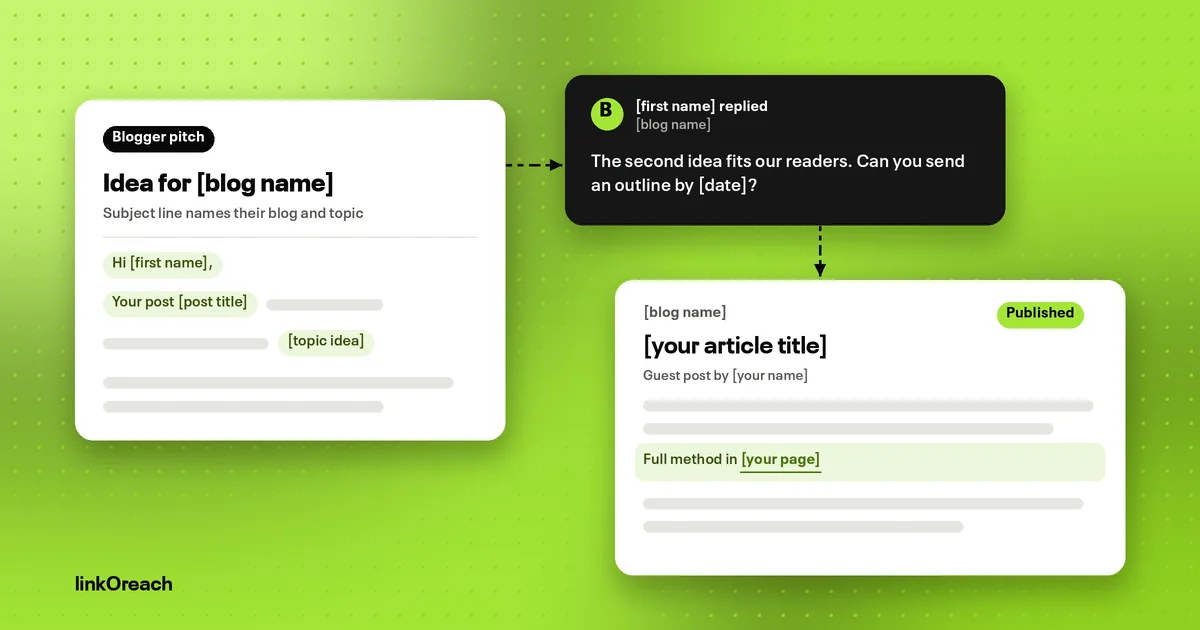
Use it when the blog publishes outside contributors (bylines from other writers, or a contributor page) and you can offer two topics that fit their recent posts.
Subject: Two post ideas for [blog name]
Hi [first name],
I'm [your name], [your role] at [company]. Your post "[recent post title]" covered [topic A] and stopped at [specific point]; a few of your readers asked about [related question] in the comments.
Two ideas that would pick up from there:
1. [Working title one]: [one line on what it covers and the example or data it uses]
2. [Working title two]: [one line on what it covers]
I write for [one or two places you have published], and I can send an outline for whichever fits before writing anything. Would either work for [blog name]?
[Your name]
[Title, company, URL]
Two titles give the blogger a choice without making them do the work. Leave links out of the pitch; agree them with the blogger once they like a topic, and follow their contributor guidelines on author bios.
2. Add your resource to an existing post
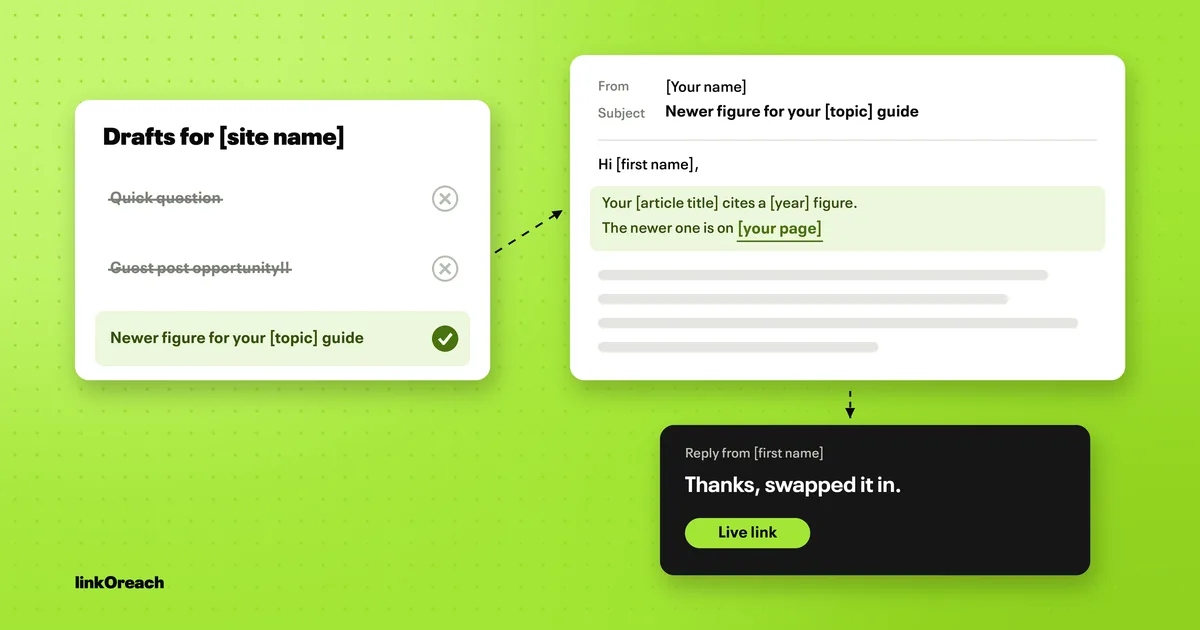
Use it when a post on the blog would be better with your page cited in one specific section: a missing example, a stale figure or a step your page explains in more depth.
Subject: An example for your [topic] post
Hi [first name],
I'm [your name] from [company]. In "[post title]", the section on [section heading] explains [point] but has no worked example.
We published one on [date]: [your page title], which walks through [what it shows] with [type of data or screenshots]. A sentence that could fit there: "[suggested sentence that mentions your page]."
Use it, change it or skip it, whatever suits the post.
[Your name]
[Title, company, URL]
3. Inclusion in a blogger's "best of" list
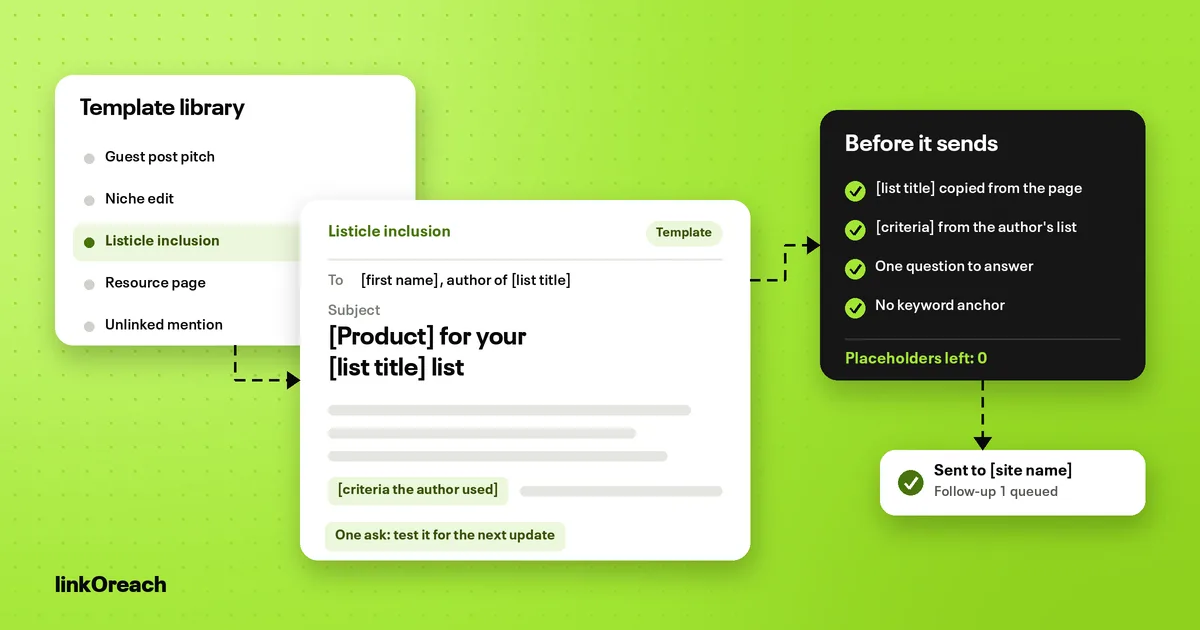
Use it for listicles such as "best [category] tools" or "[number] [category] resources" where your product or resource fits the criteria the blogger already uses.
Subject: [Product] for your [list title]
Hi [first name],
I'm [your name], [role] at [product]. Your list "[list title]" compares tools on [criteria the blogger uses, for example price and setup time], which is why I'm writing.
[Product] is a [one-line description]. On your criteria: [price fact from your pricing page], [setup fact], and it differs from [tool already on the list] in [one honest difference].
If it fits, I can send a free account so you can test it before deciding. If it doesn't, no reply needed.
[Your name]
[Title, company, URL]
Matching the blogger's own criteria is the personalization that counts here. Offering access to test is fine; offering anything in return for the placement is not (see the rules section below).
4. Product review offer, with no strings
Use it when the blogger reviews products in your category and you want them to try yours. The email offers access and asks for nothing specific in return.
Subject: Free [product] access for [blog name]
Hi [first name],
I'm [your name] at [company]. You reviewed [competitor or similar product] in "[post title]" and said [specific point they made, for example that setup took too long].
We built [product] around that problem: [one line on how]. I'd like to give you a free [plan or sample] to try for as long as you need.
There's no obligation to review it, rate it well or link to us. If you do write about it, the free access is something your readers may need to know about.
[Your name]
[Title, company, URL]
5. Expert quote for a post they are writing
Use it when the blogger has asked for expert input (on social media, in a newsletter or on a request service) or publishes regular roundups with outside quotes.
Subject: Quote for your [topic] roundup
Hi [first name],
You asked for input on [question] for your next roundup. I'm [your name], [role] at [company], and I've [relevant experience in one line].
Here's my answer in [number] words, ready to paste:
"[Quote of 60 to 100 words with one specific number, example or method.]"
Edit it however you need. If you want a headshot or a second angle, I can send either today.
[Your name]
[Title, company, URL]
6. Thanks for the mention, plus a link request
Use it when a blog post already mentions your brand, product or data without linking to it. The blogger has already chosen to cite you, so keep it short.
Subject: Thanks for mentioning [brand] in [post title]
Hi [first name],
I'm [your name] at [brand]. Thanks for including us in "[post title]"; the point about [what they said] is one we hear from customers too.
Readers who want to check [the claim or feature mentioned] may find [page title] useful, at [URL]. If you'd like to link the mention to it, that's the page I'd point to.
Either way, thank you for the mention.
[Your name]
[Title, company, URL]
7. Sponsored post inquiry, labeled from the first email
Use it only when you intend to pay for a post. Say so plainly, and say how the post and link will be marked, so nothing about the deal is hidden from the blogger or their readers.
Subject: Sponsored post inquiry for [blog name]
Hi [first name],
I'm [your name] at [company]. We'd like to sponsor a post on [blog name] about [topic], aimed at your readers who [reader need].
To be clear on terms: this would be a paid post, labeled as sponsored on the page, with any link to us marked rel="sponsored". You keep editorial control and can turn down anything that doesn't fit your readers.
Do you take sponsored posts, and if so, what are your rates and guidelines?
[Your name]
[Title, company, URL]
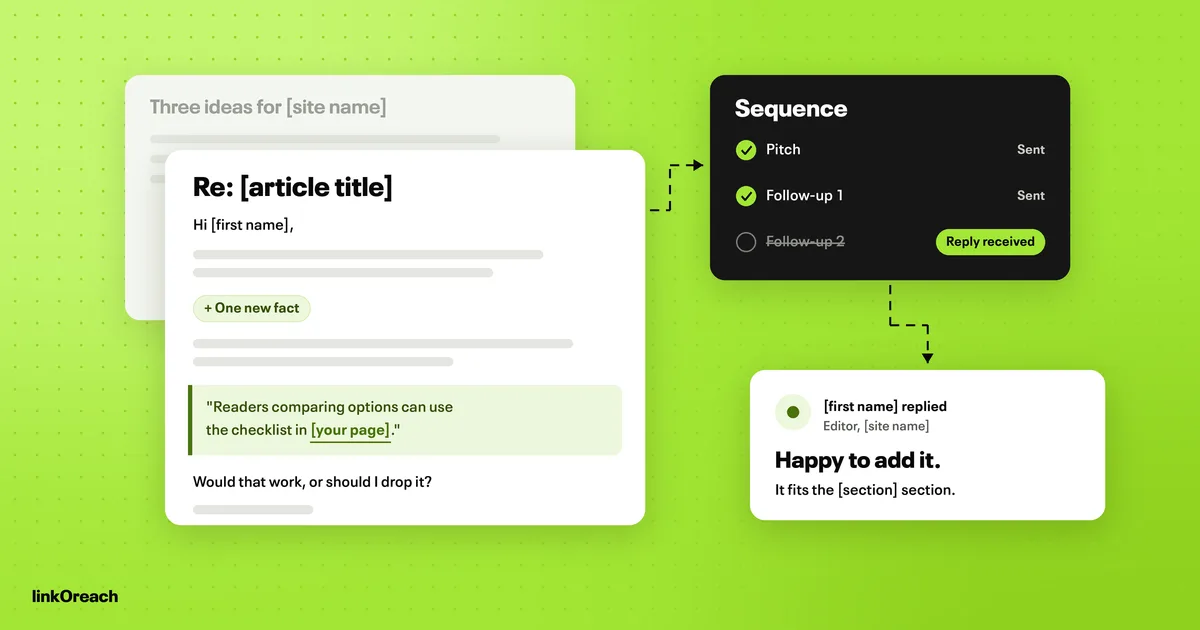
8. Follow-up one: add something new
Send it three to four business days after the first email, in the same thread. It should add one thing the first email did not have.
Subject: Re: [original subject]
Hi [first name],
One addition to my note below: [new detail, for example a third topic idea, a chart from the page, or a one-line outline of idea two].
If that makes it easier to judge, happy to send the full outline.
[Your name]
9. Follow-up two: close the loop
Send it about a week after follow-up one. It is the last email in the sequence, and it gives the blogger an easy way to say no.
Subject: Re: [original subject]
Hi [first name],
I'll leave this here so I'm not filling your inbox. If [topic or ask] fits [blog name] later, reply any time and I'll pick it up.
If it's a no, a one-word reply helps me too.
[Your name]
Stop the sequence on any reply from a person. An out-of-office is not a reply: pause, and send the next step after their return date. For the other situations a sequence runs into (a referral to a colleague, a "not now", a yes that goes quiet), we keep follow-up templates for each stage after the first pitch.
10. Reply when a blogger asks to be paid
Use it when you pitched an editorial piece and the blogger answers with a rate card. Many do. You have two honest options: decline politely, or move to a labeled sponsored post (template 7).
Subject: Re: [original subject]
Hi [first name],
Thanks for the quick reply and for sending your rates. We don't pay for editorial guest posts, so I'll step back on this one.
If you ever want a contributor for [topic] without a fee, I'd be glad to write for [blog name]. And if we run a sponsored campaign later, I'll come to you first, labeled as sponsored on your side.
[Your name]
Free products, paid posts and the rules that apply
Blogger outreach is where link building most often slides into paying for links, because bloggers are used to brand deals. Two sets of rules apply, and both affect what you can write in the email.
Google's spam policies list buying or selling links for ranking purposes as link spam, and they name three blogger deals directly: exchanging money for links or posts that contain links, exchanging goods or services for links, and "sending someone a product in exchange for them writing about it and including a link". The same policy covers links with optimized anchor text in guest posts. Google's guidance on qualifying outbound links says paid placements should carry rel="sponsored". Google's September 2026 spam update finished rolling out on October 8, two weeks after it began, so link schemes are not a theoretical risk.
The second set is about readers. The FTC's Endorsement Guides FAQ says that if a blogger receives free products or other perks with the expectation of promoting or discussing them, the FTC Act applies, and that a connection readers would not expect should be disclosed clearly and conspicuously. That is the blogger's obligation, but your email shapes it: an offer with no strings and a reminder that free access may need mentioning (template 4) keeps both of you on the right side of it.
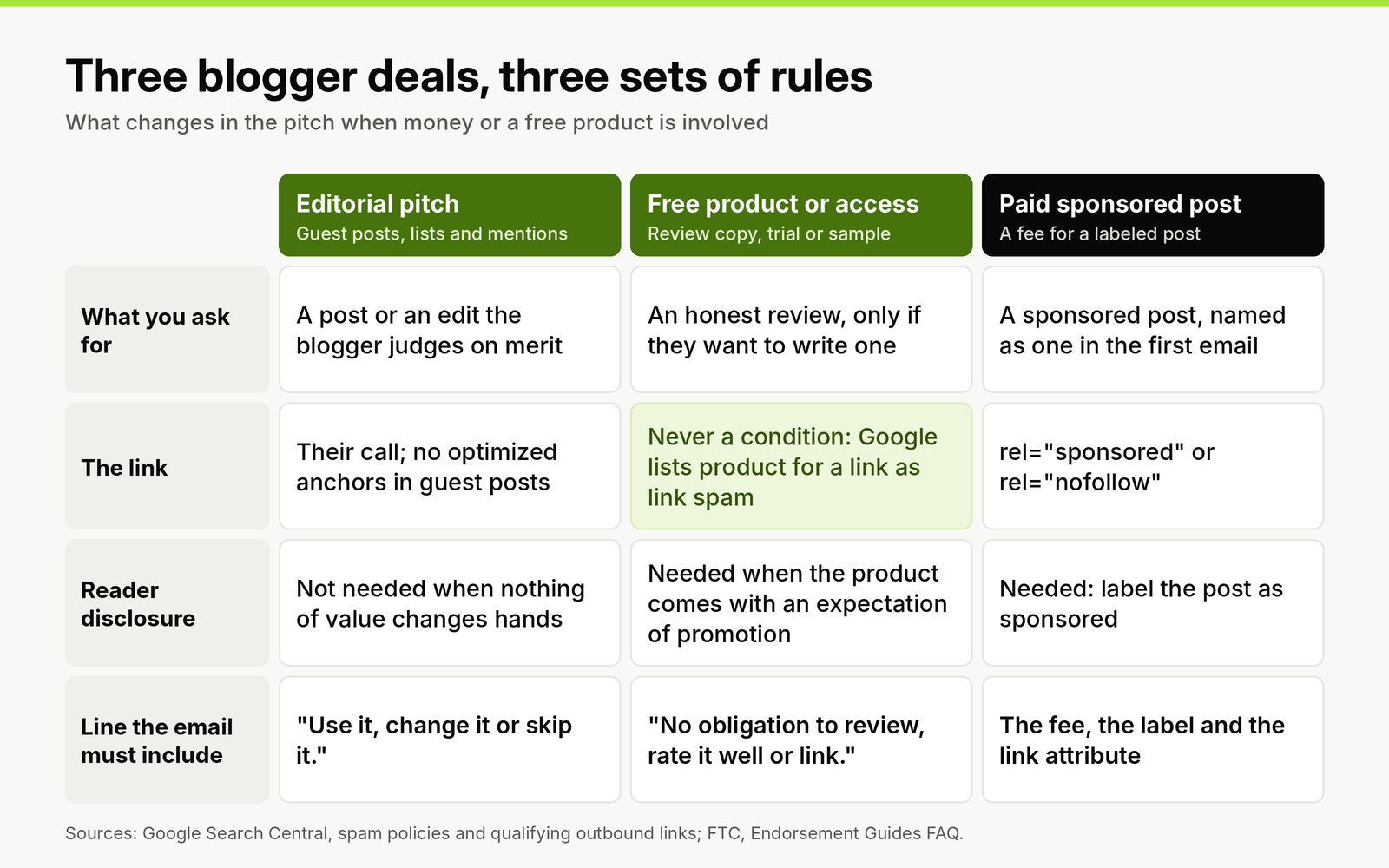
The deal decides the email. Money or a free product changes what you may ask for, how the link is marked and what readers must be told.
In practice, keep editorial pitches free of any payment or condition, never make a free product depend on a review or a link, and put the fee and the label in the first line of any sponsored inquiry. If paid placements become a regular budget line, tracking each order, the agreed price and the live URL is its own job; BuildLinks is link building management software built for that part of the work.
How to personalize a blogger template in five minutes
Personalization is where most blogger pitches fail, and also where recipients are least forgiving. In the same report's survey of US decision makers, 65% said cold emails feel too pushy or sales-focused, 61% blamed a lack of relevance, and 69% said it bothers them if AI was used to write the email. Bloggers are not decision makers in a company, but they react to the same signals.
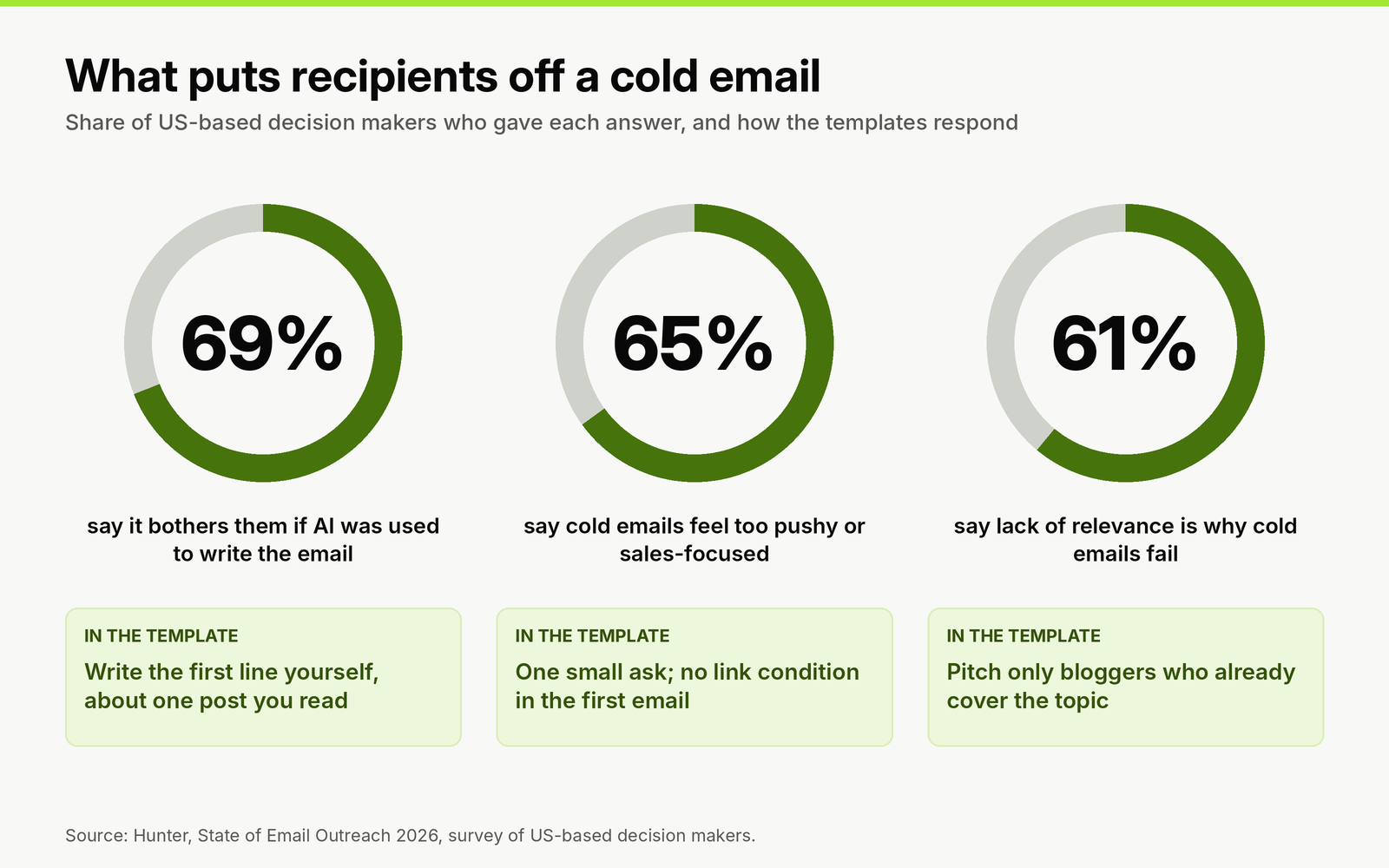
Each complaint maps to one part of the template. Source: Hunter, State of Email Outreach 2026.
Here is the routine we use per blogger, timed at about five minutes once you have the site open:
- Read the last three posts' titles and one post in full. Pick the post your pitch refers to. If none of the last ten posts touch your topic, drop the blogger rather than forcing a fit.
- Find one specific detail. A point the post stops at, a question in the comments, a section with no example. This becomes your first line.
- Check how they work with outsiders. Contributor bylines, a "write for us" page, sponsored labels on other posts, or a review policy. This tells you which template to use.
- Find the right name. The blogger's own first name, not "editor" or "team". On a multi-author blog, the author of the post you are referring to.
- Write the first two lines yourself. Software can draft the rest from your notes, but the line that proves you read the post should come from you. Then read the full email once as the blogger would.
Batch the bloggers by template before you start, so one session covers 15 to 20 guest post pitches and another covers mention requests. Grouping by template is a smaller version of splitting bloggers into segments that share one reason to link, which is also how you keep each sequence to about 50 recipients.
Mistakes that get blogger pitches ignored
- Praise with no detail. "Big fan of your work" without a post title reads as a mail merge, because it usually is one.
- Asking for a dofollow link with a set anchor in email one. It tells the blogger the email is about rankings, not their readers, and invites a rate card.
- Attaching a draft. Attachments made no meaningful difference to reply rates in the 2025 data, and a file from a stranger is one more thing for a blogger to ignore. Offer the outline instead.
- Four or more follow-ups. Reply rates fell for sequences longer than three messages. Two follow-ups, then stop.
- Tracking pixels and link tracking. Tracking lowered reply rates in the dataset, and it adds nothing you need: judge a template on replies and live links.
Sending matters as much as wording. A pitch sent from a new domain with no SPF, DKIM or DMARC records can land in spam however well it is written, so start with authenticating and warming a new outreach domain and keep daily sends per mailbox modest. If you are choosing software to send these templates at volume, we compared software built for blogger outreach on price and features.
Sending blogger outreach templates in linkOreach
Blogger outreach is one of the campaign types we built linkOreach for, and Linkzy is the AI agent inside it. You brief Linkzy on your product once and set keywords, a DR range, a traffic floor and a location; it builds the prospect list from Ahrefs data, goes for the SEO lead first at each site, then content marketing, then the CMO, and checks each address for deliverability before anything goes out. Linkzy writes a pitch for each site from that site's content, and every email can be edited before it is sent, which is where your hand-written first line goes. Follow-ups run on a cadence and stop the moment someone replies, inside built-in sending limits.
You can save the templates above, reuse them across campaigns, A/B test two pitches head to head, and send from your own Gmail, Outlook or SMTP mailbox, with replies in a shared inbox and replies and live links reported per campaign. Our per-site pitches, saved templates and stop-on-reply follow-ups are all on one page, and every step can also be run by hand. We currently offer one plan at $49 a month, an introductory price, with a 7-day trial and no credit card.
Pick a different tool if your blogger outreach is influencer marketing on Instagram, TikTok or YouTube with paid creator contracts. An influencer platform built for creator payments and content approvals suits that job better; linkOreach is built for email pitches that end in a link.
For campaign types beyond blogger outreach, such as broken links and digital PR pitches, start from our cold email templates for every other link building campaign.
Conclusion
Keep a first blogger outreach email to about 70 to 110 words: one post named with one real detail, one line on who you are, one ask, and the link left to the blogger. Send a pitch and two follow-ups, three to four business days and then a week apart, each adding something new, and stop on any reply. Keep open tracking off and let a person write the first two lines.
Match the template to the deal. Editorial pitches carry no payment or conditions, free products never depend on a review or a link, and paid posts are labeled sponsored with rel="sponsored" from the first email. Plan below the 13% link building average until you have your own numbers, and judge each template on replies and live links.
If you want per-site pitches and stop-on-reply follow-ups from your own mailbox, start a free 7-day linkOreach trial and send your first blogger campaign this week.
Frequently Asked Questions
How do you write a blogger outreach email?
Name one specific post on the blogger's site and one detail from it, say who you are in one line, make one ask (a guest post, an addition to a post or a review), and leave the link decision to the blogger. Keep a first email to about 70 to 110 words so it can be answered from a phone.
How long should a blogger outreach email be?
About 70 to 110 words before the signature for a first email, and under 50 for a follow-up. In 31 million emails sent in 2025, emails of 61 to 80 words and of 181 to 200 words both got comparatively high reply rates, so cut anything that is not about the blogger's post or your idea rather than aiming for an exact word count.
How many follow-ups should you send to a blogger?
Two. Send the first three to four business days after the pitch with something new in it, and the second about a week later to close the loop. In 2025 data, a pitch plus two follow-ups averaged a 6.8% reply rate against 3.3% for a single email, and longer sequences did worse.
Can you offer a blogger a free product in exchange for a link?
No. Google's spam policies list sending someone a product in exchange for them writing about it and including a link as link spam. Offer access with no obligation to review, rate it well or link, and remind the blogger that free products they are expected to discuss may need disclosing to readers under the FTC's Endorsement Guides.
What should you do when a blogger asks to be paid for a guest post?
Either decline politely and offer to contribute without a fee later, or move to a sponsored post that is labeled as sponsored on the page, with the link marked rel="sponsored" as Google's guidance on paid links asks. Do not pay for a post that is presented as editorial.
What reply rate should you expect from blogger outreach?
Digital PR and SEO link building sequences averaged a 13% reply rate in Hunter's data on emails sent in 2025, against 4.5% for all cold email and 3% for sales outreach. Treat 13% as an upper bound for planning and replace it with your own campaign numbers once you have them.