How to Ask for Backlinks: 7 Requests With Templates
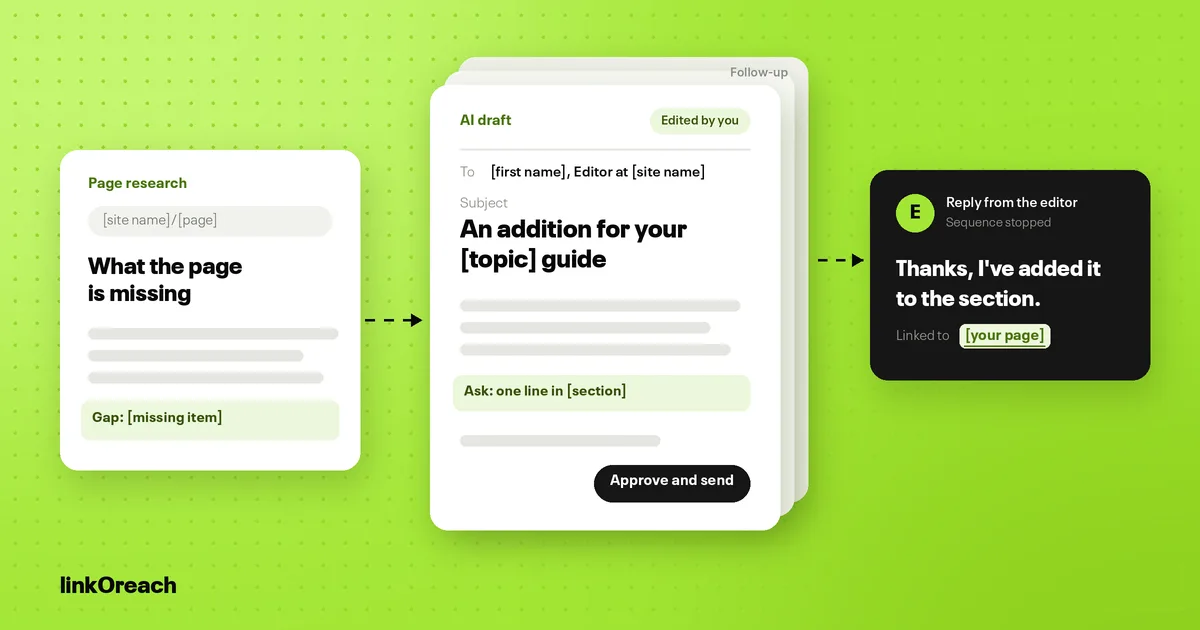
To ask for a backlink, email the person who edits one specific page, point to the exact spot where your link would help their readers, give one reason it helps, and make one plain request. Requests that fix something for the editor (a broken link, an outdated figure, an unlinked mention of your brand) get yeses far more often than requests that only say your page is good.
Most advice on how to ask for backlinks stops at "write great content and send a nice email". This guide goes further: which of seven asks fits a given prospect, a template for each, how many requests a link usually takes in published outreach data, when to follow up, and what to answer when an editor replies with a price. Asking is one stage of the full outreach campaign around these requests, which also covers prospecting, deliverability and tracking links once they go live.
What makes a backlink request work
An editor who gets your email has one question: what does changing my page do for me? Ahrefs makes the point bluntly in its guide to the four ways to get backlinks: none of the three link requests the author showed from his own inbox got a link, because none offered anything of value. His own campaign promoting a strong article landed 19 links from 111 emails, a 17% success rate he credits mostly to the Ahrefs brand, and he estimates a new site would see a rate two to three times lower. For a plain "my page is great, please link to it" ask, he says you are lucky to get 5 links from 100 emails.
So the strength of a request comes from the reason, not the wording. A reason that fixes a problem on their page beats a reason that adds something to it, and both beat a reason that only describes your page. Every request in this guide is built from the same four pieces: the exact page, the exact spot on it, the one reason the change helps their readers, and the ask itself in a single sentence. Leave any of the four out and the editor has to work out what you want, which most will not bother to do.
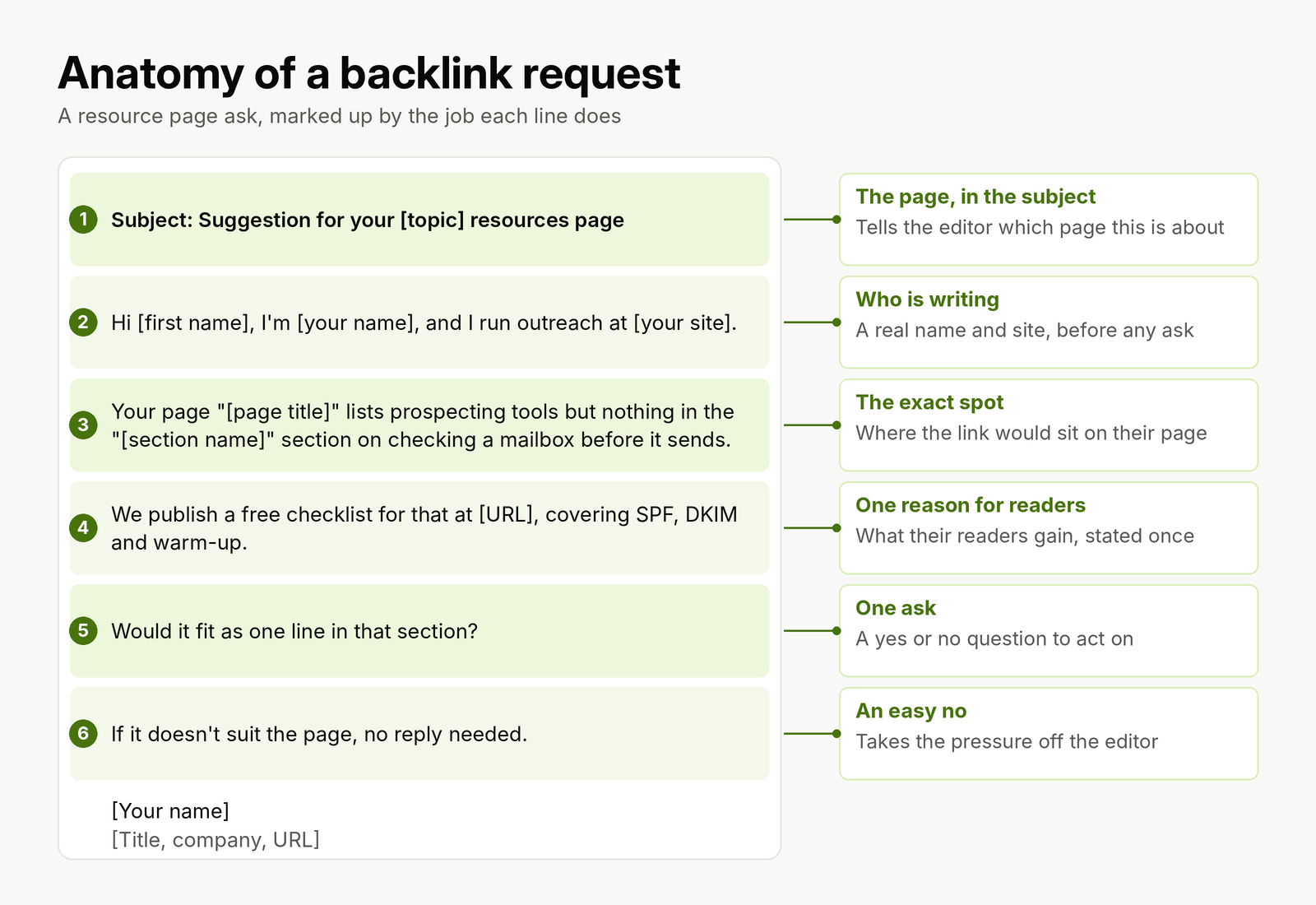
Each callout is one job the email has to do. Most rejected requests skip the spot on the page or bury the ask.
Three things to settle before you write. Pick one named person who edits the page, not a generic inbox; the byline, the site's about page and LinkedIn usually tell you who. Decide which page of yours should get the link, and make it the page that fills the gap, not your homepage. And decide what you will not offer: no payment, no automatic link swap, nothing you would not want an editor to read aloud.
Seven ways to ask for a backlink
The seven asks below run from the easiest yes to the hardest. Which one fits depends on what you can see on the prospect's page, so start by looking at the page, not at your list of templates.
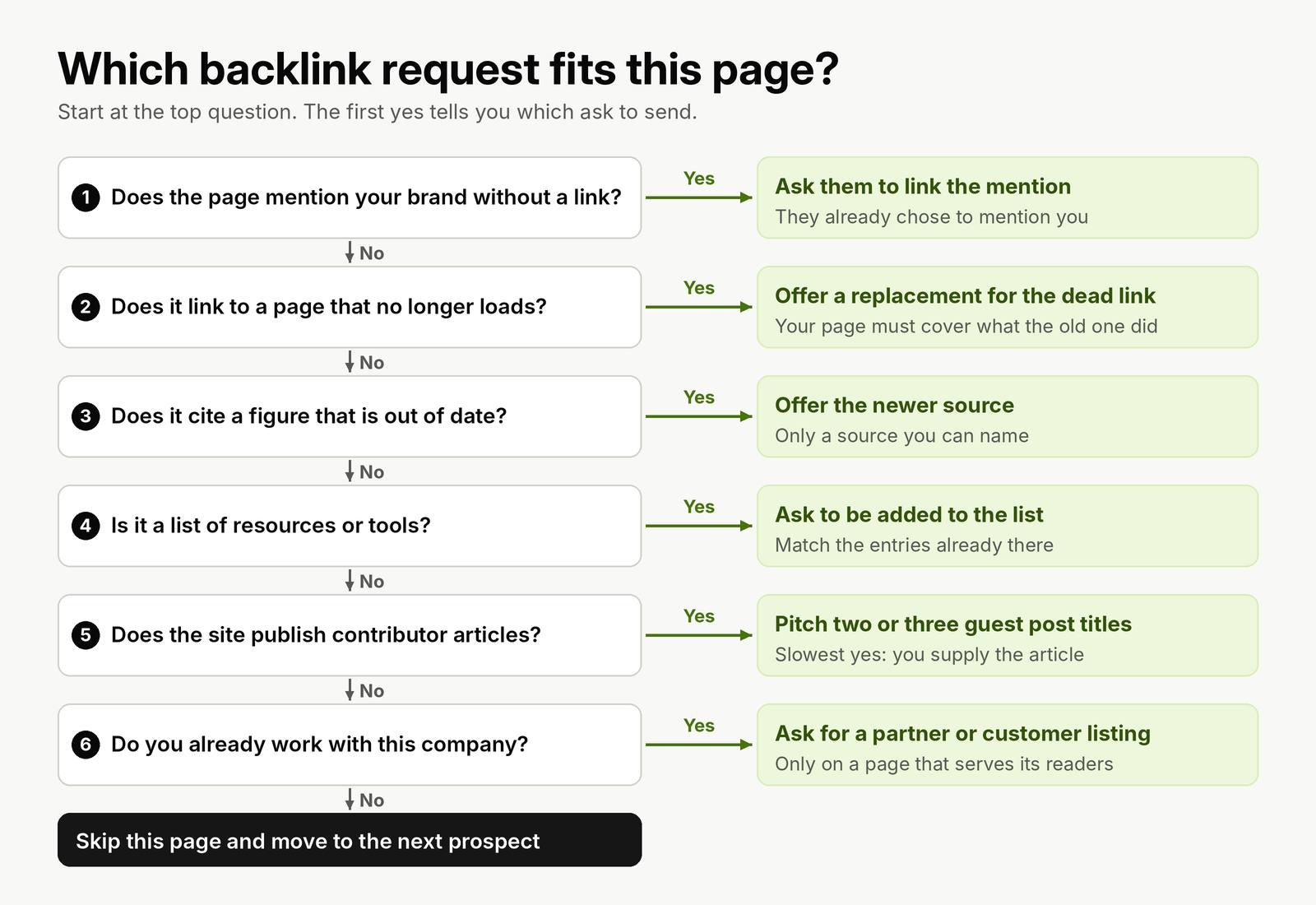
Work down the questions for each prospect page. The first yes tells you which request to send.
1. Link an existing mention of your brand
When a page already names your company, product or research without linking to it, the editor has decided you are worth mentioning. Your ask is only to make the mention clickable. Search for your brand name in quotes, minus your own site, and check each result for a missing link.
Subject: Your mention of [your brand] in [article title]
Hi [first name],
I'm [your name], [role] at [your brand]. Thanks for including us in "[article title]", in the section on [section name].
The mention isn't linked at the moment. If you're open to it, the page that matches what you wrote is [URL], so readers who want the detail can find it.
Either way, thanks for the mention.
[Your name]
[Title, company, URL]
Use it for any mention less than a year or two old; older posts get edited less often.
2. Replace a broken link
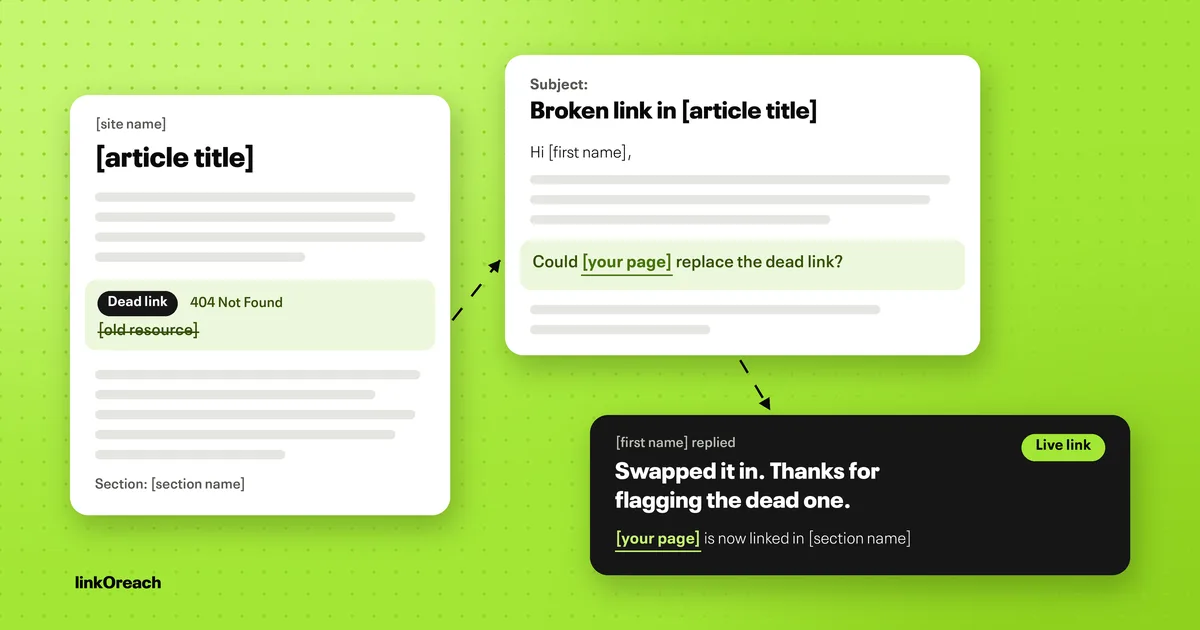
A dead link is a small problem on their page that you can solve. Find pages in your niche that link out to pages now returning a 404, check that your page covers what the dead one covered, and offer it as the replacement.
Subject: Broken link in [article title]
Hi [first name],
I'm [your name] from [your site]. In "[article title]", the link to [dead page or site name] in the section on [section name] now returns a page-not-found error.
We cover the same ground at [URL], including [one specific thing the old page had]. If it fits, it could replace the dead link.
No reply needed if it doesn't suit the page.
[Your name]
[Title, company, URL]
Use it when your page covers the same topic as the dead one. If it doesn't, report the broken link anyway and leave the ask out; that editor will remember you next time.
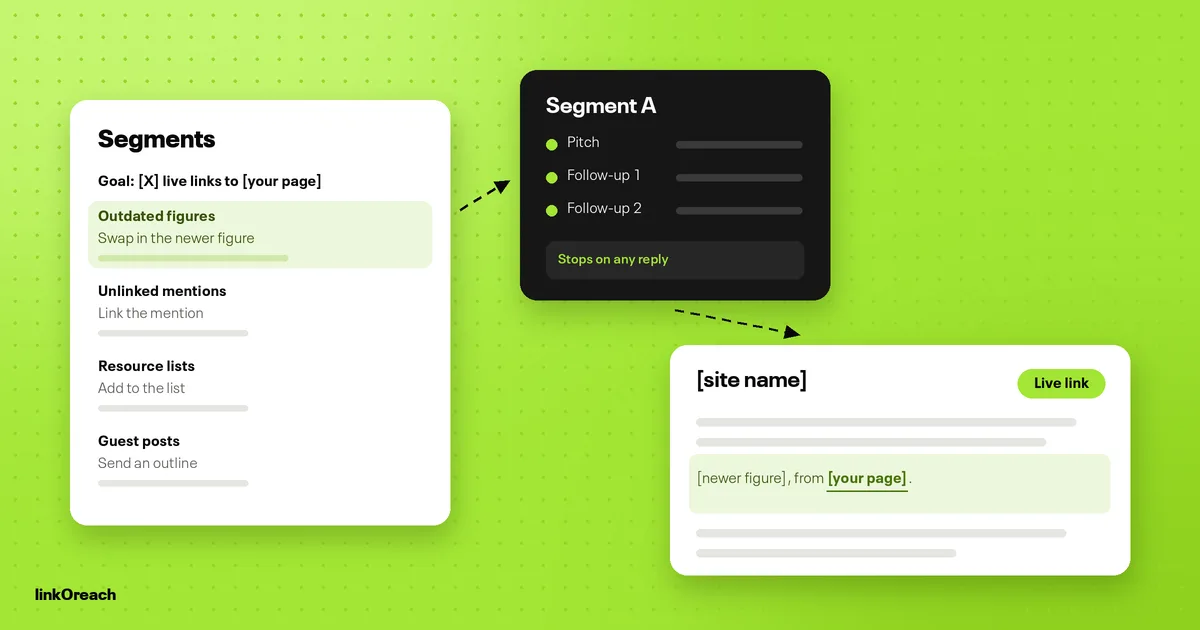
3. Offer a newer source for an outdated figure
Pages that cite a statistic from several years ago are common, and a newer figure from a source the editor can check is a real fix. This works best when your page is the newer source, or explains it with the full method.
Subject: Newer figure for your [topic] guide
Hi [first name],
Your guide "[article title]" cites [old figure] from [old source and year] in the section on [section name]. The [newer source] for [year] puts it at [new figure].
We wrote up what changed, with the full table and method, at [URL]. If you update that line, a link there would let readers check the number.
Thanks for keeping the guide current.
[Your name]
[Title, company, URL]
Use it only when the new figure comes from a source you can name. Never ask an editor to replace a figure with one you cannot back up.
4. Ask to be added to a resource page
Resource pages exist to link out, so the question is only whether your page belongs on the list. Check the page was updated in the last year or two, that it still accepts additions, and that your page is the same kind of thing as the entries already there; our guide to finding resource lists that still accept additions covers the vetting.
Subject: Suggestion for your [topic] resources page
Hi [first name],
I'm [your name], and I run [your site]. Your page "[page title]" lists [type of resources] but nothing on [the gap].
We publish a free [type of resource] for that at [URL]. Would it fit in the "[section name]" section?
If not, no reply needed.
[Your name]
[Title, company, URL]
Use it for lists with a clear theme. Pages titled "links" or "partners" that list hundreds of unrelated sites are not worth a link and may be the partner pages Google's spam policies warn about.
5. Ask to be included in a listicle or tool roundup
"Best tools for X" posts get updated when products change, and editors need accurate details. Your request should make the update easy: name the category you belong in, say who your product is for, and offer the facts the editor would need to write the entry.
Subject: [Product] for your [list title] list
Hi [first name],
I'm [your name], [role] at [product]. Your list "[list title]" covers [types of tools], and we fit the [category] group: we built [product] for [who it is for].
If you're updating the list, I can send pricing, a short description and screenshots, or set up an account so you can test it yourself.
Thanks for considering it.
[Your name]
[Title, company, URL]
Use it when your product belongs in that category by its own description. Do not offer payment for the placement; see the section on replies below.
6. Pitch a guest post
A guest post is the one ask where you give the editor something large: a finished article. It is also the slowest, because the editor has to accept a topic, review a draft and publish it. Pitch two or three specific titles that their site does not already cover.
Subject: Article idea for [site name]: [title idea 1]
Hi [first name],
I'm [your name], [role] at [your site], and I write about [topic]. I read "[recent article on their site]" and noticed you haven't covered [gap].
Two ideas: "[title idea 1]", which [one line on the angle], and "[title idea 2]", which [one line]. I'd write either from scratch for [site name], following your guidelines.
Samples of my work: [URL 1], [URL 2].
[Your name]
[Title, company, URL]
Use it for sites that publish contributor articles. A link inside a guest post should point to something that helps the reader of that article, not to a page stuffed with keyword anchors.
7. Ask a partner, customer or supplier
Companies you already work with are the warmest prospects you have. An integration partner may have a directory, a customer may publish case studies, a supplier may list the brands it serves. The link has to sit on a page that exists for its readers, such as an integrations directory or a customer story, not a page built only to swap links.
Subject: Listing on your [integrations or partners] page
Hi [first name],
I'm [your name] at [your company]. We've [worked with you on, integrated with] [what you do together] since [month and year].
I noticed your [page name] lists [other partners or customers] but not us yet. If it helps, here is a two-line description and our logo: [description], [logo link].
Thanks either way.
[Your name]
[Title, company, URL]
Use it only where the relationship is real and current. For pitch templates beyond these seven, such as niche edits and blogger campaigns, see our first-touch pitch templates for every campaign type.
How many requests does one backlink take?
Plan on sending a lot more requests than you need links. The published figures vary with how they were measured, but none of them is high.
| Source and sample | What was measured | Figure |
|---|---|---|
| Hunter's State of Email Outreach 2026, cold email sequences sent in 2025 | Reply rate, link building and digital PR sequences | 13% |
| Same report, all use cases | Reply rate, every cold email sequence | 4.5% |
| BuzzStream's reply timing study (2025), link building campaigns with over 25 emails | Reply rate on first pitches | 3.59% |
| Backlinko's outreach study (2019), 12 million outreach emails | Share of emails that got any response | 8.5% |
| Ahrefs, one campaign of 111 emails from a well-known brand | Links landed per email sent | 17% |
A reply is not a link. Some replies are a no, some are a price, and some editors add the link without answering at all. Treat the reply rates as the ceiling and the links-per-email figures as the planning number.
Worked example: ten links a month
Say you want ten links a month for a site without a known brand, mostly from resource pages and broken link replacements.
- Planning rate: the rough figure of 5 links per 100 emails for a plain ask is a fair floor for a new site. Asks that fix a problem should beat it, but plan on the floor until your own numbers say otherwise.
- Requests needed: 10 links at 5 per 100 is 200 first-touch requests a month, or about 10 a working day.
- Prospects needed: one named contact per site, so 200 vetted pages, each with a reason to link. If only half the pages you review have a usable gap, you review about 400.
- Sending: 10 first touches a day plus follow-ups sits well inside the 20 to 49 emails a day per mailbox where cold email reply rates peaked in 2025, so one mailbox covers it.
- Review after a month: if you landed 15 links from 200 requests, your rate is 7.5 per 100 and next month needs about 135 requests for the same ten links.
The number that moves most with practice is the share of reviewed pages that have a real reason to link. That is where research time goes, and it is why we size campaigns from the link goal backward, a method we cover in planning how many sends each link needs.
When to follow up on a backlink request
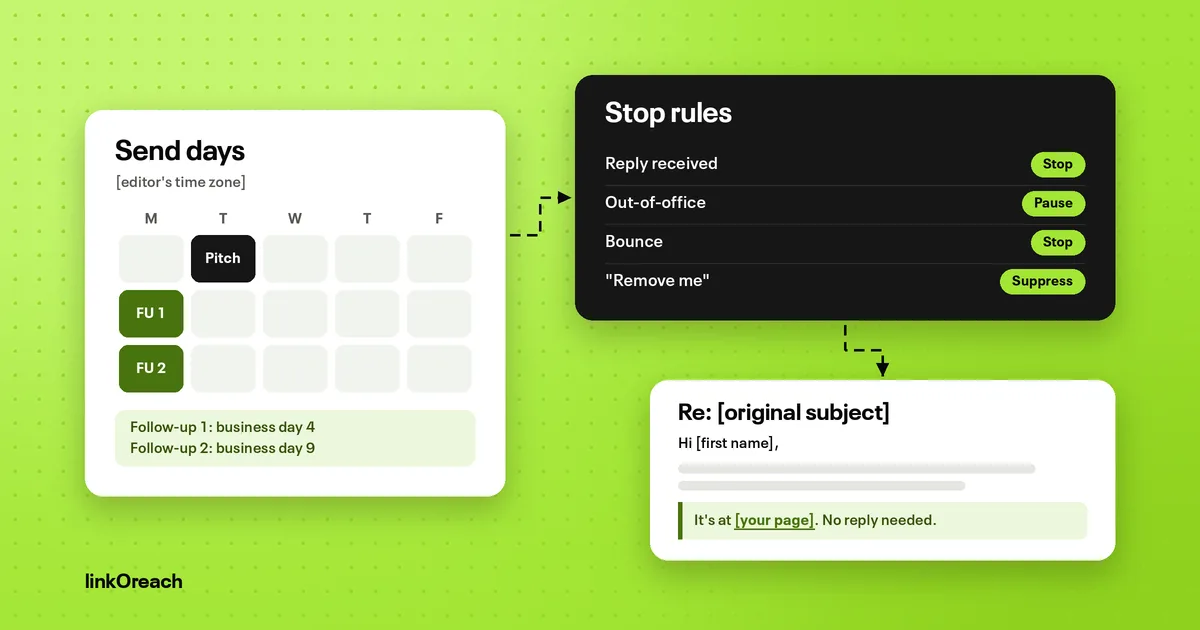
Follow up once or twice, and give the first email a few days first. Most replies come fast: in BuzzStream's data, 57% of link building replies arrived within 6 hours of the pitch and almost 90% within 2 days.
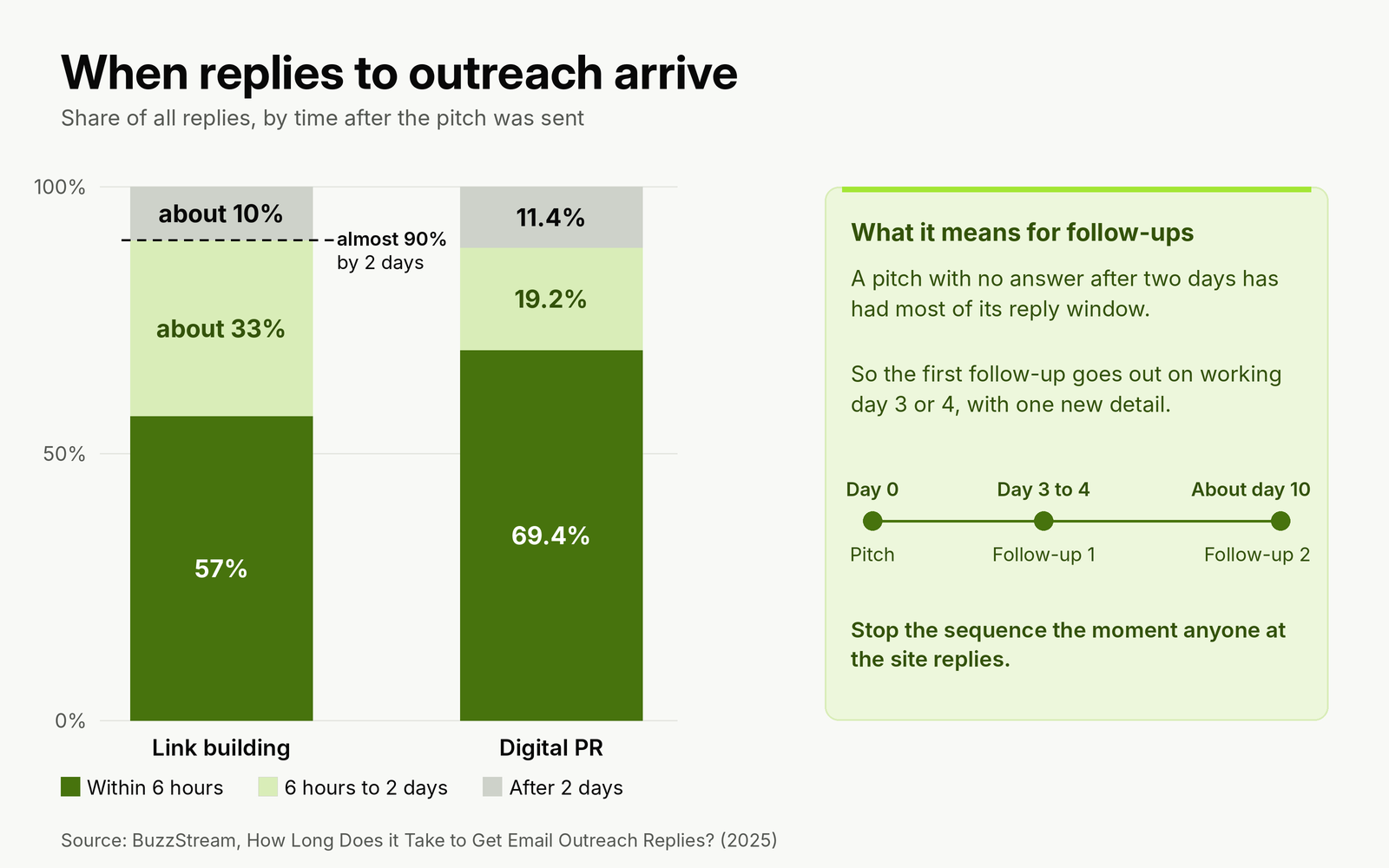
If an editor has not answered in two days, the first email has done most of what it will do. That is when a follow-up has something to add.
That points to a simple cadence: first follow-up three to four working days after the request, a second about a week after that, then stop. Hunter found that three messages in total roughly doubled replies compared with one (6.8% against 3.3%), and Backlinko's older study found a single follow-up lifted replies by 65.8%. The same Hunter data shows the best sequences stopped at three messages in total.
Each follow-up should add one thing the first email did not have: a screenshot of where the link would go, a second detail from your page, or a shorter version of the ask.
Subject: Re: Broken link in [article title]
Hi [first name],
One more detail in case it helps: the dead link is the third one in the "[section name]" list, and our page at [URL] also covers [new specific detail] that the original didn't.
If it's not a fit, I won't follow up again.
[Your name]
Stop the sequence the moment anyone at the site replies, including with a no. A follow-up that lands after a reply makes your email look automated, because it is.
How to answer the replies you get
The reply is where most link requests are won or lost, and it is the part no template can send for you.
| The editor says | What to do |
|---|---|
| "Done, the link is live." | Thank them in one line, check the link points where you asked and is followed, and log it. |
| "Send me more details." | Answer the exact question within a day, with the URL and the suggested sentence written out. |
| "What anchor text do you want?" | Suggest the page title or a plain description of the page, and let them choose. |
| "We'd rather have a guest post." | Say yes only if you can write something good for their readers; send two title ideas. |
| "Our fee is [amount]." | Decline politely, or treat it as advertising and ask for the link to carry rel="sponsored". |
| "Link to us and we'll link to you." | Decline unless the exchange is a one-off between related sites that help each other's readers. |
| "No thanks." | Thank them, stop the sequence, and note it so nobody pitches that page again soon. |
The fee and swap rows matter more than they look. Google's spam policies list buying or selling links for ranking purposes, exchanging goods or services for links, and excessive link exchanges as link spam, and they say paid links are fine only when marked rel="nofollow" or rel="sponsored". Google's September 2026 spam update finished rolling out in October, alongside reports that it may be issuing more manual actions, so a paid followed link is a risk you take on knowingly, not a safe shortcut.
Mistakes that get backlink requests ignored
Asking for a link to your homepage is the most common one. Editors link to pages that help a reader with the topic of their article, and a homepage rarely does.
Praise you did not mean comes next. "I loved your amazing article" before a link request reads as a template, and editors see dozens a week. Name the section you read instead; it proves more and costs one line. The same goes for AI drafts: letting AI draft the pitch while you write the ask keeps the speed without the invented praise.
Several asks in one email is the third. A request that offers a guest post, a link swap or "any kind of collaboration" leaves the editor to design your campaign for you. Pick one.
Last, emailing three people at one small site at once. Sequences that contacted one or two people per company replied better than those that contacted three or more (5.1% against 3.5%). On a small blog, those three addresses often reach the same person.
Asking for backlinks with linkOreach
We built linkOreach for exactly this work, and Linkzy is the AI agent inside it. You brief Linkzy once on your product, set keywords, DR range, traffic floor and location, and it builds the prospect list from Ahrefs data, looks for the SEO lead at each site first, then the content marketing lead, then the CMO, and checks each address before anything goes out. It writes a request around each site's content, and every email can be edited before it sends, which is where your spot on the page and your one-line ask go. Follow-ups run on a cadence inside built-in sending limits and stop when someone replies, replies land in a shared inbox, and per-campaign reports show replies and live links. Campaign types cover guest posts, niche edits, listicles, blogger outreach, link exchange and brand mentions, and every step can be run by hand; our page on pitches written per site and follow-ups that stop on reply shows each one.
We currently offer one plan at $69 a month, or $117 a quarter, which works out to $39 a month, with a 7-day trial and no credit card. If you send a handful of requests a month to editors you already know, a spreadsheet and your own inbox are enough, and you do not need us. If links are already agreed and the work is tracking orders, vendors and client reports, BuildLinks is built for that side of the job.
Conclusion
Ask for a backlink with a reason the editor gains from: an unlinked mention, a broken link, an outdated figure, a resource list with a gap, a roundup missing your category, a guest article, or a real partnership. Name the page, the spot and the one change in a single sentence, and send it to the person who edits that page. Plan on about 5 links per 100 requests until your own numbers are in, which means roughly 200 requests for ten links a month.
Follow up once three to four working days after the request and once more a week later, stop on any reply, and decline fees and swaps unless you are willing to mark them as paid.
If you want prospects, contacts and per-site requests prepared for you, start a free 7-day linkOreach trial and run your next campaign through Linkzy.
Frequently Asked Questions
How do you ask for a backlink politely?
Email the person who edits the page, say who you are in one line, name the exact page and the spot where your link would help, give one reason it helps their readers, and ask a single yes or no question. Close with an easy way out, such as "if it doesn't suit the page, no reply needed". Skip praise you did not mean and never ask for a link to your homepage.
What should a backlink request email include?
Six things: a subject line that names their page, who is writing, the exact page and section, one reason the change helps their readers, one ask in one sentence, and a low-pressure close. Keep it short enough to read in one screen and send it from a real person's mailbox on your own domain.
How many backlink requests does it take to get one link?
For a site without a known brand, plan on about 5 links per 100 requests until your own numbers say otherwise. Ahrefs landed 19 links from 111 emails in one campaign, a 17% rate it credits mostly to its brand. Requests that fix something on the editor's page, such as a broken link or an outdated figure, tend to beat a plain request.
When should I follow up on a backlink request?
Three to four working days after the first email, then once more about a week later, then stop. In BuzzStream's data, 57% of link building replies arrived within 6 hours and almost 90% within 2 days, so a follow-up sent before then adds little. Make each follow-up add one new detail, and stop the sequence on any reply.
Is it okay to pay for a backlink?
Google's spam policies list buying or selling links for ranking purposes as link spam. A paid link is acceptable to Google only when it carries rel="sponsored" or rel="nofollow", which means it passes no ranking credit. If an editor quotes a fee, either decline or treat the placement as advertising and ask for the sponsored attribute.
Should I offer a link exchange when asking for a backlink?
Not by default. Google's spam policies name excessive link exchanges as link spam, and an automatic swap offer makes a request read like a scheme. A one-off link between two related sites that help each other's readers is a different case, but decide that deliberately, not as a line in every pitch.