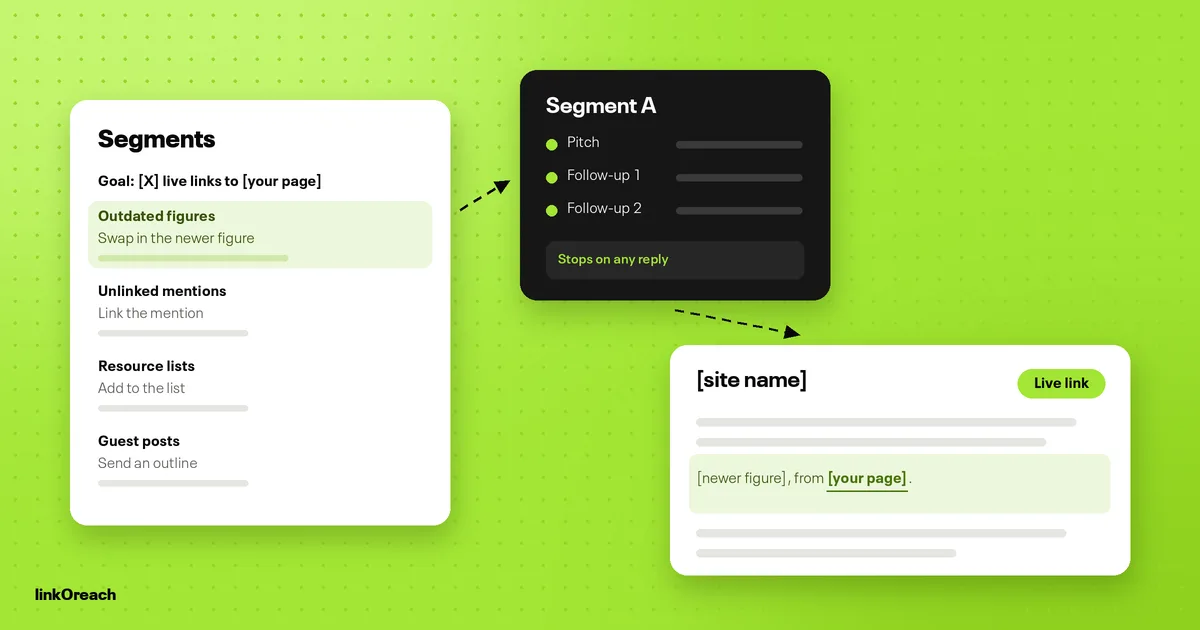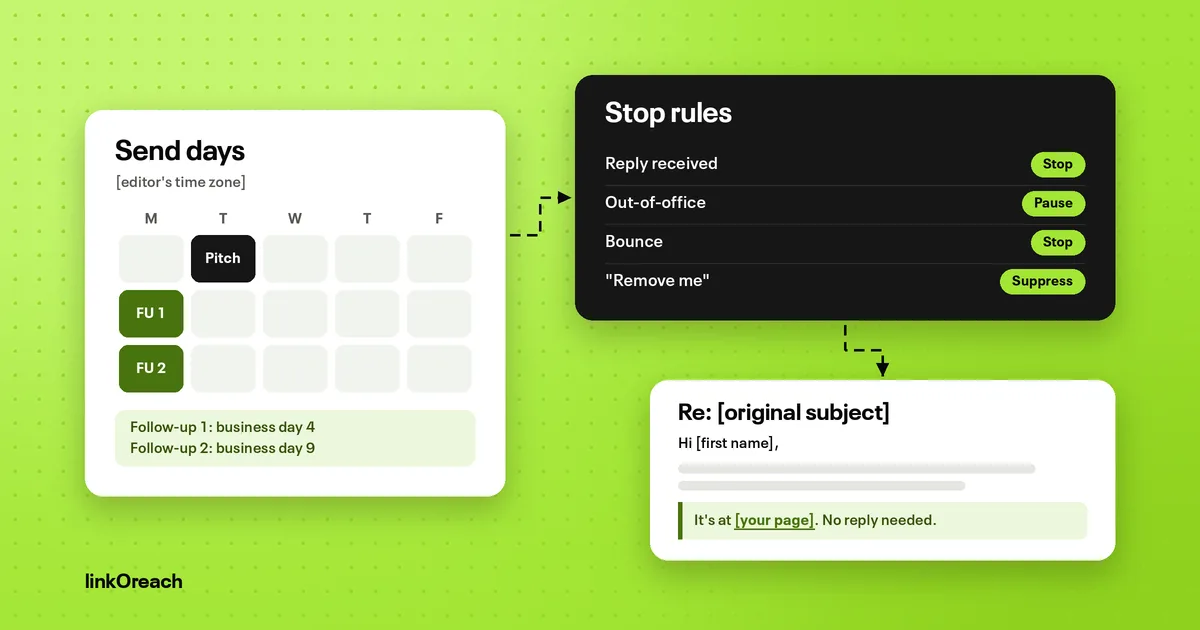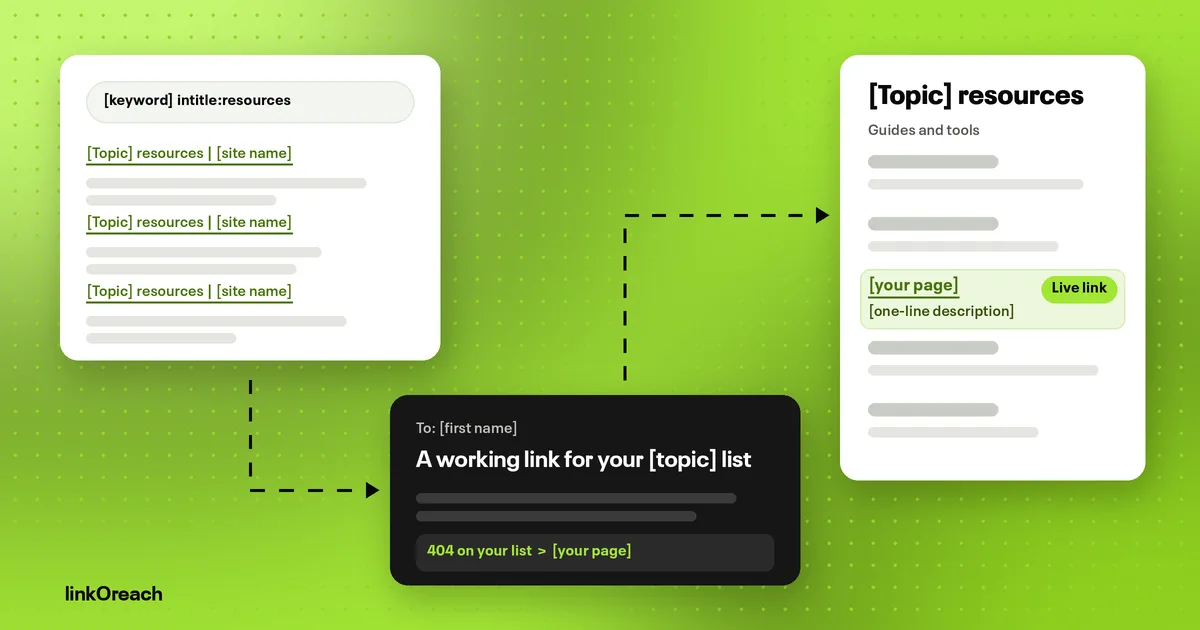
AI Cold Email for Link Building: Prompts, Examples, Checks
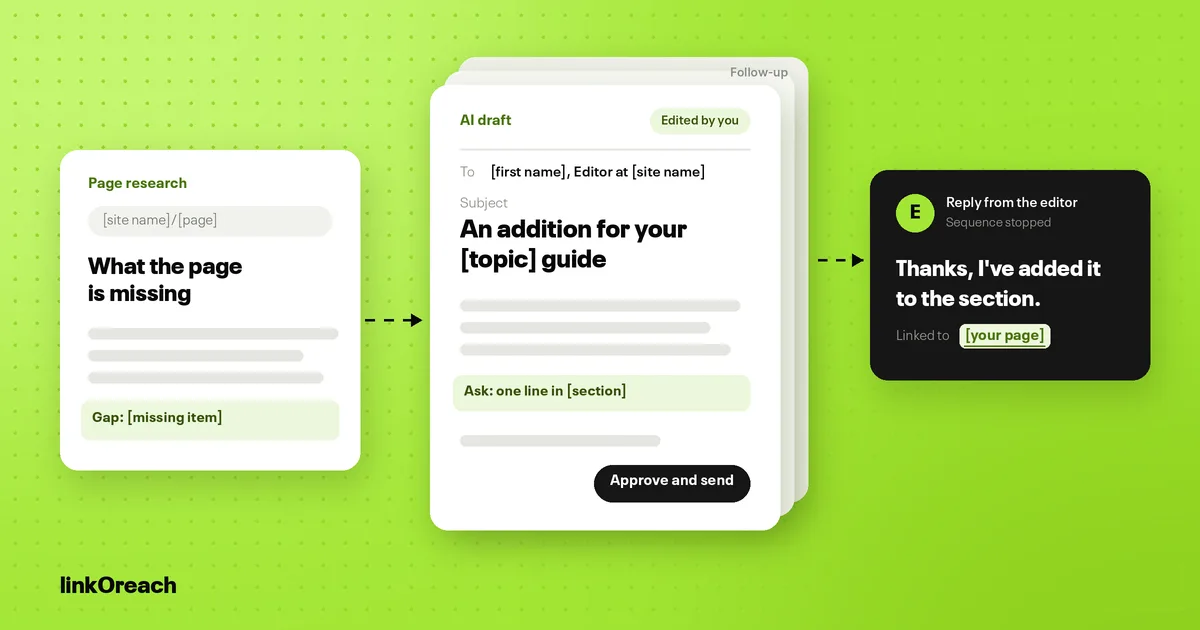
AI cold email works for link building when the AI does the research and the first draft and a person checks every claim and the ask before anything sends. Use it to qualify sites, summarize the page you are pitching and draft a pitch around that page; write the line that proves you read their work and the request yourself, and keep each mailbox at a human sending pace.
Most guides to AI cold email are tool roundups for sales teams booking demos. A link request is a different email: it goes to an editor who owes you nothing, it asks them to change a specific page, and a single invented detail about that page ends the conversation. This guide covers where AI helps a link pitch and where it hurts, the inputs a model needs to write one well, a prompt you can copy, two before and after examples, and the checks to run before an AI draft goes out. It covers one step of the complete link building outreach process, the pitch and its follow-ups.
What AI cold email means for link builders
"AI cold email" covers three different jobs, and most tools do only one of them well.
- Research: reading a prospect's page, pulling out what it covers and what it lacks, and checking that the site and contact are worth an email.
- Drafting: writing the subject line, the pitch and the follow-ups from that research and from a brief about your own asset.
- Running the sequence: sending from your mailbox in a daily window, following up on a cadence, stopping on a reply and sorting the replies.
A free AI cold email generator does the drafting and nothing else, so the research it writes from is whatever you paste in. Sales platforms with AI writers do the drafting and the sequence but research companies and job titles, not pages. For link building the research step decides everything, because the pitch only works if it is about one page and one gap on that page. That is why we treat AI for link outreach as a research tool first and a writing tool second, the same split we make when deciding which link building stages are safe to automate.
What recipients say about AI-written outreach
Recipients have noticed. Two 2026 surveys cover opposite ends of the inbox: decision makers who receive sales email, and journalists who receive pitches.
| Finding | Figure |
|---|---|
| US decision makers bothered if AI was used to write a cold email | 69% |
| More likely to reply when personalization uses publicly available information | 67% |
| Say cold emails fail because they feel too pushy or sales-focused (top complaint) | 65% |
| Say cold emails fail for lack of relevance | 61% |
| Receive a useful cold email about once a week | 40% |
| Journalists who oppose AI-generated pitches, over accuracy and personalization | 53% |
Sources: the first five rows are from Hunter's State of Email Outreach 2026, which pairs 31 million emails sent in 2025 with recipient surveys; the last row is from Cision's 2026 State of the Media.
Read the first two rows together. People do not object to research; two thirds reward personalization built from public information. They object to emails that read as synthetic. The report adds that earlier surveys showed more tolerance for AI-assisted outreach, so the resistance is growing, not fading. For journalists the concern is sharper because an invented fact in a pitch can end up in print, which is why media pitches to journalists need the most human editing of any campaign type.
The email data shows which sending choices move replies. Digital PR and SEO outreach replied at 13% against 3% for sales sequences, so link builders start from a better base. The chart below shows four choices that matter more than who wrote the copy.
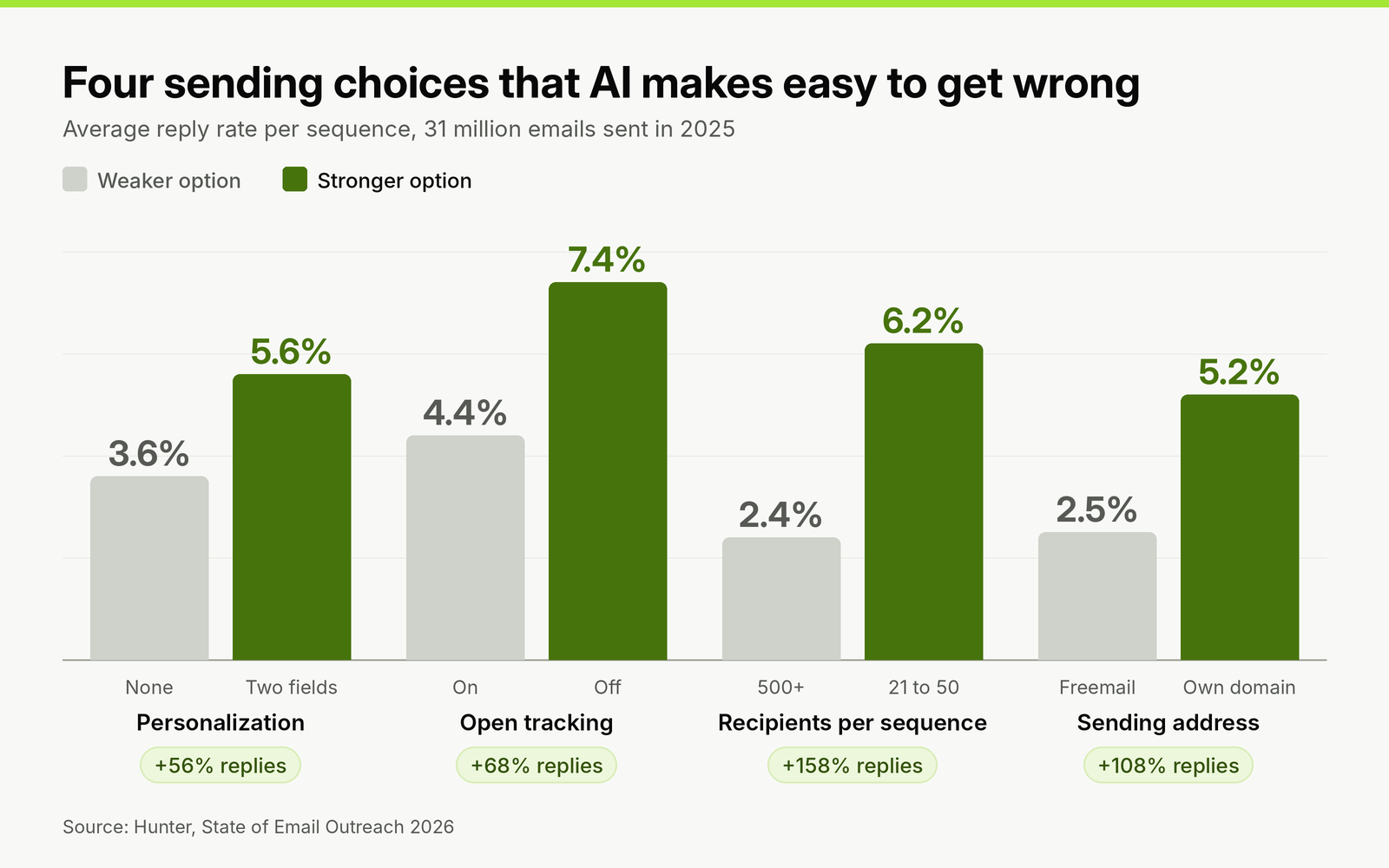
Each pair compares one sending choice. AI makes the weaker option in every pair easier, which is the risk. Source: Hunter, State of Email Outreach 2026.
That is the real danger of AI cold email for link builders: not that the copy is bad, but that cheap copy tempts you into big segments, generic personalization and more volume per mailbox. Every one of those choices lowered replies in the data, whoever wrote the words.
Where AI helps a link pitch, and where it hurts
Sort every task in a pitch by two questions: how much time does AI save here, and what does a mistake cost? The answers put each task in one of four places.
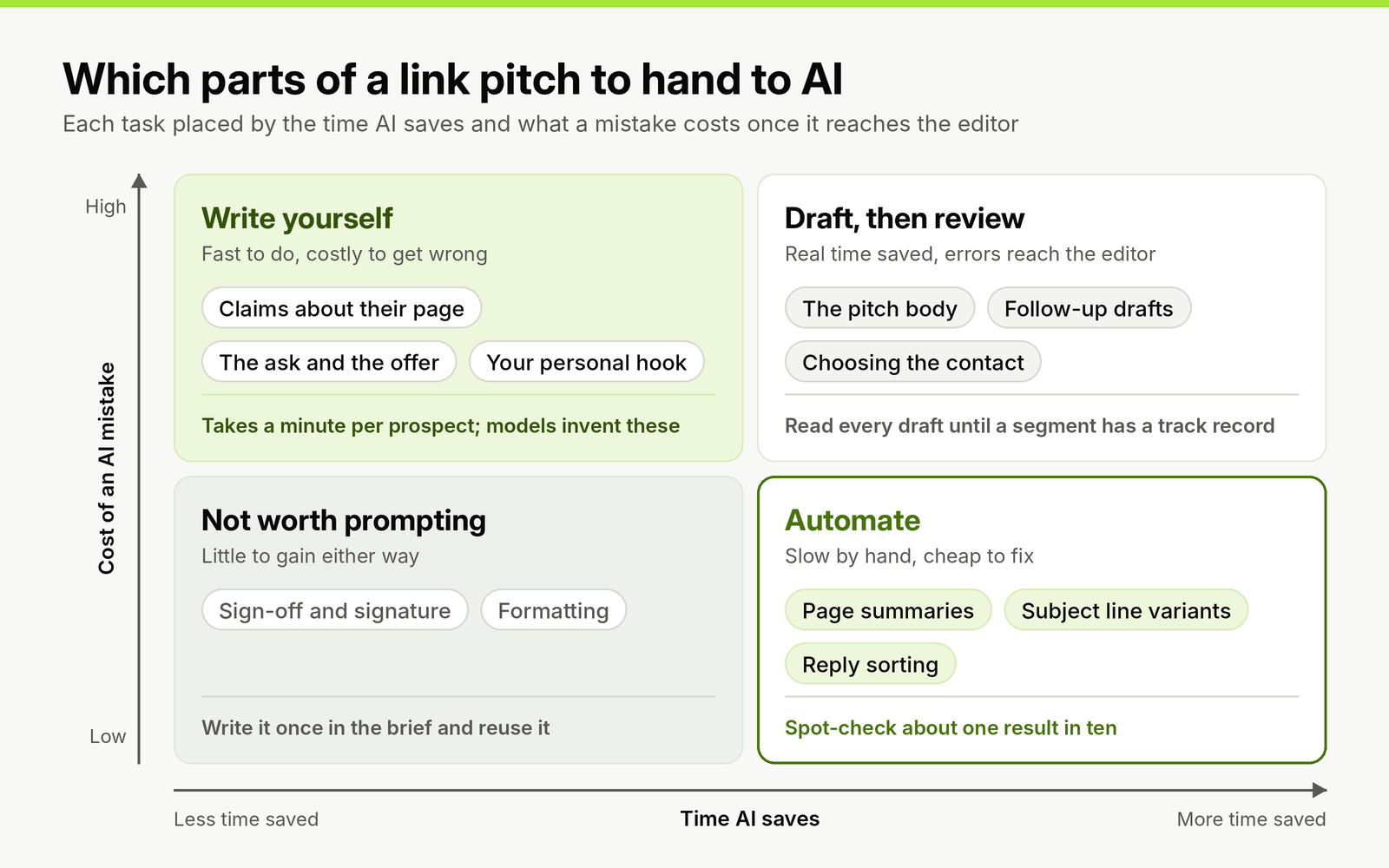
The tasks that save the most time are not the ones that do the most damage when the model gets them wrong.
The "automate" quadrant is where AI earns its keep. Summarizing 200 prospect pages into two lines each, proposing five subject lines per segment and sorting replies into "interested", "not now" and "wrong person" are slow by hand, and a weak result costs little because you see it before it matters.
The "draft, then review" quadrant holds the pitch body, the follow-ups and the choice of contact. AI saves real time here, but an error reaches the editor, so every draft gets a read. A model that picks the wrong contact sends a good pitch to someone who cannot change the page.
The "write yourself" quadrant is small but decides the pitch. Any statement about the recipient's page ("your section on X is missing Y"), the exact ask and what you offer in return, and the one line that shows you read their work. These take a minute each and they are where AI fails worst: models invent sections that do not exist, praise articles they did not read, and soften the ask until it says nothing.
What an AI pitch needs to know
A model writes a generic email when it is given generic inputs. For link building, these are the fields that turn a draft into a pitch about one page. Collect them per prospect, in your sheet or your outreach tool, before you ask for a draft.
- Target URL and title: the exact page you want the link on, not the homepage.
- What the page covers: two lines, written or checked by you.
- The gap: the specific thing missing, outdated or broken, with where it sits on the page.
- Your asset: the URL you want linked and the one fact or tool on it that fills the gap.
- Campaign type: guest post, niche edit, resource page, listicle, link exchange or unlinked mention, because each one asks for something different.
- Contact and role: the person who edits that page, and how you know.
- Sender facts: your name, role and site, written once in the brief so the model never improvises them.
If you cannot fill the gap field, do not send the pitch. No prompt fixes a prospect with no reason to link.
A prompt you can copy
This prompt works in any general model or in an outreach tool that takes custom instructions. It forbids the habits that make AI pitches easy to spot and forces every claim to come from the fields you supplied.
Prompt: Write a link building outreach email of 70 to 120 words.
Recipient: [first name], [role] at [site name]. Their page: [target URL], titled "[page title]". What it covers: [two-line summary]. The gap: [specific missing or outdated item and where it sits].
Sender: [your name], [role] at [your site]. Asset: [asset URL], which offers [one fact, tool or resource that fills the gap]. Campaign type: [type]. The ask: [exact request, for example "add one sentence and a link in the section on X"].
Rules: Mention only facts given above. Do not praise the article, the site or the author. Do not invent statistics, sections, dates or past contact. One ask, stated plainly in the second or third sentence. No exclamation marks, no "I hope this finds you well", no "quick question". Plain text, short paragraphs, no bullet points. Write a subject line of five or six words that names their page topic. Then write one follow-up of under 60 words that adds one new detail from the asset and does not repeat the ask word for word.
The word range and subject length come from the same report's reply data: emails of 61 to 80 words replied comparatively well (so did 181 to 200 words), and five or six words was the sweet spot for subject lines. Link pitches need a little more room than sales emails because they have to name the page and the gap, so 70 to 120 words is a fair target.
AI cold email examples: the draft and what to send
The two drafts below are typical of what a general model writes from thin inputs. The edited versions are what we would send. Each fix is small; together they are the difference between an email that reads as mail merge and one an editor answers.
Example 1: resource page addition
Raw AI draft, written from a URL and nothing else:
Subject: Loved your amazing resource page!
Hi there,
I hope this email finds you well! I just came across your incredible list of marketing resources and was blown away by how comprehensive it is. Your insights on SEO really resonated with me.
I recently created a guide that I think would be a great fit for your audience. It covers everything about link building and would add tremendous value to your readers.
Would you consider adding it to your page? Let me know your thoughts!
Best,
[Your name]
What is wrong: generic greeting, praise of things it never read, "insights on SEO" that the list may not contain, an asset described in superlatives, and an ask with no location on the page. Here is the edited version, built from the input fields above.
Subject: Addition for your outreach tools list
Hi [first name],
I'm [your name], and I run outreach at [your site]. Your page "[page title]" lists tools for finding prospects but nothing for checking whether a mailbox is ready to send.
We published a free checklist for that, covering SPF, DKIM, DMARC and warm-up, at [asset URL]. Would it fit as one line in the "[section name]" section?
If it doesn't suit the page, no reply needed.
[Your name]
[Title, company, URL]
Example 2: niche edit with an outdated figure
Raw AI draft, written from a URL and a keyword:
Subject: Quick question about your article
Hi [first name],
Your article on email marketing is truly one of the best I have read this year. As a fellow marketer, I noticed some of the statistics might be a bit outdated, and I have a fantastic resource with the latest data that your readers would love.
Including a link to our page would really boost the value of your post. Happy to return the favor with a link from our blog!
Cheers,
[Your name]
What is wrong: "quick question" subject lines underperformed in the reply data, "some statistics might be outdated" names none of them, and the closing line offers a link exchange the sender never decided to make. Google's spam policies list excessive link exchanges as link spam, so an offer like that should never come from a model on its own initiative. The edited version:
Subject: Updated figure for your [topic] guide
Hi [first name],
Your guide "[article title]" cites a [old figure] from [old source and year] in the section on [section name]. The [newer source] for [year] puts it at [new figure].
We wrote up what changed and why at [asset URL], with the method and the full table. If you update that line, a link to the source would let readers check it.
Either way, thanks for keeping the guide current.
[Your name]
[Title, company, URL]
Neither edit needs new research once the input fields are filled in. That is the trade AI cold email should give you: minutes saved on research and structure, spent back on the two or three sentences that carry the pitch. For more pitches built the same way, start from our hand-written pitch templates for each campaign type and let the model adapt them per site rather than write from nothing.
Checks before an AI draft sends
Run these on every AI-written pitch until a segment has a track record, then on a sample of at least one in ten.
- Every statement about the recipient's page is true, and you can point to where it sits on the page.
- The email names the exact page and the exact place a link would go.
- There is one ask, and it matches the campaign type.
- No praise, no invented statistic, no claim of past contact, no offer you did not approve (payment, a reciprocal link, a guest post in return).
- The contact is the person who edits that page, and the address has been verified.
- The subject line names their topic and avoids overused patterns such as "quick question".
- Read aloud, it sounds like you. If you would not send it under your own name, do not send it under an AI's.
Follow-ups and replies in an AI sequence
Inbox AI now reads your sequence as a whole. Since October 2026 Google has been rolling out Gmail's AI Inbox to paid Workspace users in the US, and it pulls suggested to-dos out of email threads and summarizes multi-message conversations. If an editor's site runs on paid Workspace, they may see your thread as a one-line summary before reading a word you wrote. Two consequences follow. A pitch with one plain ask is easy to turn into a to-do; a pitch with three hedged asks is not. And a follow-up that only says "bumping this" adds nothing to the summary, so make each follow-up carry one new detail: a second data point, a screenshot of where the link would sit, a shorter version of the ask.
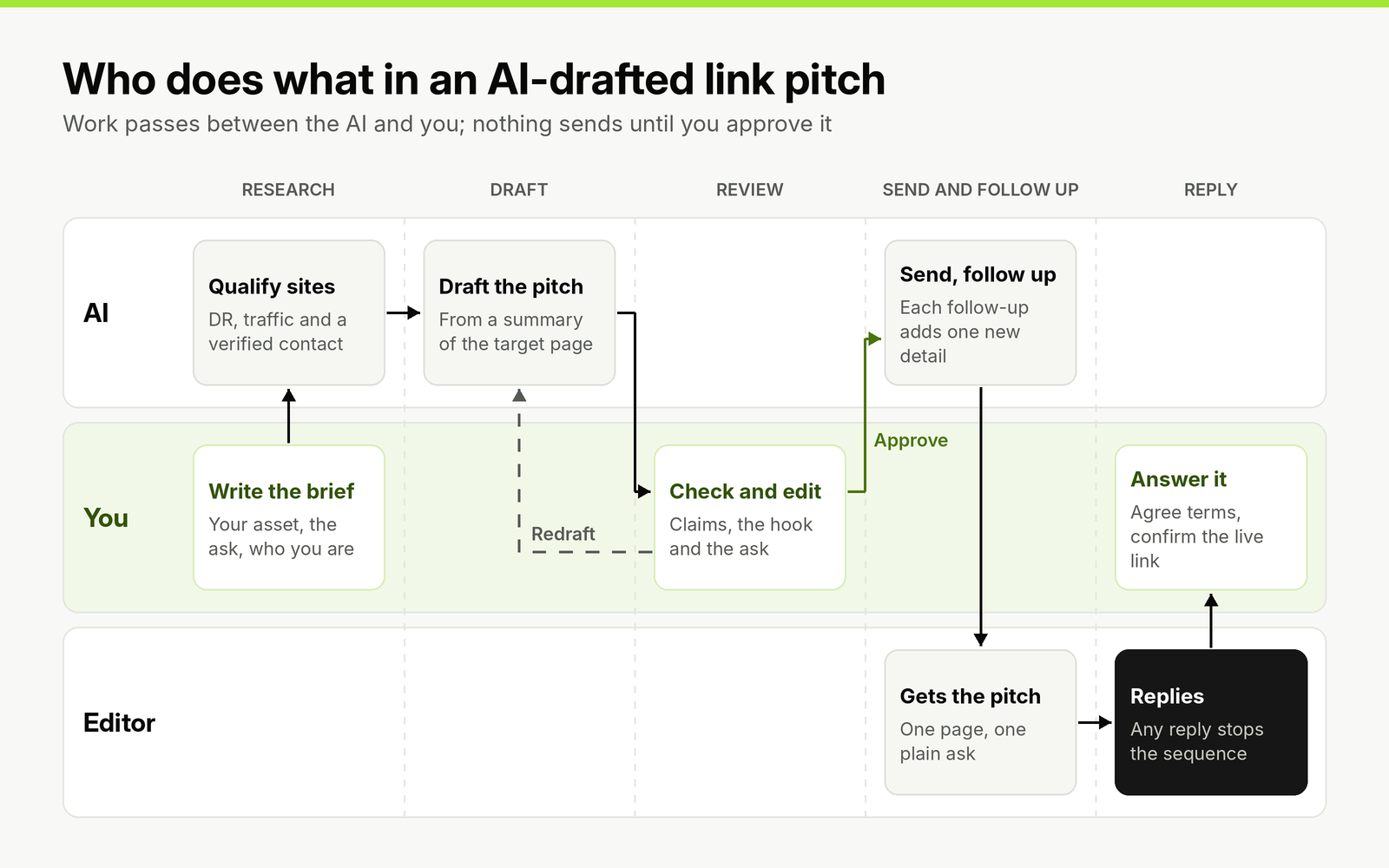
The work moves back and forth. AI never sends a draft you have not approved, and it never answers a reply.
Stop the sequence on any human reply, including a no. Then answer replies yourself. A reply is where the deal is made: the editor asks for a different anchor, a guest post instead of an edit, or a fee. A model will agree to all three, and the third one is paid link territory under the same Google policy.
The policy also lists "using automated programs or services to create links to your site" as link spam. Outreach where an editor reads a request and decides whether to link is not that, but AI-generated comments, forum posts and profile links are, and some "AI link building" services sell exactly those. Keep AI on the side of the work that ends with a person choosing to link.
Keep AI volume inside safe sending limits
Drafting stops being the bottleneck the day you use AI, and sending volume tends to jump. Hold it down. In the same 31 million emails, mailboxes sending 20 to 49 a day replied above average, and Google's email sender guidelines ask every sender to keep the spam rate reported in Postmaster Tools below 0.3%. AI drafts that all sound alike also make your campaign easier to classify as bulk mail, which is one more reason to keep segments to a few dozen prospects. Before you raise volume at all, get domain authentication and warm-up right for the mailbox that sends.
AI cold email in linkOreach
We built linkOreach around that division of work between AI and you, and Linkzy is the AI agent inside it. You brief Linkzy on your product once and it carries that context into every campaign. It builds the prospect list from Ahrefs data with your keyword, DR, traffic and location filters, looks for the SEO lead first, then the content marketing lead, then the CMO, verifies each address before anything sends, and writes a pitch around each site's content. Every email can be edited before it goes out, which is where your hook and your ask go. Follow-ups run on a cadence inside built-in sending limits and stop the moment someone replies, replies land in a shared inbox, and you can A/B test two pitches against each other. Mail goes from your own Gmail, Outlook or SMTP mailbox, and every step can be run by hand. Our per-site pitches you can edit before they send sit alongside per-campaign reports of replies and live links.
We currently offer one plan at $69 a month, or $117 a quarter, which works out to $39 a month, with a 7-day trial and no credit card; our plan and quarterly billing lists the credits and top-ups. Pick a different tool if you are a sales team writing AI emails to book demos, where a sales sequencer with CRM sync fits the job better, or if you only need an occasional draft, which a free AI cold email generator handles at no cost.
Conclusion
Use AI for the parts of a link pitch that are slow and cheap to get wrong: qualifying sites, summarizing pages, drafting structure and follow-ups, sorting replies. Write the claims about their page, the hook and the ask yourself, keep pitches to about 70 to 120 words with one request, and review every draft until a segment proves itself. Recipients reward public-information personalization and push back on anything synthetic, so the edit is not optional.
Keep segments small, open tracking off and each mailbox near 20 to 49 sends a day, stop on every reply, and never let a model offer payment or a link swap.
If you want an AI agent that researches each site and drafts the pitch while you approve every email, start a free 7-day linkOreach trial and run your next campaign through Linkzy.
Frequently Asked Questions
Does AI cold email work for link building?
Yes, when AI handles research and first drafts and a person writes the claims about the recipient's page, the hook and the ask. Unedited AI pitches are easy to spot: 69% of US decision makers in Hunter's 2026 survey said it bothers them if AI wrote a cold email, while 67% were more likely to reply to personalization built from public information.
Can recipients tell when a cold email was written by AI?
Often, yes. The giveaways are praise for articles the sender clearly did not read, vague claims such as "some statistics might be outdated", superlatives about the sender's own resource, and stock openers like "I hope this email finds you well". A pitch that names the exact page, the exact gap and one plain request reads as human whoever drafted it.
Is using AI for link building outreach against Google's guidelines?
Using AI to research sites and draft emails is not, as long as an editor reads the request and decides whether to link. Google's spam policies do list using automated programs or services to create links, buying or selling links, and excessive link exchanges as link spam, so AI-generated comments or forum links, paid placements and automatic link swap offers are a problem whoever writes them.
What should an AI prompt for a link building pitch include?
The target page URL and title, a two-line summary of what it covers, the specific gap on that page, your asset URL and the one fact that fills the gap, the campaign type, the contact's name and role, your own name and site, and the exact ask. Add rules: no praise, no invented facts, one ask, 70 to 120 words, and a subject line of five or six words.
How much editing does an AI-written cold email need?
For link building, read every draft until a segment has a track record, then check at least one in ten. Rewrite any statement about the recipient's page, the personal hook and the ask yourself, and remove any offer you did not approve, such as payment or a reciprocal link. These edits take a minute or two per email once the research fields are filled in.
How many AI cold emails can I send a day?
Keep each mailbox near 20 to 49 sends a day, follow-ups included; in Hunter's data on 31 million emails sent in 2025, that range replied above average. Gmail's sender guidelines also ask senders to keep their spam rate below 0.3%. AI makes drafting fast, but sending volume should stay at a human pace.