Media Pitch Guide for Link Builders: 8 Templates to Copy
A media pitch is a short, personal email that offers a journalist a story their readers want, and for a link builder it works best when the story lives on a page of yours the journalist will cite. Keep it to about 100 to 200 words, send it to a reporter whose beat it fits, lead with one number or one source the reporter cannot get elsewhere, and point to the page that holds the proof.
Most media pitch guides are written for PR teams measured on mentions. Link builders are measured on links, and that changes three things: what you pitch (something that needs a source page), where the proof lives (on your site, not in the email), and what you do after the story runs. This guide covers all three, with eight media pitch templates to copy and the data on what journalists say they reject. Digital PR is one channel inside planning a link building outreach campaign end to end, and the same rules on lists, contacts and sending apply.
What a media pitch is, and how it differs from a press release
A press release is a public announcement written once and sent to many outlets. A media pitch is a private note to one journalist, written for that person's beat, that offers a story angle and the material to report it: data, a source to interview, images or early access. A pitch can mention a release, but it should never be one pasted into an email.
For link building there is a second distinction. A link request asks an editor to change a page that already exists. A media pitch asks a journalist to write something new, and the link is a by-product of what they cite. You cannot ask for the link in the pitch without sounding like a link seller; you can make your page the obvious thing to cite. Every template below is built around that.
What journalists want from a pitch
Two large surveys from 2026 agree on most of it. The table puts the figures that matter for a link builder side by side.
| Finding | Figure | What it means for a link builder |
|---|---|---|
| Prefer pitches by email | 97% | Email is the channel; social messages are a distant second at 14% |
| Want more data or research from PR | 47% | Original data is the asset most likely to be cited with a link |
| Want more embargoed or early access information | 45% | An exclusive window is worth offering one outlet at a time |
| Want more access to experts or interviews | 42% | A named expert who can talk today wins reactive stories |
| Ideal pitch length | About 100 to 200 words | Put the method and charts on your page, not in the email |
| Expect a response from PR contacts within 24 hours | 52% | Have data, quotes and images ready before you send |
Source: Cision's 2026 State of the Media Report, a survey of 1,899 journalists in North America, EMEA and APAC fielded in January and February 2026. Some questions allowed several answers.
Muck Rack's State of Journalism 2026 points the same way. In a summary of that survey, 78% of journalists prefer pitches before noon, 69% prefer pitches under 200 words, 62% prefer a one-to-one email, and 70% value clear relevance to their beat. Original data or research was valued by 40%, and 43% said relevant pitches are rare. Half did not care which day they were pitched.
The gap between those last two numbers is the opportunity. If close to half of journalists rarely see a pitch that fits their beat, a pitch that does fit stands out before a word of it is read.
Why journalists reject media pitches
The same survey asked journalists why they reject pitches. Relevance is the clear leader, and being too promotional comes second.
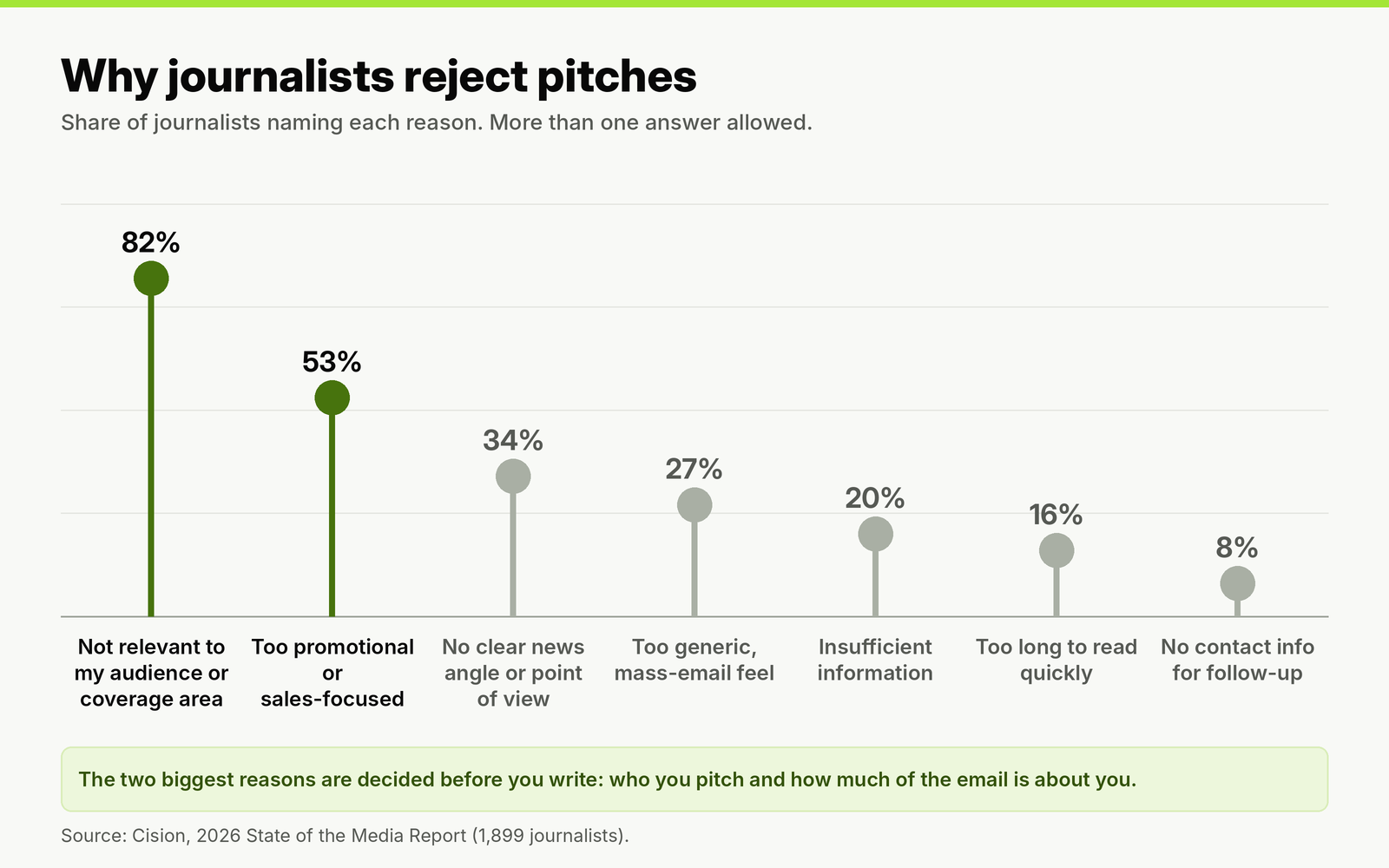
The two biggest reasons are settled before the email is written. Source: Cision, 2026 State of the Media Report.
Link builders fall into the second trap more often than PR teams do, because the thing they want is a link to a commercial site. A pitch that opens with the product, or that offers a "resource" that is a landing page, reads as promotional however it is dressed. The announcement of the report adds two more warnings: 72% of journalists say fewer than a quarter of the pitches they get are relevant, and 53% oppose AI-generated pitches over accuracy and personalization. Software can draft the body; the line that shows you read the reporter's work should be yours, and our guide to using AI to draft outreach without sounding synthetic shows where to draw that line.
Anatomy of a media pitch that earns a link
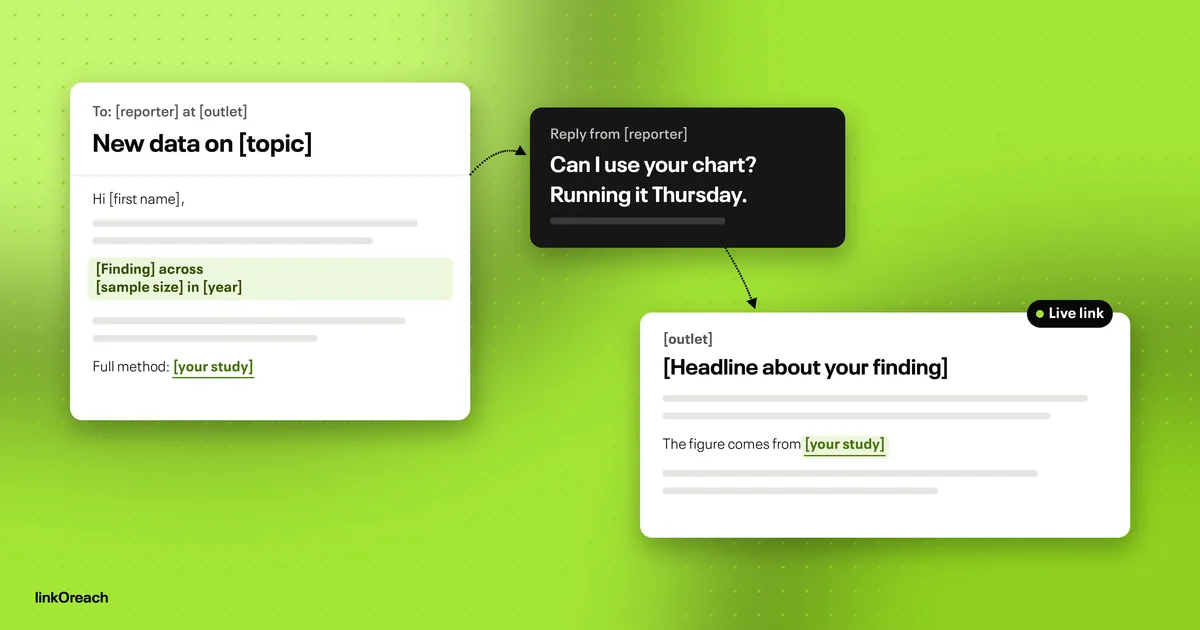
A link-earning pitch has six parts, and only one of them carries a URL. The study page is the proof: method, charts and the full dataset in one place. Journalists link to where a figure lives, so the page has to be worth citing on its own.
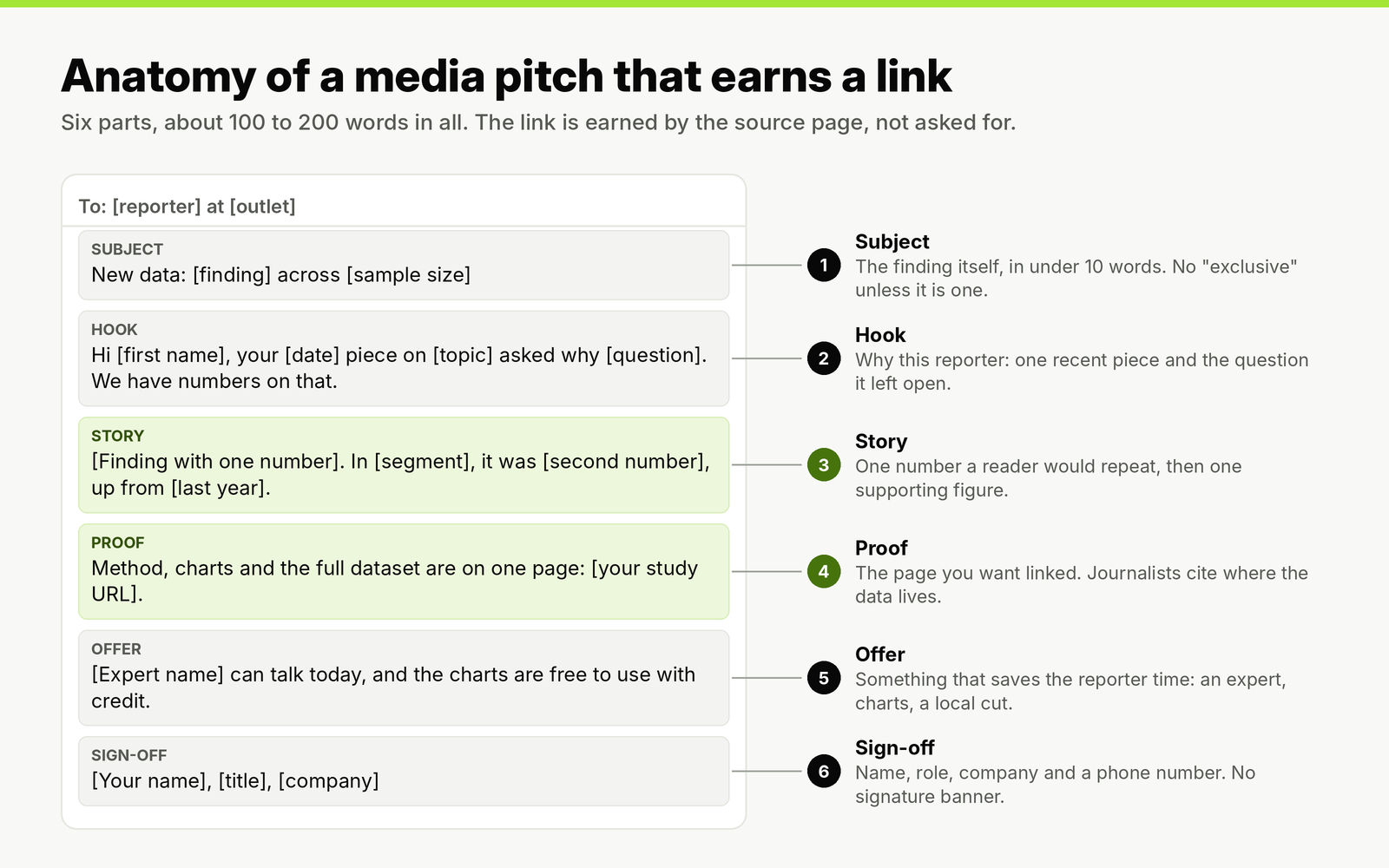
The study page does the linking work. The email only has to make the reporter want to open it.
Three choices decide whether that page gets linked rather than just named:
- Host everything on one URL. Method, sample, charts, a downloadable table and a short "how to cite" line. If the charts sit in a Google Drive folder, the reporter will credit the drive or nothing.
- Do not gate the data. A form in front of the dataset makes the reporter cite a summary from somewhere else.
- Pitch the page, not the homepage. If a reporter needs a source for "[figure]", the citation should go to the page with [figure] on it, which is also the page you want ranking.
The subject line deserves its own minute. Put the finding in it, keep it under about ten words, and use "exclusive" only when you are offering one outlet first. We keep subject lines sorted by the kind of link you want, and the data story lines there work for journalists too.
8 media pitch templates for digital PR links
Each template is written for a link builder pitching a journalist. Replace every bracketed placeholder with something specific, and cut any line you cannot fill with something true. None of them asks for a link; each one points to the page that should earn it.
1. Data story pitch
Use it when you have original data (a survey, an analysis of public records, data from your product) and a reporter who has covered the topic in the last few months.
Subject: New data: [finding in under 10 words]
Hi [first name],
Your [month] piece on [topic] asked why [question it left open]. We have numbers on that.
We surveyed [sample size and who] in [month and year]. [Headline finding with one number]. Among [segment], it was [second number].
The method, charts and full table are on one page: [study URL]. The charts are free to use with credit.
If it helps, [expert name], our [role], can talk through the results today or tomorrow.
[Your name]
[Title, company, phone]
2. Exclusive offer to one outlet
Use it for your most newsworthy dataset, sent to one reporter at the outlet you want most. Give a real deadline, and only pitch the next outlet after it passes or they decline.
Subject: Exclusive for [outlet]: [finding]
Hi [first name],
I'd like to offer [outlet] first use of new research on [topic], before we publish it on [date].
The short version: [finding with one number], based on [sample and method in one line]. It bears on your coverage of [their recent story or beat].
You'd get the full dataset, charts and an interview with [expert name] now, with the study page going live at [time, time zone] on [date]. If you can't use it by then, no problem; just let me know and I'll offer it elsewhere.
[Your name]
[Title, company, phone]
3. Reactive expert comment
Use it within hours of a news story your client's expert can add something to. Speed matters more than polish here; a comment that arrives after the story is written is worthless.
Subject: Comment on [news event] from [expert role]
Hi [first name],
If you're following up on [news event], [expert name], [role] at [company], can comment today. Their view in two lines:
"[Quote of 40 to 60 words with one specific number, example or consequence.]"
The figure in that quote comes from our [study or dataset]: [URL]. [Expert name] is free until [time, time zone] at [phone].
[Your name]
[Title, company]
4. Reply to a journalist request
Use it for requests on Qwoted, Source of Sources, Featured or a reporter's own social post. Answer the exact question, in the length asked, before the deadline.
Subject: Re: [request title] ([expert role])
Hi [first name],
Answering your question on [topic] for [outlet]:
"[Answer of 80 to 120 words, written to be pasted as is, with one data point and one concrete example.]"
[Expert name], [title] at [company]. [One line of credentials relevant to the question.] The data point is from [study title]: [URL].
Headshot and a longer answer available on request.
[Your name]
Not every request is worth answering for a link. In BuzzStream's study of seven journalist request platforms, only 21.9% of quote requests explicitly said they would provide followed links. Source of Sources had the highest followed share at 36.26%, and 70.3% of the opportunities on Qwoted came from high-authority outlets. Filter by outlet before you write, and treat unlinked quotes as brand coverage, not link building.
5. Local or niche cut of national data
Use it when a national dataset you published can be broken down by city, state or industry. Regional and trade reporters rarely get data cut for their audience.
Subject: [City or industry] numbers on [topic]
Hi [first name],
We published national data on [topic] last [week or month]. Since you cover [city, region or industry], I pulled out the figures for [your area]:
[Local figure] against [national figure] across the country, which puts [area] [rank or comparison].
The local breakdown is in a table on our study page, here: [study URL with anchor to the local table]. Happy to send the raw rows for [area] if you want to check them.
[Your name]
[Title, company, phone]
6. Follow-up with a new angle
Send one follow-up, three or four business days after the pitch, in the same thread. It should add something the first email did not have.
Subject: Re: [original subject]
Hi [first name],
One addition since my note below: [new detail, for example a second finding, a chart for [segment], or an expert available on [day]].
If [topic] doesn't fit your plans, no reply needed.
[Your name]
Journalists tolerate one nudge, and the survey above concludes that "one extra nudge is enough". Stop there for media pitches, even if your link building sequences usually run longer; we cover how many follow-ups to send before you stop for other campaign types.
7. Coverage that names you without a link
Use it once, within a week of publication, when a story credits your brand or your data but does not link. Thank the reporter first and make the request easy to decline.
Subject: Thanks for citing [study title]
Hi [first name],
Thanks for using our [study title] in "[article headline]". The section on [point] was the angle we hoped someone would pick up.
If it's useful for readers who want the method or the full table, the study page is [study URL]. Linking the mention to it is entirely up to you and your editor.
Either way, I'll send you the next dataset before anyone else.
[Your name]
8. Coverage that credits a site that reused your data
Use it when a story cites your figure but links to an aggregator, a statistics roundup or another article that took the number from you.
Subject: Original source for the [figure] in your piece
Hi [first name],
Your article "[article headline]" cites [figure] via [site they linked]. That number comes from our [study title], published [date], and [site they linked] quotes it from us.
The original page, with the method and sample, is [study URL]. If your outlet prefers to cite primary sources, that's the one to use.
Thanks for covering [topic].
[Your name]
For pitches to independent bloggers rather than newsroom journalists, the tone and the deal are different; use our templates for pitching independent bloggers instead. For niche edits, listicles and the other campaign types, start from pitch templates for the other link building campaign types.
Turning coverage into links
The work does not end when a story runs. Some coverage links to your study, some links to your homepage, some names you without linking and some credits a site that copied your number. Each case gets a different response, and some get none.
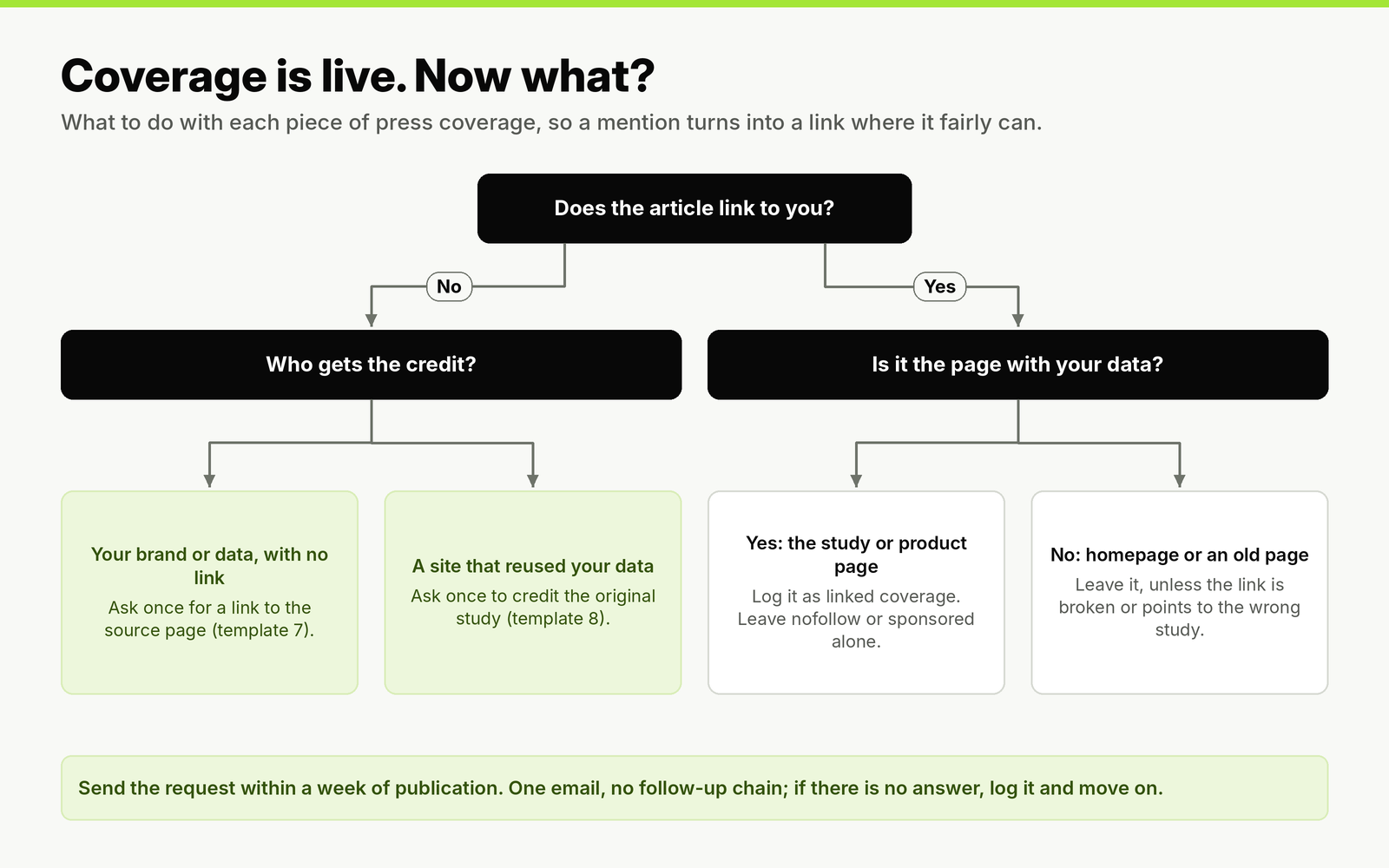
Ask once, only where the request is fair, and log everything else as coverage.
Three rules keep this from damaging the relationship you just built. Ask once, with no follow-up chain. Never ask a journalist to remove nofollow or sponsored from a link; many outlets apply those by policy, and pushing on it marks you as someone to avoid. And keep a simple log for every campaign: outlet, URL, date, whether it links, which page, and the link attribute. That log is your real campaign report, because "15 pieces of coverage" and "15 links" are very different results.
Timing, volume and lists
Send media pitches before noon in the reporter's time zone, Monday to Thursday, which fits the before-noon preference above and the reply data we covered in when editors and journalists open pitches. For reactive comment, ignore the clock and send as soon as the expert's quote is ready.
Keep lists small. A data story that fits 30 reporters on one beat will outperform the same story sent to 300 names from a database export, because relevance is the first reason pitches are rejected. Link building outreach as a category already replies at a higher rate than most cold email: digital PR and SEO link building sequences averaged a 13% response rate in data on 31 million emails sent in 2025, against 3% for sales outreach. Plan below that until you have your own numbers, since a newsroom reporter gets far more pitches than a niche site editor.
Pre-send checklist for a media pitch
- The reporter has covered this topic recently, and the hook names that piece.
- The finding fits in the subject line and the email is under 200 words.
- The study page is live, ungated, and holds the method, charts and table.
- An expert is available within 24 hours, with a phone number in the email.
- The email asks for nothing except interest in the story; no link, anchor or "dofollow" request.
- One follow-up is scheduled for three or four business days later, and stops on any reply.
- Coverage tracking is set up: outlet, URL, link or no link, target page, attribute.
What Google's spam policies say about press links
Digital PR is the cleanest way to earn links from news sites, but two common shortcuts fall under Google's spam policies. Paying for an article that includes a link, or exchanging money, goods or services for links, is listed as link spam. So are links that pass ranking credit in press releases distributed on other sites and in advertorials where payment is received for articles that include links. Sending someone a product in exchange for writing about it with a link is named too.
In practice: never offer payment, gifts or an ad buy alongside an editorial pitch, and do not count wire release pickups as links. If an outlet offers paid placement, it is advertising, and Google's guidance on qualifying outbound links says paid links should carry rel="sponsored". Earned coverage of a good study needs none of that.
Running media pitches in linkOreach
We built linkOreach for link building outreach, and Linkzy is the AI agent inside it. For digital PR, the parts that carry over are the sending and the tracking. You can write your own templates or let Linkzy draft a pitch for each site from that site's content, edit every email before it goes out (which is where your hand-written hook goes), and send from your own Gmail, Outlook or SMTP mailbox. Follow-ups run on a cadence and stop the moment someone replies, replies land in a shared inbox, and reports show replies and live links per campaign.
Template 7 is also a campaign type of its own: our brand mention campaigns, per-site pitches and a shared inbox are built for turning unlinked mentions into links. Every step can be run by hand. We currently offer one plan at $49 a month, an introductory price, with a 7-day trial and no credit card.
Pick a different tool if your PR team needs a journalist database with beat search, press release distribution and media monitoring across print and broadcast. A dedicated PR platform suits that job better; linkOreach is built for pitches that end in a link.
Conclusion
Write media pitches for links the way journalists ask to be pitched: one reporter whose beat fits, 100 to 200 words, sent before noon on a weekday, with one number in the subject and one follow-up at most. Put the method, charts and full table on a single ungated study page, and point every pitch at that page rather than asking for a link. Answer request platforms only where the outlet links, and count linked coverage, not mentions.
When a story runs without a link, ask once for the source page; when it credits a copy of your data, ask once for the original. Never pay for placement or push on nofollow.
If you want per-recipient pitches, stop-on-reply follow-ups and brand mention campaigns from your own mailbox, start a free 7-day linkOreach trial and send your next data story this week.
Frequently Asked Questions
What is a media pitch?
A short, personal email to one journalist that offers a story angle for their beat and the material to report it: data, an expert to interview, images or early access. Unlike a press release, it is written for one person. For link building, the pitch points to a page on your site that the journalist will cite.
How long should a media pitch be?
About 100 to 200 words. Cision's 2026 survey of 1,899 journalists puts the sweet spot in that range, and in Muck Rack's 2026 survey 69% of journalists preferred pitches under 200 words. Put the method, charts and full data on your study page instead of in the email.
What is the difference between a media pitch and a press release?
A press release is a public announcement written once for many outlets. A media pitch is a private email to one journalist, tailored to their beat, offering an angle and the sources to cover it. A pitch can reference a release, but pasting a release into an email is not a pitch.
How do you follow up on a media pitch?
Once, three or four business days after the pitch, in the same thread, with something new: a second finding, a chart for their audience or an expert available on a set day. Journalists tolerate one nudge; stop after that and stop at once on any reply.
How do you get a backlink from press coverage?
Make your page the thing worth citing: one ungated URL with the method, charts and full table, pitched to reporters whose beat it fits. If a story names you without a link, ask once, within a week, whether they would link the mention to the source page. Never ask for a link in the pitch, never offer payment, and never ask an outlet to remove nofollow.
What is the best time to send a media pitch?
Before noon in the journalist's time zone, Monday to Thursday. In Muck Rack's 2026 survey, 78% of journalists said they prefer pitches before noon, and half did not mind which day. Reactive expert comment is the exception: send it as soon as the news breaks.